Cold Spark Machine Buyer Guide: 6 Questions That Produce The Right Machine
Cold Spark Machine Buyer Guide: How To Choose | CryoFX
Cold Spark Machine Buyer Guide: 6 Questions That Produce The Right Machine
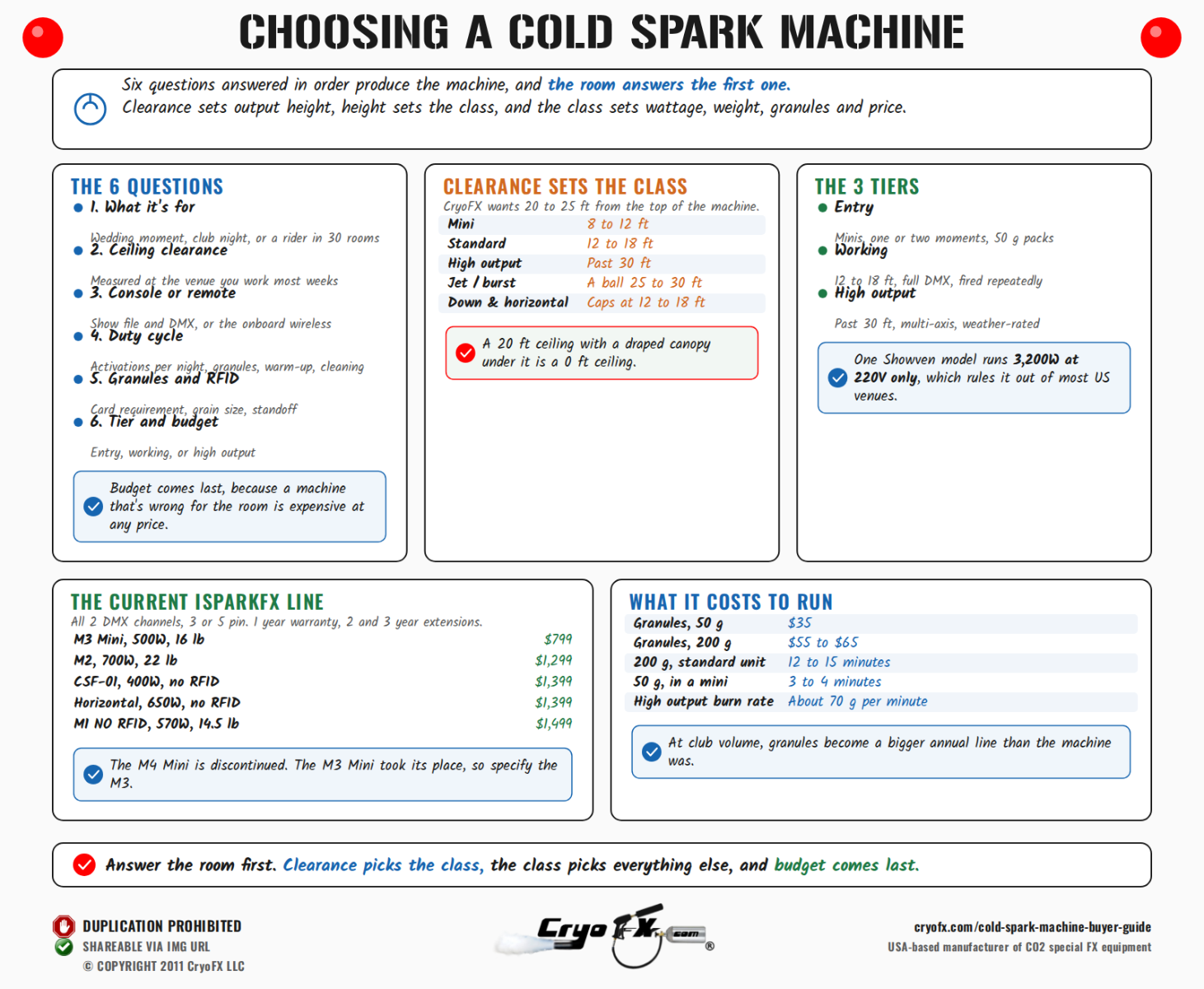
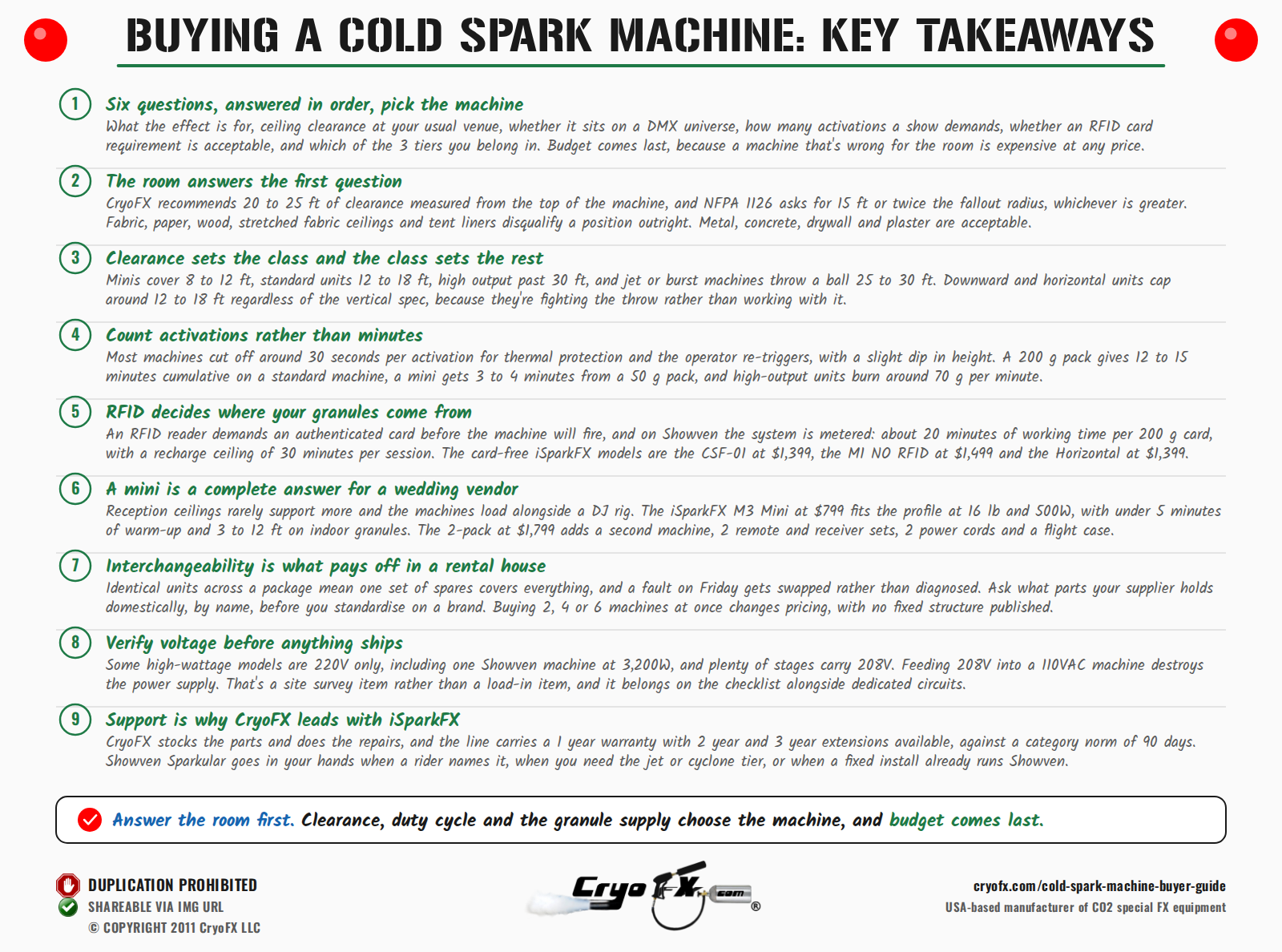
Choosing a cold spark machine is a sequence of 6 questions answered in order, and the room answers the first one. Ceiling clearance sets your maximum output height, output height sets the machine class, and the class decides wattage, weight, granule consumption and price. Budget is the last question, because a machine that's wrong for the room is expensive at any price. This page ends with a recommendation for each buyer type.
Work the questions in order rather than jumping to a model. Every buyer who ends up with the wrong machine got there by starting with a price or a video. The complete cold spark machine guide covers what's happening inside the machine, which is worth 5 minutes before you spend money on one.
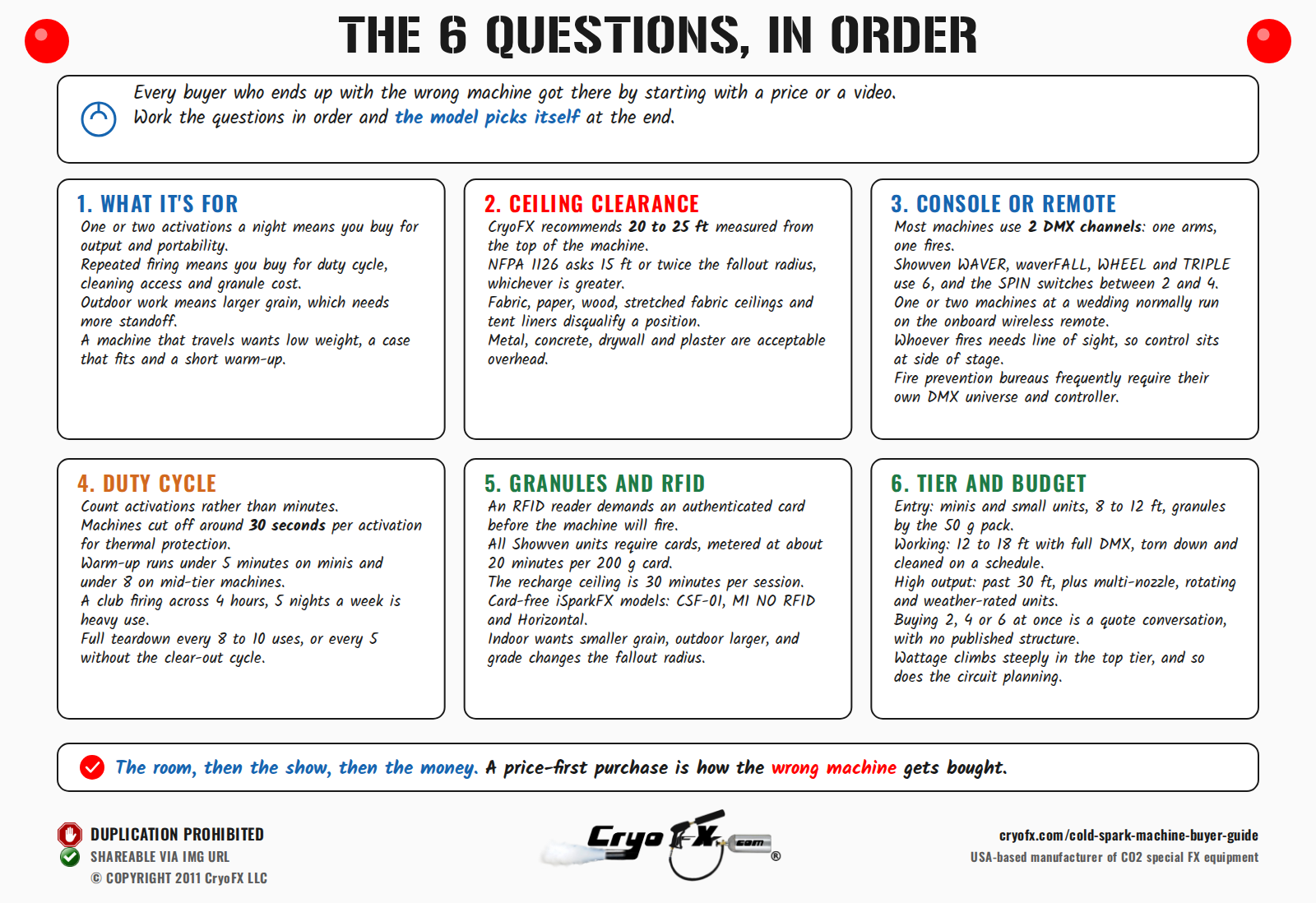
Question 1: What is the effect for?
A single moment at a wedding is a different machine from a hit that fires 20 times across a club night, which is a different machine again from a package that has to satisfy a rider in 30 rooms.
Ask how many times the effect fires in a typical night. One or two activations means you can buy for output and portability. Repeated firing across hours means you're buying for duty cycle, cleaning access and the cost of consumables, because a club burns through granules at a rate a wedding vendor never sees.
Indoor, outdoor or both changes the answer too. Most machines aren't waterproof, sparks are a night effect because daylight kills them, and wind is judged case by case on speed and gusts against whether sparks would leave the intended pattern or blow into people and set pieces. Outdoor work also means larger grain, which needs more standoff.
Then decide whether the machine lives in a fixed install or a vehicle. A machine that travels wants low weight, a case that fits, a warm-up short enough to survive a schedule that slips, and a hopper you can empty in a loading bay.
Question 2: What is your ceiling clearance?
CryoFX recommends 20 to 25 ft of clearance measured from the top of the machine. That number, and the NFPA 1126 requirement of 15 feet or twice the fallout radius whichever is greater, are set out on the cold spark machine safety guide.
Measure the venue you work most weeks and design to that number. Then match the class:
| Class | Output height | Typical room |
|---|---|---|
| Mini | 8 to 12 ft | Hotel ballrooms, barns, small stages |
| Standard | 12 to 18 ft | Clubs, corporate stages, mid-size venues |
| High output | past 30 ft | Arenas, festival stages, outdoor |
| Jet / burst | throws a ball 25 to 30 ft | Large stages, accent moments |
Downward and horizontal units cap around 12 to 18 ft regardless of what the vertical spec says, because they're fighting the throw rather than working with it.
What sits overhead matters as much as how far away it is. Fabric, paper, wood, stretched fabric ceilings and tent liners disqualify a position outright. Metal, concrete, drywall and plaster are acceptable. A 20-ft ceiling with a draped canopy underneath is a 0-ft ceiling.
Question 3, does it need to sit on a console
Most cold spark machines use 2 DMX channels: one that handles pre-heat, emergency stop and the clear-material function, and one that fires. That 2-stage architecture is deliberate, and it's why a machine can't be armed and fired from a single fader by accident.
Multi-port and moving units need more. Showven's WAVER, waverFALL, WHEEL and TRIPLE use 6 channels, and the SPIN switches between 2 and 4.
If you're running one or two machines at weddings, the onboard wireless remote is normally what gets used and a DJ can operate it from the booth. Anything on a show file needs wired DMX, and whoever fires needs direct line of sight to the machines, which is why concert pyro control sits at side of stage rather than at front of house. Fire prevention bureaus frequently require these machines on their own DMX universe with their own controller and cables; cold spark machine DMX control has the channel maps and the patching warnings.
Question 4, what duty cycle does the show demand
Count activations, not minutes. Most machines cut off around 30 seconds per activation for thermal protection and the operator re-triggers, with a slight dip in height on reactivation. A wedding with an entrance gateway, a first dance and a cake reveal is a light duty cycle. A club firing across 4 hours, 5 nights a week, is heavy.
Granule consumption follows from that. A 200g pack gives 12 to 15 minutes of cumulative run time on a standard machine, a mini gets 3 to 4 minutes from a 50g pack, and high-output units burn around 70g per minute. At club volumes granules become a bigger annual line than the machine was.
Warm-up is a cueing constraint people forget until the first show. Minis come up in under 5 minutes, mid-tier machines in under 8, and Showven units take around 5 minutes with the exact figure moving with voltage and ambient temperature. Build that into the cue sheet, because a machine brought up late is a machine that misses the moment.
Cleaning frequency scales directly with use. A full teardown every 8 to 10 uses if the clear-out cycle is run after every show, every 5 if it isn't, and cold spark machine maintenance has the intervals and the teardown order.
Question 5, granule flexibility and RFID
Many machines carry an RFID reader that demands an authenticated card before the machine will fire. Cards ship with granule packets, and on Showven the system is metered: a 200g card adds about 20 minutes of machine working time, with a recharge ceiling of 30 minutes per session. Certain cards only work with certain machines.
For a touring package with a purchasing department, that's paperwork. For an owner-operator who buys granules on price or needs to run at short notice with whatever's on the shelf, it's a constraint that shows up at the worst time.
All Showven units require cards. On the iSparkFX side some models require them and some don't: the M1 NO RFID at $1,499 and the CSF-01 at $1,399 are the card-free options, and iSparkFX also sells granules without cards that work in almost any machine, including JMaz and Blitzz units.
Grain size is the other half of the granule question. Indoor is smaller grain for a tighter, lower plume, outdoor is larger for height and distance, and swapping grade after the plot is drawn changes the fallout radius. Cold spark granules covers the grades and what each one does in a room.
Question 6, which of the 3 tiers you belong in
Entry. Minis and small units. Low weight, short warm-up, 8 to 12 ft, one or two moments per night, granules by the 50g pack. This is where a wedding vendor or a small mobile operation belongs, and it's a complete answer rather than a compromise for that use.
Working. Standard floor units at 12 to 18 ft with full DMX, built to fire repeatedly and be torn down and cleaned on a schedule. Clubs, corporate stages, most rental inventory. If one machine has to cover both indoor and outdoor work, it's here.
High output. Past 30 ft, plus multi-axis, multi-nozzle, rotating and weather-rated units. Festival stages, arenas, broadcast. Wattage climbs steeply in this tier and so does the circuit planning, and one Showven model runs 3,200W at 220V only, which rules it out of most US venues before the conversation starts.
Buying 2, 4 or 6 machines at once changes the pricing, with no fixed structure published, so it's a quote conversation. It also changes your spares position, which matters more. Full cost modelling including granules, labour and permits is on how much a cold spark machine costs.
Recommendations by buyer type
Wedding DJ or mobile entertainment vendor
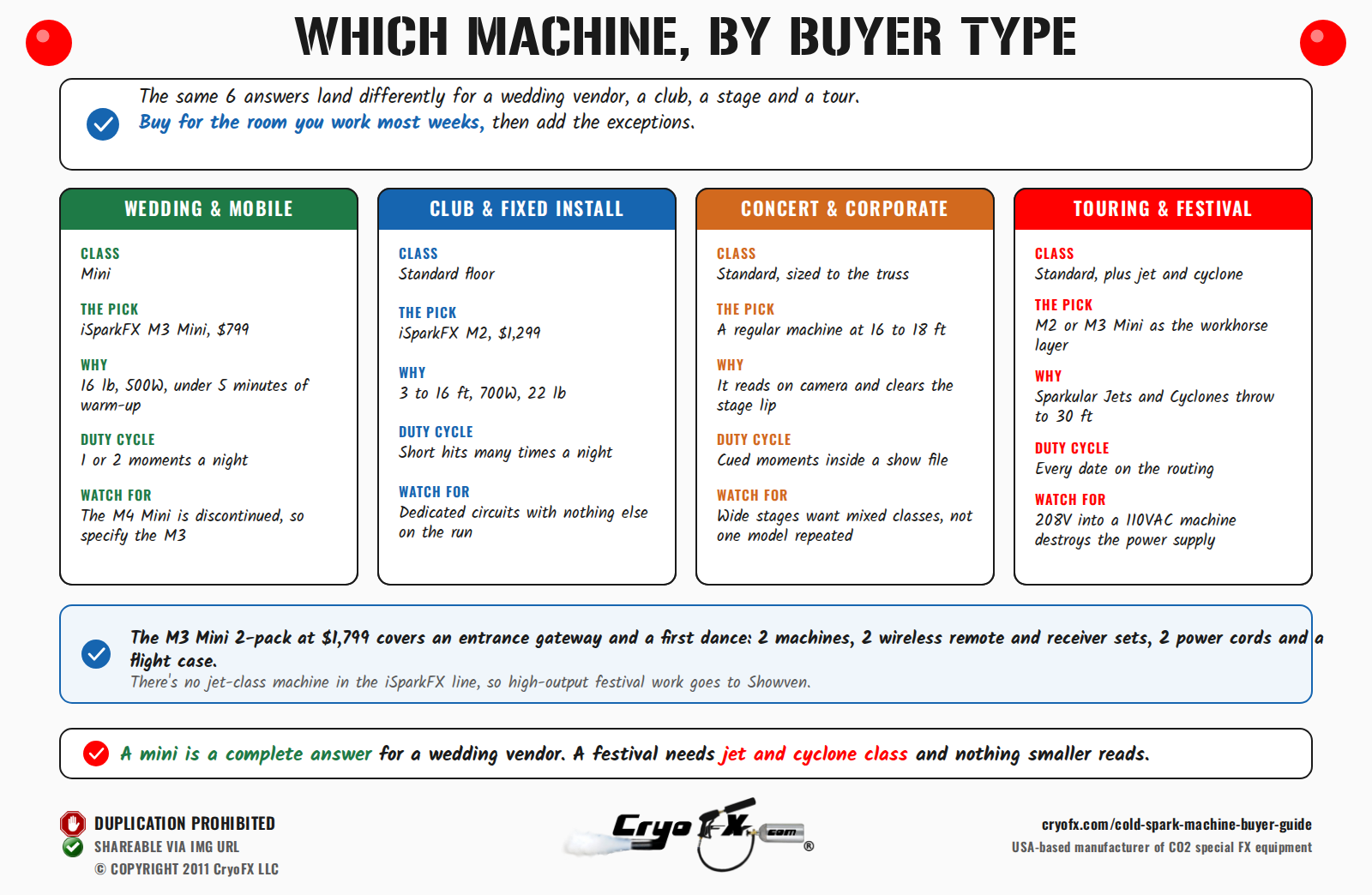
Minis, in almost every case. Reception ceilings rarely support more, the machines load alongside a DJ rig, and a 2-machine gateway covers the entrance and the first dance. The iSparkFX M3 Mini at $799 fits the profile at 16 lb with under 5 minutes of warm-up and 3 to 12 ft on indoor granules. The M4 Mini that appears in older listings is discontinued and the M3 Mini took its place, so specify the M3.
Buy in pairs. The M3 Mini 2-pack at $1,799 includes 2 machines, 2 wireless remote and receiver sets, 2 power cords and a flight case. The buying, licensing and insurance side of this is worked through on indoor wedding fireworks for sale.
Nightclub or venue with a fixed install
The iSparkFX M2 at $1,299 or the M3 Mini, depending on truss height and how the effect reads from the floor. If you go M2, specify the no-RFID version, which costs a little more than the standard configuration and takes the card system out of a workflow where nobody wants to be hunting for a card at 1am.
Clubs fire short hits many times a night, which suits the 30-second thermal cutoff well. Duty cycle and cleaning access matter more than peak height. Put the machines on dedicated circuits with nothing else on the run, and if the venue runs 3 to 5 nights a week, ask the fire marshal about a blanket or running permit rather than paying per event.
Concerts and corporate stages
A regular machine at 16 to 18 ft is the working answer for most concert and corporate work. It reads on camera, it clears a stage lip with room to spare, and it sits inside the clearance you can usually get signed off in a ballroom or a theatre.
Production company or rental house
Mixed inventory, weighted toward whatever your market books most. The purchasing criterion that pays off over 5 years is interchangeability: identical units across the package means one set of spares covers everything, and a fault on Friday gets swapped rather than diagnosed. Ask what parts your supplier holds domestically, by name, before you standardise on a brand.
Touring production
Buy for the smallest room on the routing and the language in the rider. Standard units carry most dates, with high-output or jet machines added for the arena shows. The iSparkFX M2 or M3 Mini travel well as the workhorse layer.
Verify voltage on everything before it ships. Some high-wattage models are 220V only, plenty of stages carry 208V, and 208V into a 110VAC machine destroys the power supply. That's a site survey item, not a load-in item, and cold spark machine power requirements has the arithmetic.
Corporate and convention work
Wide stages want mixed classes rather than one model repeated. CryoFX ran a 20-machine setup on a convention centre stage roughly 100 ft side to side with a 20 ft runway, using 8 minis centre and full-size units on the outside so the effect held its scale across the whole width without overpowering the middle.
Massive festivals
Ultra and EDC scale means jet and cyclone class. Sparkular Jets and Cyclones throwing to 30 ft are what fill that tier, because nothing else reads from the back of a field. There's no jet-class machine in the iSparkFX line, so high-output work goes to Showven.
What CryoFX would put in your hands
For most buyers, iSparkFX. The reasoning is support rather than badge: CryoFX stocks the parts, does the repairs, and the line carries a 1-year warranty with 2-year and 3-year extensions available, against a category norm of 90 days. iSparkFX is a separate company that produces the machines, and CryoFX buys them to sell and keeps the spares on the shelf. That's the difference between a fault costing a week and a fault costing a season.
Showven Sparkular goes in your hands when a client or a rider names it, when you need the jet or cyclone tier, or when a fixed install already runs Showven and you want interchangeable spares. CryoFX is an authorised Showven distributor and the main distributor for a large part of the western United States, so both lines come from the same parts shelf.
Once you've answered the 6 questions, matching them to a model is quick. Current stock, configurations and bundles for cold spark machines for sale will tell you what's on hand, and not everything CryoFX carries is listed online, so ask by model name.
Frequently asked questions
How do I choose a cold spark machine?
Work from the room outward. Ceiling clearance sets your maximum output height, output height sets the machine class, and the machine class sets everything else. After that, answer whether you need DMX, how much continuous run time a show demands, and whether an RFID card requirement is acceptable in your workflow. Budget comes last, because a machine that's wrong for the room is expensive at any price.
What questions should I answer before buying?
Six, in order: what the effect is for, what the ceiling clearance is at your typical venue, whether the machine has to sit on a DMX universe with a console, how many activations and how many minutes a show needs, whether an RFID card requirement blocks your granule supply, and where the machine sits across the entry, working, and high-output tiers.
Which machine is right for a wedding DJ?
A mini, in almost every case. Reception ceilings rarely support more, the machine has to load alongside a DJ rig, and a 2-machine gateway covers the entrance and first dance. Look for low weight, short warm-up, indoor granule compatibility, and no RFID requirement so you can source granules freely. The iSparkFX M3 Mini fits that profile at 16 lb with under 5 minutes of warm-up.
Which machine is right for a nightclub?
A standard floor unit with DMX, sized to the truss height and run repeatedly across a night. The iSparkFX M2 or M3 Mini both work here, and on the M2 it's worth specifying the no-RFID version. Clubs fire the effect many times over several hours, so duty cycle and cleaning access matter more than peak height. Machines time out around 30 seconds per activation for thermal protection and the operator re-triggers, which suits a club's short hit pattern well.
Which machine is right for a touring production?
Whatever the rider and the smallest venue on the routing will both accept. Touring buys mixed inventory: standard units for most rooms, high-output or jet units for the arena dates, and directional or horizontal machines for specific looks. Prioritise identical units across the package so spares are interchangeable, and verify the voltage, since some high-wattage models are 220V only.
What is an RFID card requirement and does it matter?
Many machines ship with an RFID reader that demands an authenticated card before the machine will fire. It ties you to one granule supply and meters your runtime. It matters most to owner-operators who buy granules on price or need to run at short notice with whatever's on the shelf. Several iSparkFX models, including the CSF-01, M1 and Horizontal, have none.
How much duty cycle do I actually need?
Count activations, not minutes. Most machines cut off around 30 seconds per activation for thermal protection, so a wedding needing 2 gateway moments and a cake reveal is a light duty cycle, while a club firing across 4 hours is heavy. A 200g granule pack gives 12 to 15 minutes cumulative on a standard machine, and high-output units burn about 70g per minute.
Should I buy minis or full-size machines?
Minis if your ceilings are the limiting factor and the machines travel in a car. Full-size if you work rooms with real height, need output past 12 ft, or want one machine to cover both indoor and outdoor work. Mixed inventory is common on large stages: CryoFX ran a 20-machine corporate setup across a convention centre stage combining minis and full-size units.
___
CryoFX® is the leading manufacturer, designer, and global supplier of CO2 special effects equipment and custom special effects systems
for Theme Parks, Sporting Arenas, Mega Nightclubs & Day Clubs , TV/FILM & large scale events & installs in any industry requiring Co2 Systems.
CryoFX LLC Global Headquarters • 3859 S Valley View Blvd, Suite 2, Las Vegas, NV 89103 • 1.855.527.9639
Updated - 08/17/2026.