Cold Spark Machine DMX Control: Channels, Addressing, And Universe Separation
Cold Spark Machine DMX Control and Channel Setup | CryoFX
Cold Spark Machine DMX Control: Channels, Addressing, And Universe Separation
Cold spark machines are DMX 512 fixtures. Most use 2 channels: one arms the machine and brings the heating element up to temperature, the other fires it. They patch into GrandMA, ShowXpress or any other console as a simple fixture over standard XLR, 3-pin or 5-pin depending on model.
The part that separates this from a generic DMX article is what fire prevention bureaus ask for. These machines are frequently required to sit on their own DMX universe, with their own controller and their own cables, and the reason is a specific failure mode rather than bureaucracy.
The other part is that the 2-channel maps are not the same between brands. Showven and iSparkFX assign the arm function and the fire function to opposite channels, and both maps are published below, because patching a mixed rig from one fixture profile is how the wrong value ends up on the wrong channel.
Why cold spark machines use 2 DMX channels
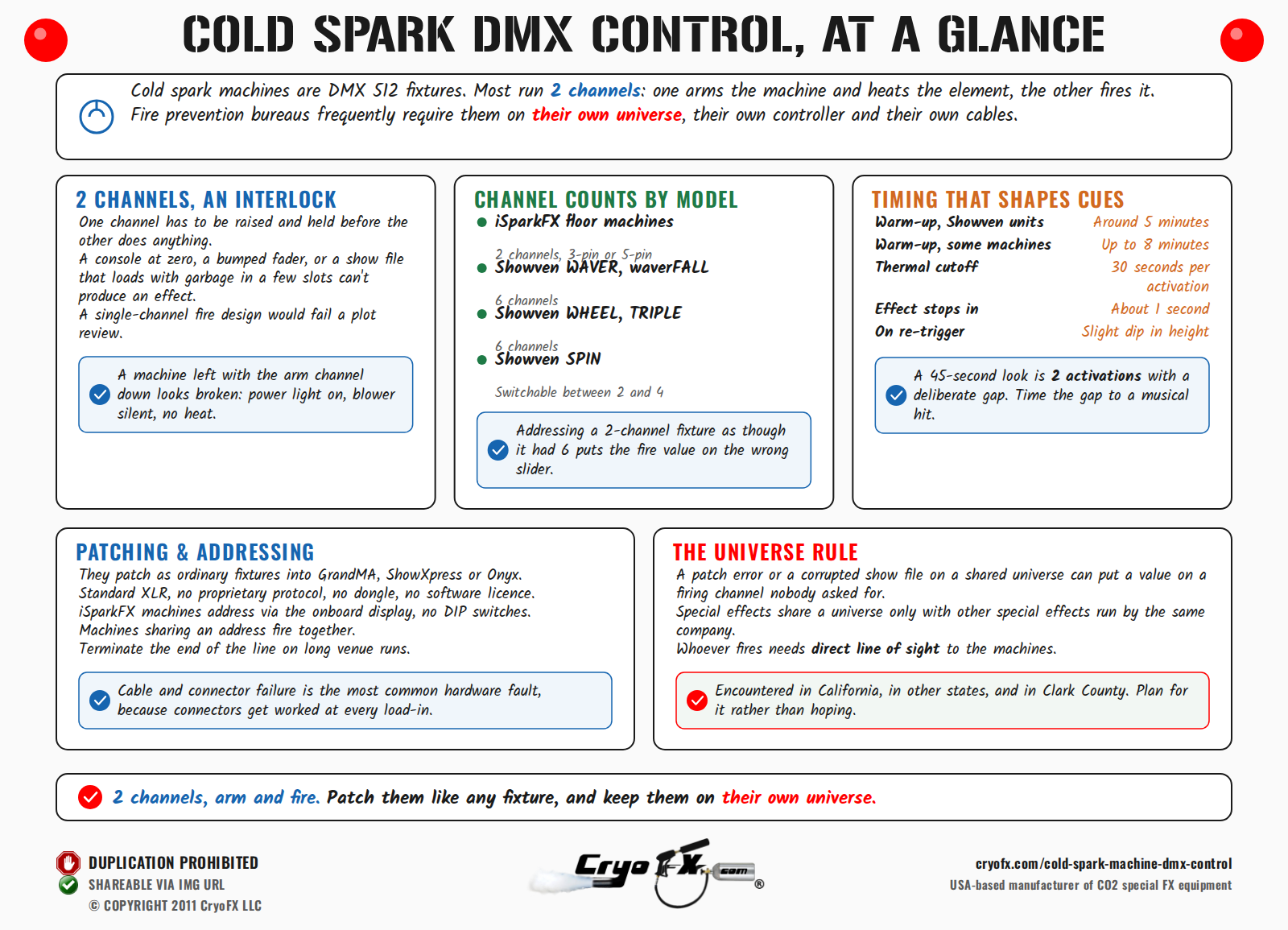
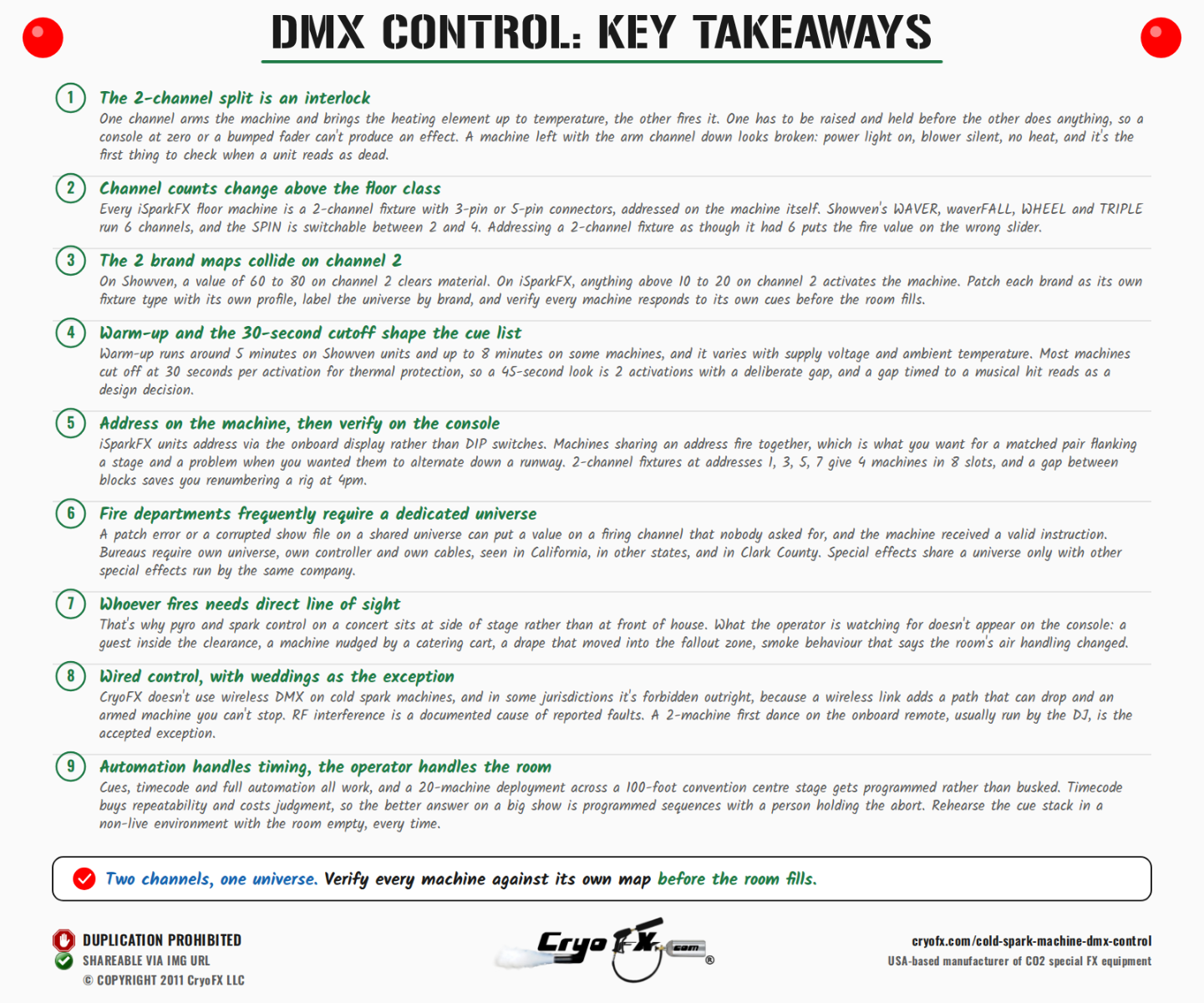
The 2-channel design is an interlock. One channel has to be raised and held before the other does anything, so a console at zero, a bumped fader, or a show file that loads with garbage in a few slots can't produce an effect on its own.
A single-channel fire design would be unacceptable on a plot review, and rightly. One stray value, one crossed patch, one universe shared with a lighting desk mid-programming, and you have an unattended machine throwing incandescent metal into a room.
Channel counts do vary above the floor-machine class. Multi-port and moving units need more: Showven's WAVER, waverFALL, WHEEL and TRIPLE run 6 channels, and the SPIN is switchable between 2 and 4. Every iSparkFX floor machine is a 2-channel fixture with 3-pin or 5-pin connectors, addressed on the machine itself.
Arming, heating, and firing
Channel 1 or channel 2, and why it matters which
Whichever channel handles arming has to be raised for the element to power at all. Warm-up runs around 5 minutes on Showven units and up to 8 minutes on some machines, and it varies with supply voltage and ambient temperature, so a cold room at load-in runs longer than a warm one at 11pm. The complete cold spark machine guide covers what's happening inside the chamber during that warm-up.
A machine that's been forgotten on the arm channel looks broken. Power light on, blower silent, no response to the fire channel, no heat. Operators send these to the bench. It's the first thing to check when a unit reads as dead.
The fire channel
Raising the fire channel past its threshold starts the feed auger and the effect runs while the value is held. Drop it and the effect stops within about a second, since there's nothing sustaining combustion once material stops entering the chamber.
The 30-second cutoff
Most machines cut off at 30 seconds per activation for thermal protection. The operator re-triggers, and there's a slight dip in height on reactivation while the chamber recovers.
Write cues around that rather than against it. A 45-second look is 2 activations with a deliberate gap, and a gap timed to a musical hit reads as a design decision. A gap timed to the machine's thermal cutoff reads as a fault.
Both channel maps, and the mixed-rig warning
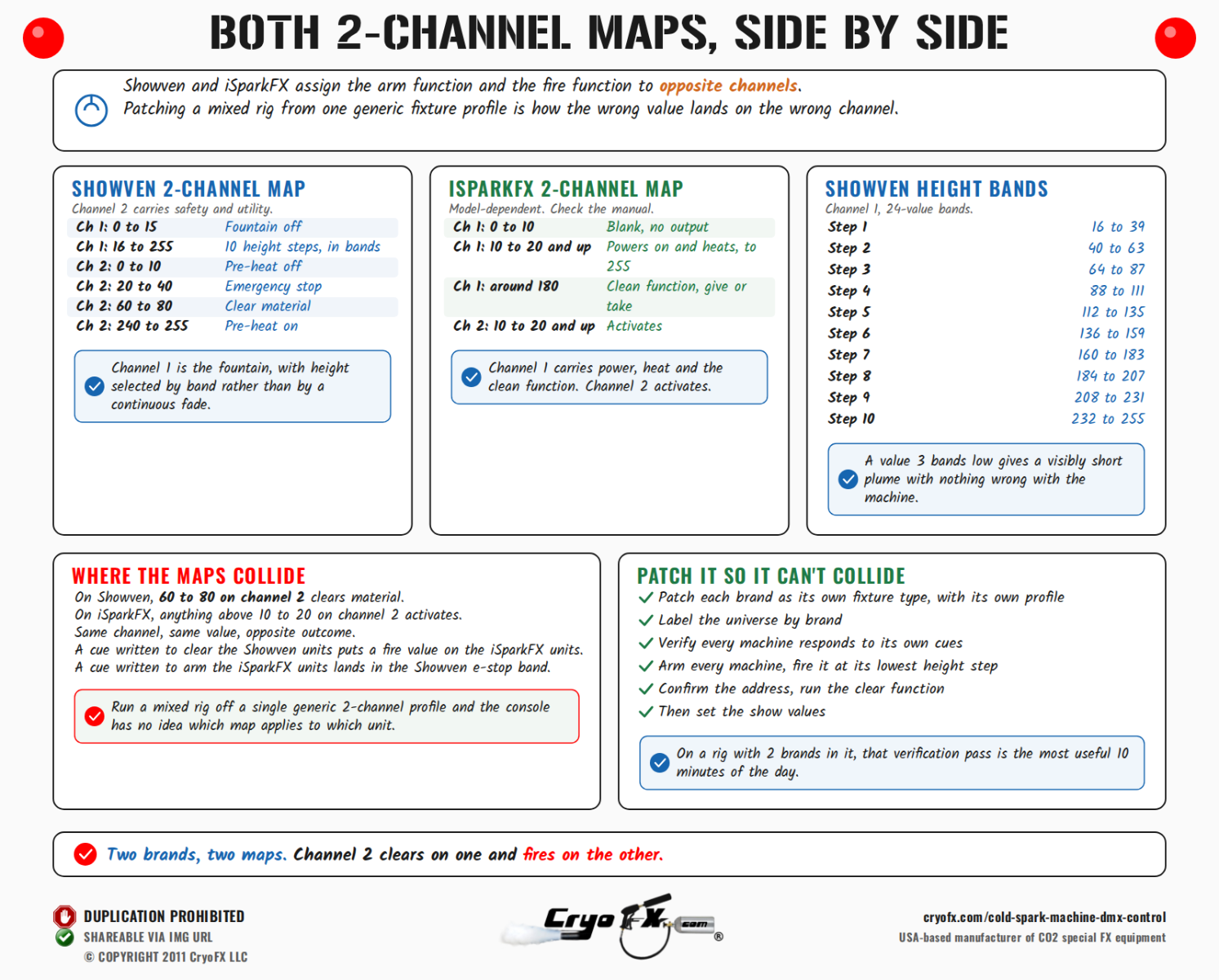
Showven 2-channel map
| Channel | Value | Function |
|---|---|---|
| 1 | 0 to 15 | Fountain off |
| 1 | 16 to 255 | 10 discrete height steps in 24-value bands: 16-39, 40-63, 64-87, 88-111, 112-135, 136-159, 160-183, 184-207, 208-231, 232-255 |
| 2 | 0 to 10 | Pre-heat off |
| 2 | 20 to 40 | Emergency stop |
| 2 | 60 to 80 | Clear material |
| 2 | 240 to 255 | Pre-heat on |
Note the shape of it. On Showven, channel 2 is the safety and utility channel carrying pre-heat, e-stop and the clear-material function, and channel 1 is the fountain with height selected by band rather than by continuous fade. Height steps in bands means a value 3 bands low produces a visibly short plume with nothing wrong with the machine.
iSparkFX 2-channel map, model-dependent
| Channel | Value | Function |
|---|---|---|
| 1 | 0 to 10 | Blank, no output |
| 1 | above 10 to 20 | Powers the machine and starts heating, running to 255 |
| 1 | around 180, give or take | Clean function |
| 2 | above 10 to 20 | Activates |
The iSparkFX map is model-dependent, so check the manual for the unit in front of you. Channel 1 carries power, heat and the clean function, and channel 2 activates.
Why this matters on a mixed rig
Look at the 2 maps together. On Showven, a value of 60 to 80 on channel 2 clears material. On iSparkFX, anything above 10 to 20 on channel 2 activates the machine. Same channel, same value, opposite outcome.
Run a mixed rig off a single generic 2-channel fixture profile and the console has no idea which map applies to which unit. A cue written to clear the Showven units puts a fire value on the iSparkFX units. A cue written to arm the iSparkFX units lands in the Showven e-stop band.
Patch each brand as its own fixture type with its own profile, label the universe by brand, and verify every machine responds to its own cues before the room fills. On a rig with 2 brands in it, that verification pass is the most useful 10 minutes of the day.
Setting the address
iSparkFX machines address via the onboard display. No DIP switches. Set the address on the machine, patch the same address on the console, and confirm the machine responds before anything else happens in the room.
Machines sharing an address fire together. That's what you want for a matched pair flanking a stage on the same cue, and it's a problem when you wanted them to alternate down a runway. Give every machine its own address unless simultaneous fire is the intent.
Address planning for a multi-machine deployment is simple arithmetic and worth writing down. 2-channel fixtures at addresses 1, 3, 5, 7 give you 4 machines in 8 slots with no overlap. Leave a gap between blocks if there's any chance of adding units, because renumbering a rig at 4pm is how patch errors get made.
Specify the channel count and connector type when you order, since 3-pin and 5-pin both exist across the range and a venue that only stocks one is a common load-in surprise. Every current model we list under cold spark machines for sale publishes both, along with Power Con in and out for daisy-chained power.
Verify before doors. Arm every machine, fire every machine at its lowest height step, confirm the address, run the clear function. Then set the show values.
Patching into a console
[EMBED youtube.com/watch?v=YJGE5Mwp9Ms, DMX with special effects, with VideoObject schema]
These patch as ordinary fixtures. GrandMA, ShowXpress, Onyx, anything that outputs DMX 512 over standard XLR will drive them. There's no proprietary protocol, no dongle and no software licence involved.
Terminate the end of the line. Long runs at a venue are where DMX gets flaky, and an unterminated line on a 200-foot cable pull through a convention centre will give you machines that respond intermittently and a diagnosis that eats an hour.
DMX cable and connector failure is the most common hardware fault we see on these machines, because the connectors get worked at every load-in. Pre-show inspection of cables and connectors is on the maintenance and fault diagnosis checklist for exactly that reason.
The dedicated universe requirement
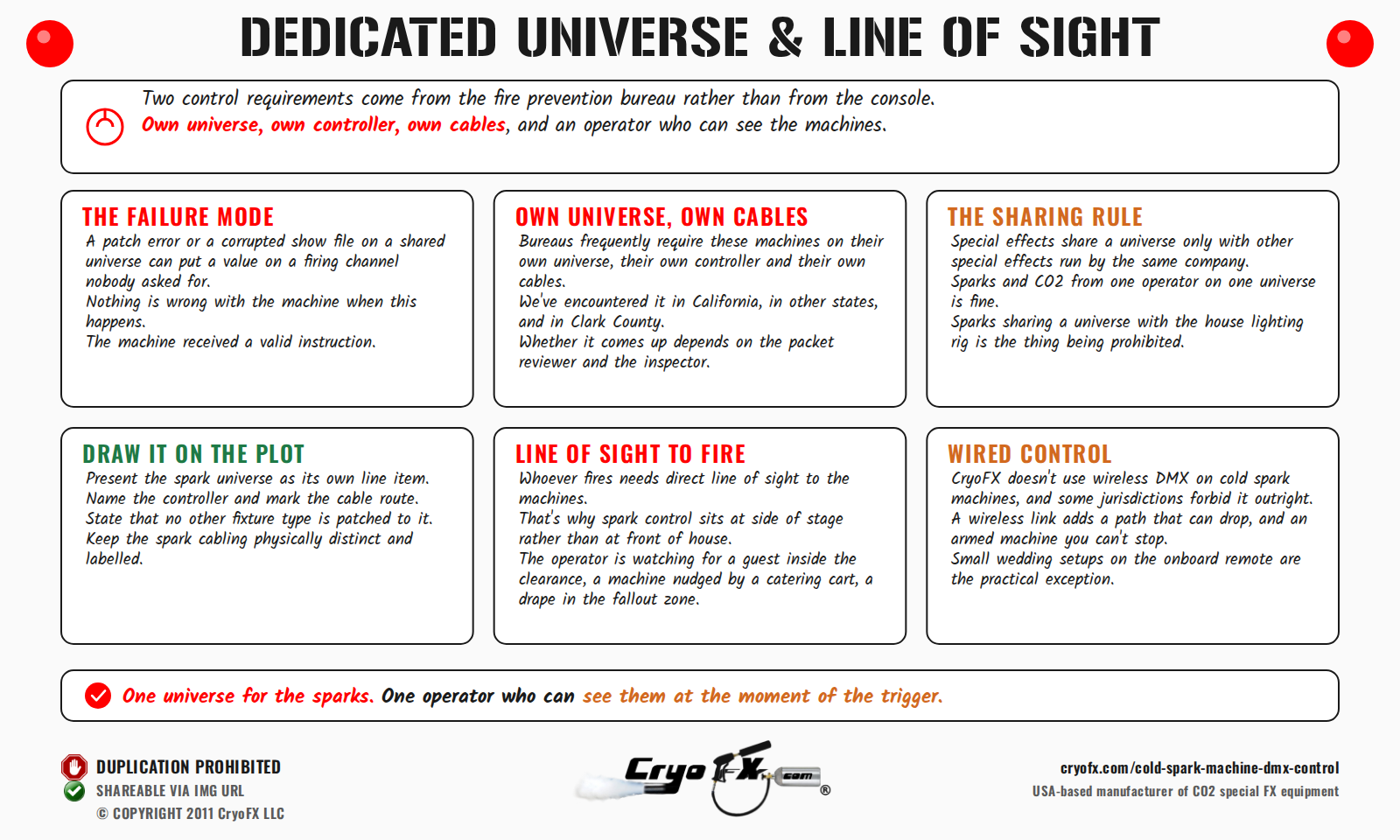
The failure mode is narrow and worth stating precisely. A patch error or a corrupted show file on a shared universe can put a value on a firing channel that nobody asked for. Nothing is wrong with the machine when this happens. The machine received a valid instruction.
Fire prevention bureaus frequently require cold spark machines on their own universe, their own controller and their own cables. We've encountered it in California, in other states, and in Clark County, and whether it comes up depends on the packet reviewer and on the on-site inspector. Plan for it rather than hoping.
The working rule: special effects share a universe only with other special effects run by the same company. Sparks and CO2 from one operator on one universe is fine. Sparks sharing a universe with the house lighting rig is the thing being prohibited.
Present it on the plot as its own line item. Draw the spark universe separately, name the controller, mark the cable route, and state that no other fixture type is patched to it. A reviewer who can see the separation on the drawing rarely asks a second question about it.
When the venue's LD pushes back, and they will, because a second output means a second run of cable during an already tight load-in, the answer is that the requirement came from the AHJ and the permit is issued against the plot as drawn. Take a second output from the same console if the desk supports it, or run a small dedicated controller. Keep the spark cabling physically distinct and labelled, so nobody repatches it during a late change.
Wireless control and where it's acceptable
CryoFX doesn't use wireless DMX on cold spark machines, and avoids it unless there's no alternative, because in some jurisdictions it's forbidden outright.
The reason is the loss-of-stop failure mode. Wired control means the operator's e-stop reaches the machine as long as the cable is intact. A wireless link adds a path that can drop, and an armed machine you can't stop is a category of problem no venue wants on its floor.
RF interference is also a documented cause of reported faults. A remote that worked in the parking lot and stops working once 400 phones arrive in the room is a support call we take regularly, and it isn't a machine fault.
The practical exception is a small wedding setup. Weddings use the machine's onboard wireless remote, typically operated by the DJ, and for 2 machines on a first dance that's the accepted way it's done. When we operate professionally, it's wired.
Line of sight and where the operator stands
Whoever fires needs direct line of sight to the machines. This is why pyro and spark control on a concert sits at side of stage rather than at front of house.
What the operator is watching for doesn't appear on the console. A guest who wandered inside the clearance. A machine that got nudged by a catering cart. A drape that's moved into the fallout zone. Smoke behaviour that says the room's air handling changed.
That's not theoretical for us. We had machines physically moved at a ranch wedding while the operator stepped away for about a minute, and because of the sight line he couldn't tell they'd been repositioned next to treated florals. The full account is on the cold spark safety guide, and the lesson is that the person on the trigger has to be able to see the machines at the moment of the trigger.
Music sync, timecode, and automation
Cues, timecode and full automation all work. A 20-machine deployment across a 100-foot convention centre stage gets programmed rather than busked, because no operator hits 20 discrete cues by hand across a keynote reveal.
Timecode buys repeatability and costs judgment. Bands stretch, hosts overrun, and a locked cue list will fire into an empty stage without hesitation. A skilled operator reading the room beats rigid timecode on most live work, and the better answer on a big show is programmed sequences with a person holding the abort.
Rehearse in a non-live environment, every time, whether the show is busked or timecoded. Run the cue stack with the machines armed and the room empty, watch where the sparks actually land against where the plot says they land, and find the mis-timed cue there rather than in front of an audience.
Frequently asked questions
Can cold spark machines be DMX controlled?
Nearly all of them are, and DMX is the expected control method on any professional job. The machine patches into GrandMA, ShowXpress, or any other console as a simple fixture over standard XLR, 3-pin or 5-pin depending on model. Handheld remotes exist for small setups, and a console is what a venue or fire marshal expects to see on a plot.
How many DMX channels does a cold spark machine use?
Most use 2. Multi-port and moving units use more: Showven's WAVER, waverFALL, WHEEL and TRIPLE run 6 channels, and the SPIN is switchable between 2 and 4. Every iSparkFX floor machine is a 2-channel fixture with 3-pin or 5-pin connectors. Check the manual before patching, because addressing a 2-channel fixture as though it had 6 puts the fire value on the wrong slider.
What do the DMX channels control?
One channel is safety and heat. It has to be raised before the machine powers the heating element and comes up to temperature, which takes 3 to 8 minutes. The other channel fires. The split is deliberate, so an idle console or an accidentally bumped fader can't fire an unarmed machine. Most machines cut off at 30 seconds per activation for thermal protection and need re-triggering.
Why do fire departments require a separate DMX universe?
Because of one failure mode. A patch error or a corrupted show file on a shared universe can put a value on a firing channel that nobody asked for. Fire prevention bureaus frequently require these machines on their own universe, own controller, and own cables for exactly that reason. Special effects gear shares a universe only with other special effects gear run by the same company.
Can I run cold spark machines on my lighting console?
Yes, they patch as ordinary fixtures. The constraint sits on the universe rather than the desk. Where the venue or AHJ requires separation, you take a second output from the same console or run a separate one, and keep the spark cabling physically distinct from lighting runs so nobody repatches it during a late change. Rehearse in a non-live environment first.
Can cold spark machines be controlled wirelessly?
Wireless works, and it sits outside standard practice for a reason. Wired direct control is a code and safety requirement in many jurisdictions, because a wireless link introduces a failure mode where the operator loses the ability to stop an armed machine. Small 2-machine wedding setups on a wireless remote are the practical exception. Anything on a stage gets cable.
How do I set the DMX address on a cold spark machine?
Set it on the machine, then patch the same address on the console and verify the machine responds before the room fills. iSparkFX units address via the onboard display rather than DIP switches. Machines sharing an address fire together, which is what you want for a matched pair flanking a stage and a problem when you wanted them to alternate. Give each machine its own address unless simultaneous fire is the intent.
Can cold spark machines run an automated show sequence?
They can. Cues, timecode, and full automation all work, and a large deployment like a 20-machine convention centre stage gets programmed rather than busked. The requirement that doesn't move is that a person with line of sight keeps the ability to stop it. Automation handles timing, the operator handles the room.
Can cold spark machines be synced to music?
Yes, through timecode or a cue stack. A skilled operator watching the room usually beats rigid timecode, because bands stretch, hosts talk, and a fixed cue list will happily fire into an empty stage. Where timecode is used, run multiple rehearsals in a non-live environment so a mis-timed cue gets found before an audience is in the room.
___
CryoFX® is the leading manufacturer, designer, and global supplier of CO2 special effects equipment and custom special effects systems
for Theme Parks, Sporting Arenas, Mega Nightclubs & Day Clubs , TV/FILM & large scale events & installs in any industry requiring Co2 Systems.
CryoFX LLC Global Headquarters • 3859 S Valley View Blvd, Suite 2, Las Vegas, NV 89103 • 1.855.527.9639
Updated - 08/13/2026.