Cold Spark Machine Guide: Sparkular, Cold Sparks & Permits | CryoFX
Cold Spark Machine | CryoFX
Cold Spark Machine from CryoFX. Rent or Purchase. CALL NOW to Order!
As You've Seen The Sparkular Machine / Sparktacular Machine by Showven
Sparkular Rental • Sparkular for Sale from CryoFX • Cold Spark Effect
For A Sparkular Price / Sparkular Cost... Rent or Purchase Call CryoFX.
Contact us NOW for info...Call:1.855.527.9639

CryoFX LLC • 3859 S Valley View Blvd, Suite 2, Las Vegas, NV 89103 • 1.855.527.9639
24/7 Rental Inquiry Submission: https://www.cryofx.com/rentals
Cold Spark Machine Guide: Sparkular, Cold Sparks & Permits | CryoFX®
The complete guide to cold spark machines: cold sparks, Sparkular, and cold fireworks explained
Cold Spark Machine: Professional Sparks & Sparklers Guide
No category in special effects has more names for the same device than this one. Cold spark machine, cold sparks, Sparkular, cold fireworks, cold pyro, spark fountain, indoor fireworks, wedding sparks, Sparktacular. They all point at the same piece of equipment: a box that heats metal granules and blows them into the air while they're glowing.
This guide covers all of it. What the machine actually does mechanically, what the word "cold" is doing in the name, what fire code says about it, what it costs to buy and to run, and what happens when it goes wrong at a show.
CryoFX supplies, rents, installs, services, and operates these machines. We hold pyrotechnic licenses, we file the permit packages, and we've walked into enough venues to know what the honest answer is when a client asks whether they really need one. We also stock the parts and publish the repair videos, which means we see what breaks and why.
The reason this category deserves a straight explanation is that the marketing around it has been misleading for a decade. "Cold" and "flameless" are commercial positioning. They are not safety certifications, and a fire marshal will tell you the same thing. The effect is excellent. It photographs better than almost anything else you can put in a room. It's also a pyrotechnic device under the applicable national standard, and it will set your ceiling on fire if you put it in the wrong place.
What is a cold spark machine?
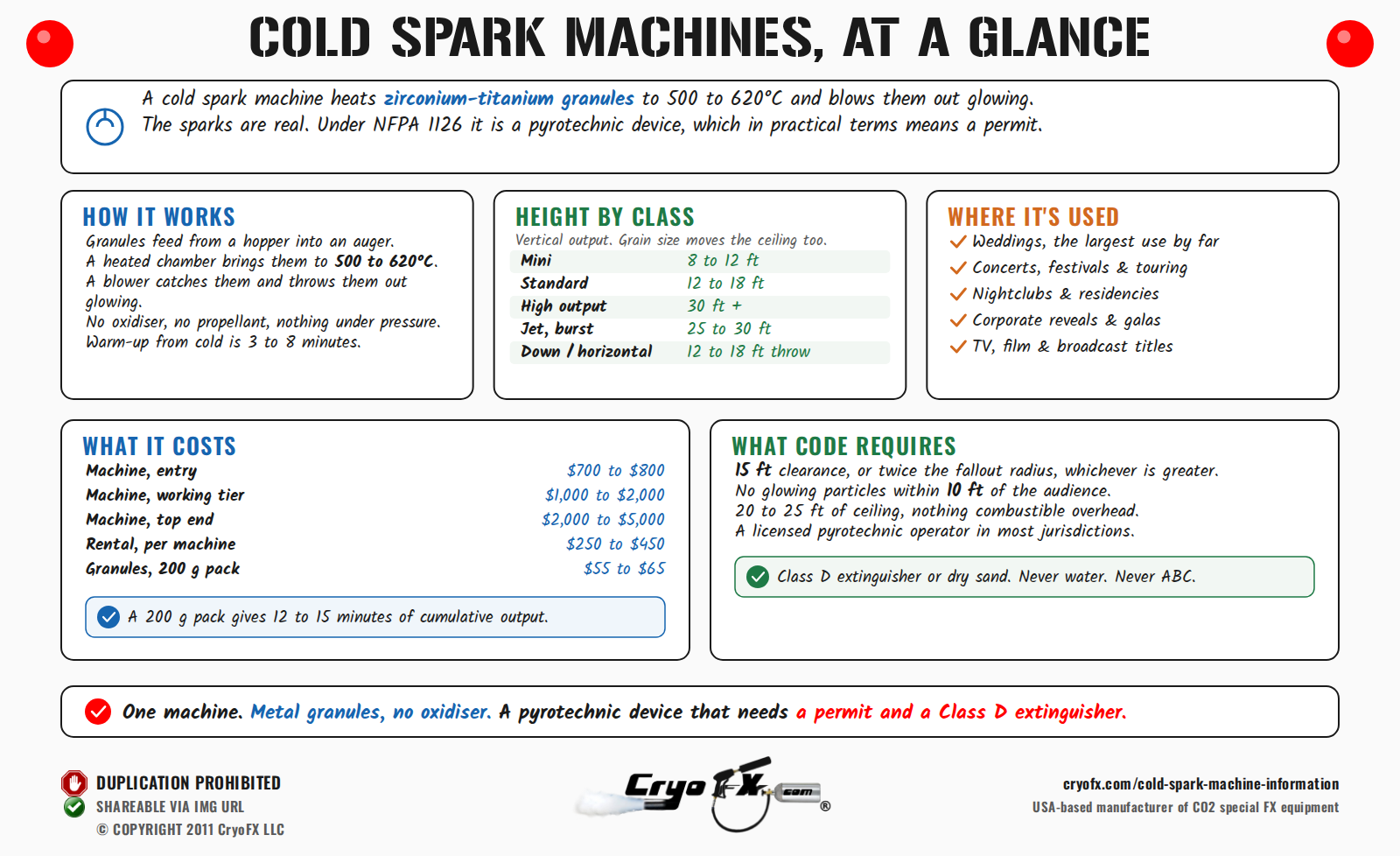
A cold spark machine is a combination of electronic components that take fine metal granules, heat them, and blow them out into the air while they're glowing. The result is a fountain of sparks that can run for as long as the operator holds the trigger.
The sparks are real sparks. They're the same thing that comes off an angle grinder cutting steel, and the same class of material found inside conventional pyrotechnics. The difference is what's missing. Pyrotechnics add an oxidiser, usually a perchlorate or a nitrate, plus a fuel and often a binder. That combination self-ignites, burns fast, and is over. A cold spark machine has no oxidiser at all. It has a heater, a blower, and metal.
That single difference drives everything else about the category: the longer effect duration, the operator control, the permitting profile, and, critically, how you put out a fire if one starts.
How the machine works, step by step
Granules go into a hopper on top of the machine. That hopper feeds down into an auger, which most operators call a corkscrew. The corkscrew drives the granules into a metal funnel, which narrows them into a small opening on the side of a cylindrical chamber.
That chamber is the heart of the machine. It has a heating element wrapped around the outside and a second corkscrew running down the centre. As the corkscrew pushes granules through the chamber, the heating element brings them up to temperature until they're glowing.
At the far end of the chamber, the granules exit into an airstream. A blower sitting underneath the heating assembly is already running, and it catches the glowing granules and throws them out of the nozzle. Depending on the machine, that's straight up, out to the side, or straight down.
One or two circuit boards handle everything: power, heater regulation, motor speed, and DMX. On most machines it's a single board doing all of it, which is why a board failure takes the whole machine down at once.
That's the entire mechanism. There's no combustion chamber, no ignition source, no propellant, and nothing under pressure. It's a heater, two augers, and a fan. CryoFX has a teardown video on the YouTube channel showing the internals, and once you've seen the inside of one, the failure modes stop being mysterious.
What "cold" actually means
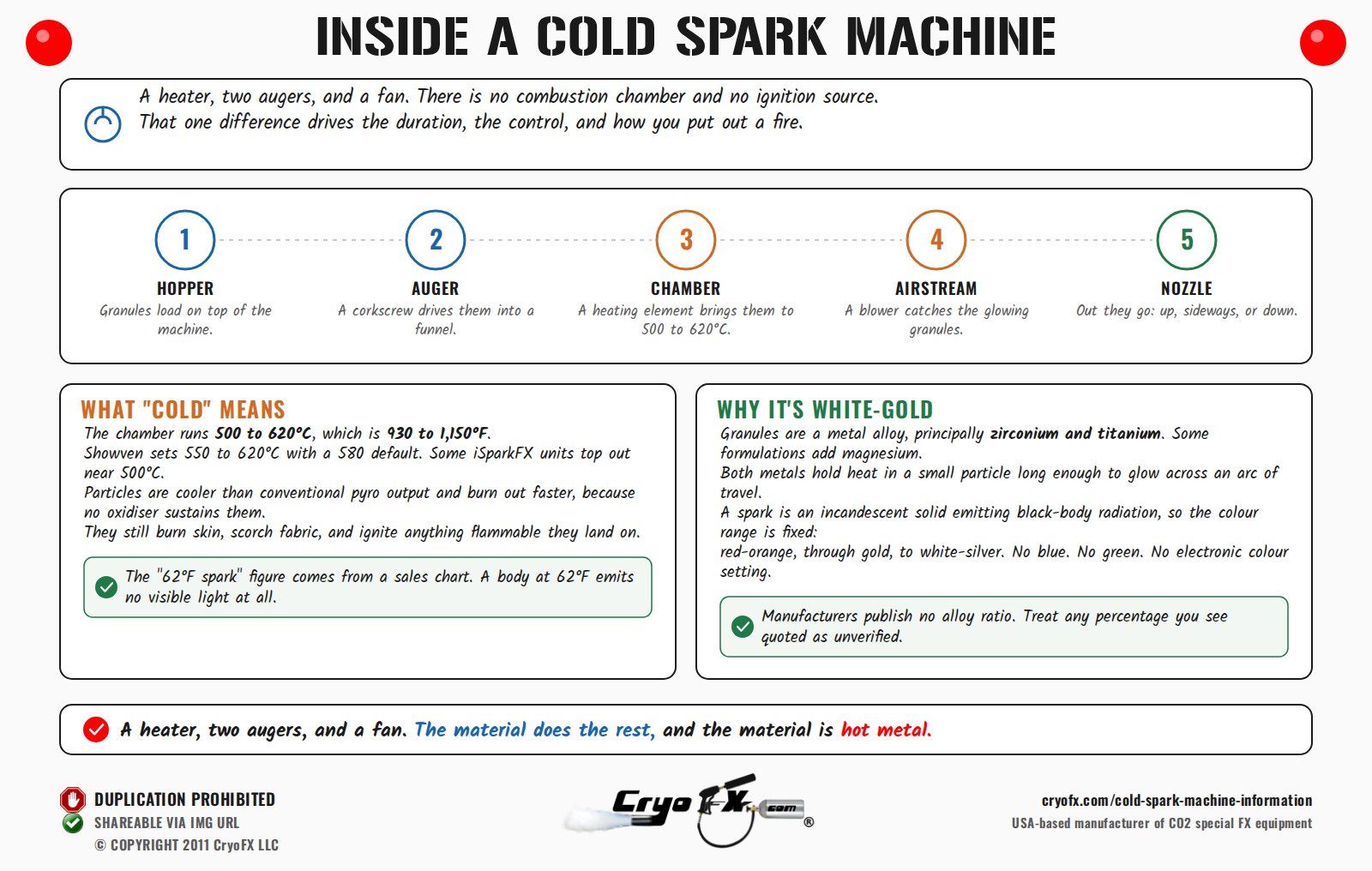
The heating chamber on a professional machine runs between roughly 500 and 620 degrees Celsius, which is 930 to 1,150 Fahrenheit. Some of our iSparkFX machines top out around 500°C. Showven's manual sets a range of 550 to 620°C with a 580 default. A high-output machine like the 10-metre units runs closer to 600.
Those are not cold numbers. They're roughly the temperature of a stove element at maximum, applied to metal.
You'll see a figure circulating that cold spark particles are around 62°F. That number originates in a manufacturer's sales comparison chart, and it can't be describing the spark. A body at 62°F is below room temperature and emits no visible light at all. The reason you can see the effect is that the particles are incandescent. Whatever that measurement was taken on, it wasn't the glowing particle.
The honest version is this. Cold spark particles are cooler than conventional pyrotechnic output and they burn out faster, because there's no oxidiser sustaining the reaction. They are still hot metal. They will burn skin on contact, they will scorch fabric, and they will ignite anything flammable they land on.
CryoFX has a video on its YouTube channel of us deliberately starting fires with these machines. We manufactured those conditions on purpose to show what the material actually does. The uncomfortable part is that the same conditions get manufactured all the time accidentally, by an operator who puts the machine two feet from a drape or under a low ceiling.
Word of caution on the terminology: "cold sparks" is a name. Treat it as a product category label, not a description of the hazard.
Are cold sparks actually fire?
Technically, no. There's no flame front and no combustion of a fuel-oxidiser mixture. What you have is a heated piece of metal moving through air, oxidising at its surface, and cooling as it travels.
Functionally, it doesn't matter. Grinder sparks aren't "fire" either, and they'll still burn a hole in your shirt and light cardboard. These particles behave the same way. The grain is smaller and the source is a purpose-built machine instead of a wheel on steel, but the material is doing the same thing.
One correction to a comparison you'll see repeated: the branching, forking spark pattern people associate with a grinder comes from carbon burning explosively inside hot iron. Titanium and zirconium don't do that. They produce a brilliant white or gold spark that's straighter and cleaner. The heat comparison holds. The visual mechanism is different.
What the effect looks like, and how high it goes
Picture a grinder at floor level throwing sparks upward, except the stream is controlled, sustained, and shaped. The particles read as small orange-gold flecks climbing and then burning out mid-air. If you've seen a handheld wedding sparkler, it's that, with a tighter stream, far more output, and a much better look on camera.
Height depends almost entirely on the machine. The pipeline through the chamber only handles so many granules per second, and the blower only pushes so hard. That constraint is exactly why there are different models at different price points.
Mini machines run 8 to 10 feet, with some reaching 12. Standard machines run 12 to 16 feet, some to 18. High-output machines go up past 30. Then there are burst machines like the Showven Sparkular jet units, which throw a ball of sparks 25 to 30 feet rather than a steady stream.
Everything above assumes vertical. Downward and horizontal machines exist and typically cap around 12 to 18 feet of throw.
Grain size matters too. A 200 gram pack comes in small, medium, or large grain, and larger grain goes higher. When a machine is rated 16 to 18 feet, that spread is partly the granule, not just the motor. The operator controls anything from about 5 feet up to the machine's ceiling. The granule sets where that ceiling lands.
How long the effect lasts
The effect runs as long as the operator holds the trigger, with one hard limit. Most machines time out at 30 seconds per activation as a thermal protection measure. The operator re-triggers to continue, and you'll usually see a slight dip in output across the handoff.
Total runtime is a granule question. A mini running a 50 gram pack gets 3 to 4 minutes. A standard machine on a 200 gram pack gets 12 to 15 minutes of cumulative effect. High-output machines burn through material much faster: a 10-metre machine consumes around 70 grams a minute, so a full 550 gram load is 5 to 6 minutes of continuous run.
For show planning, count activations, not minutes. A wedding using two machines for a grand entrance, a first dance, and a cake cut is maybe 90 seconds of total output across the night. One 200 gram pack per machine covers it with margin.
Cold pyro machine
Cold pyro machine is the same device under a different name. It's the term production and lighting professionals tend to use, and it shows up on technical riders more often than "cold spark machine" does.
The term has more credibility than "cold fireworks," because what comes out of the machine really is a pyrotechnic composite. It's less accurate than "cold spark machine" in one way: nothing about the device is cold. Both terms are in wide use and both point at the same equipment.
Types of cold spark machines and brands
Most brands in this category do the same thing. What you're paying for is build quality, parts availability, and whether anyone picks up the phone when a machine fails 40 minutes before doors.
The market as it actually is
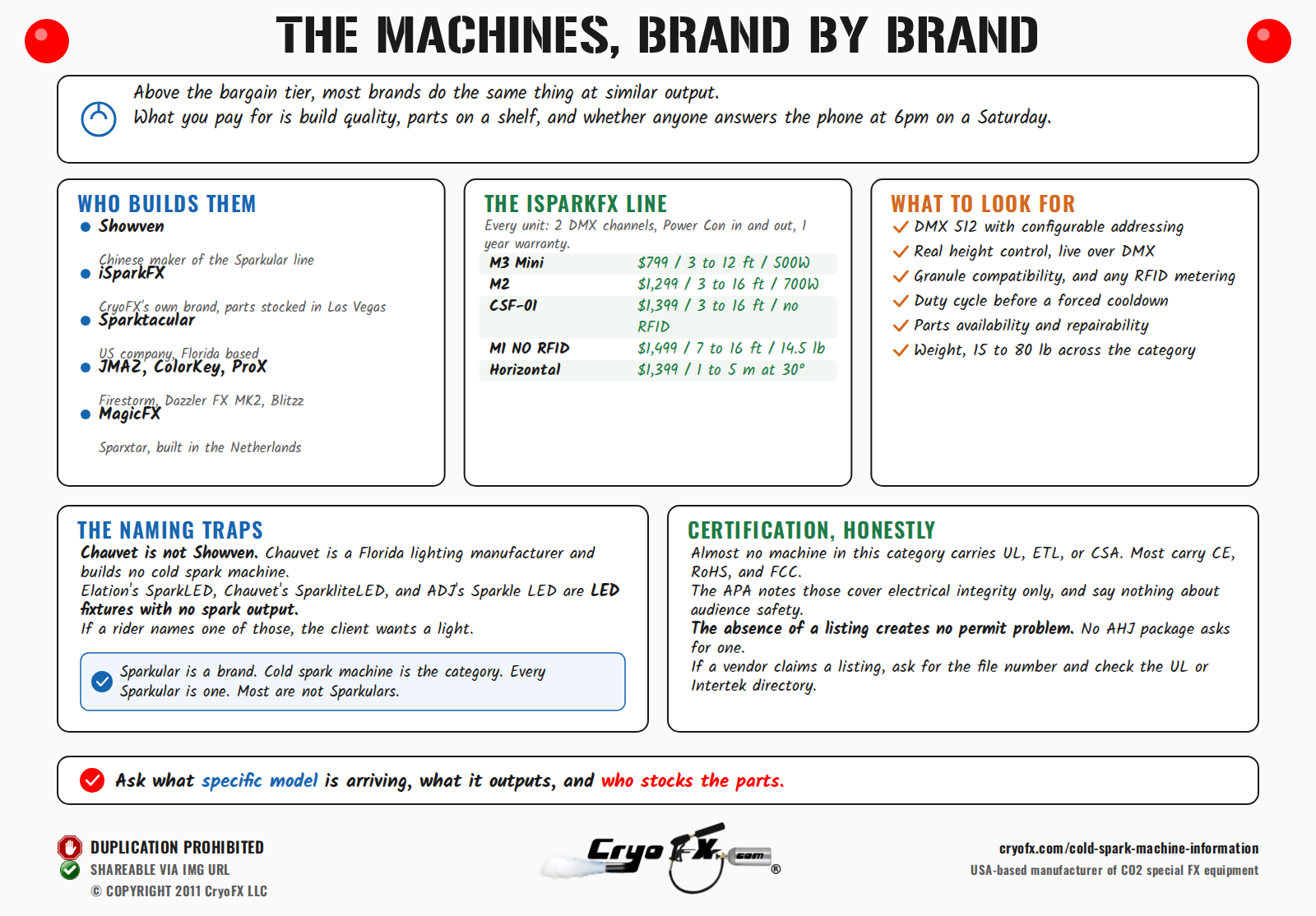
Showven is the Chinese manufacturer behind the Sparkular product line. They build a very good machine. Their patents, their engineering, and their quality control are all real, and the brand deserves the reputation it has.
Sparktacular is a US company based in Florida with a solid machine of their own. Like most equipment sold in America, portions of it are manufactured or assembled overseas, which says nothing about whether it's good. The majority of products bought in US stores are made in whole or in part in China.
That's the point worth internalising. Country of origin is a weak predictor of quality. Business standards are a strong one. A company with high standards produces a good product and its customers respect it regardless of where the factory sits. A company that cuts corners produces a bad product, because the product is a reflection of how the business runs. That's as true in Shenzhen as it is in Ohio.
Where it goes wrong is the bottom of the market. Once a patented design gets copied, factories with no standards start selling near-identical-looking machines at a fraction of the price. Most of those end up on Amazon. Most of them break.
When they break, the buyer discovers the real cost. Parts have to come from overseas with shipping both ways, or the machine goes to a US repair shop at several hundred dollars, or it ships back to the factory at the owner's expense in both directions. Any of those paths costs a meaningful fraction of a new machine. Some sellers will repair under warranty and still leave you paying freight twice plus the downtime. Buy a cheap machine and you frequently end up paying for two.
Sparkular by Showven
Sparkular entered the market early, marketed hard into weddings and events, and achieved what marketers call the Xerox effect. The brand name replaced the category name in everyday use. For several years, if a planner asked for "a Sparkular," they meant any cold spark machine.
That's starting to fade. The term is dissolving back into the broader vocabulary of cold spark machine, cold spark fountain, cold sparks, wedding sparks, and cold pyro, which is the normal lifecycle for a genericised brand once competitors reach parity.
Sparkular machines integrate fully with DMX 512 and drop into any standard production environment. Output height, DMX channel count, granule consumption, reservoir capacity, and footprint all vary by model, and the range runs from a compact mini up through 3,200-watt high-output units that require 220-volt power.
Showven recommends their own granules, and that's a real engineering constraint rather than pure lock-in. More on why in the granule section below.
The friction with Showven isn't the machine. It's distribution. Their US market structure has been a persistent problem, and CryoFX has consulted with them on distribution model, margin structure, and channel strategy more than once. The advice hasn't been taken, which creates gaps in the supply chain that end users feel. If you want Showven product, Sparkular USA availability through CryoFX is the cleanest route, and Sparkular China sourcing carries all the documentation and support risks discussed above.
iSparkFX, and why we recommend it
iSparkFX is CryoFX's own brand, and it's what we put in front of customers first.
The reasoning is practical. We control the spec, we stock every internal component, we run a second phase of testing in-house before a unit ships, and we operate a repair centre with parts on the shelf. When something fails, the part is in Las Vegas, not in a container. We also publish the repair and diagnostic videos, which means an owner can troubleshoot a fault at 6pm on a Saturday without waiting for a support ticket.
- The current line runs from a $799 mini through to a $1,499 high-output unit:
- The M4 Mini at $799 covers 3 to 6.5 feet on 500 watts, weighs 16 pounds, and warms up in under 5 minutes. It's the machine for small rooms, low ceilings, and tight budgets.
- The M3 Mini, also $799, is the same chassis pushed to 3 to 12 feet.
- The M2 at $1,299 runs 3 to 16 feet on 700 watts and weighs 22 pounds. This is the workhorse for event production companies.
- The CSF-01 at $1,399 hits the same 3 to 16 feet on 400 watts, and ships with no RFID card requirement.
- The M1 NO RFID at $1,499 covers 7 to 16 feet on 570 watts at 14.5 pounds, and is the lightest machine in the range for its output.
- The horizontal side-spark unit at $1,399 throws 1 to 5 metres at up to a 30 degree angle. Put two of these at the wings of a stage alongside vertical machines and you fill the dead space where performers enter and exit. It's a look most rooms haven't seen.
Every unit runs 2 DMX channels on DMX 512, with 3-pin or 5-pin connectors, PowerCon in and out, and a 1-year warranty with 2- and 3-year extensions available.
The RFID point deserves explanation. A number of machines on the market ship with an RFID reader that requires an authenticated card before the machine will fire. That ties the operator to one granule supply and meters their runtime. Several iSparkFX models have no card requirement at all. Power on and go, unlimited runtime, and free choice of consumable.
Sparktacular
Sparktacular machines are good machines. Output, DMX integration, and granule type all sit close to Sparkular, which is true of most brands in this category once you get above the bargain tier. Their SparkOne runs to about 17 feet on 600 watts, and their RainFall unit drops sparks 18 feet.
There's rarely a reason to specify Sparktacular over Sparkular or the reverse on performance grounds. It comes down to price, availability, or a specific machine one line has and the other doesn't.
We recommend iSparkFX over both, for the parts, service, and support reasons above.
Other brands worth knowing
Several other manufacturers sell real machines into the US market. JMAZ Lighting's Firestorm line covers roughly 3 to 13 feet on 500 watts. ColorKey's Dazzler FX MK2 runs 5 to 15 feet on 600 watts. ProX sells rebadged units under the Blitzz name. MagicFX in the Netherlands builds the Sparxtar. Global Special Effects sells an 800 watt unit up to 15 feet.
One naming trap catches people constantly. Chauvet is a US lighting manufacturer in Florida. Showven is the Chinese manufacturer of Sparkular. They are unrelated companies and Chauvet does not build a cold spark machine. Separately, Elation's SparkLED, Chauvet's SparkliteLED, and ADJ's Sparkle LED are all LED fixtures with no spark output whatsoever. If a rider says one of those, the client wants a light, not a spark machine.
Cold fireworks machine
Cold fireworks machine is the generic descriptive name for the category, and we avoid it where we can.
Both halves of the phrase are wrong. The sparks aren't cold, and the device isn't a firework. It contains no explosive composition, produces no report, and isn't regulated as a firework at the federal level. Using the phrase in a permit application or a fire marshal conversation invites confusion at exactly the moment you want precision.
There's a second reason to be careful with it. Describing yourself as a "cold fireworks supplier" can read to a regulator as a claim to sell fireworks, which is a different licensing category entirely and draws attention from the ATF. If you're using the term for search reasons, and plenty of people search it, make sure the page states clearly that these are cold spark machines and not fireworks.
Spark fountain and cold spark fountain
Cold spark fountain describes the visual rather than the box. A single machine makes one fountain. Two machines flanking an entrance make a gateway. A row of six across a stage edge makes a wall.
Same equipment, different geometry. The word "fountain" tends to show up more in wedding and venue conversations, where the imagery matters more than the hardware.
Certification, and what it's actually worth
Almost no cold spark machine on the market carries a UL, ETL, or CSA listing. Most carry CE, which is an electrical conformity marking, plus RoHS and FCC. Showven has confirmed directly that Sparkular is not UL listed. The American Pyrotechnics Association acknowledges that some manufacturers have obtained UL, CE, or CSA approvals, while pointing out that those cover electrical integrity only and say nothing at all about whether the effect is safe to use in front of an audience.
Taking a machine through full NRTL listing is a five-figure process that runs months, risks destroying test units, and would push retail prices up substantially. So it doesn't happen in this category.
Here's what matters for you: the absence of a UL or ETL listing does not create a permit problem. No AHJ permit package we've filed has ever asked for one. What they ask for is the equipment cut sheet, the granule MSDS, a plot diagram, distances, show duration, the pyro license, and insurance. Get those right, and the listing question never comes up.
If a vendor claims a UL or ETL listing, ask for the file number and verify it in the UL or Intertek directory. It takes two minutes, and it's the fastest way to sort a real claim from a marketing one.
Where cold spark machines are used
Weddings, corporate events, concerts, nightclubs, churches, festivals, TV and film, music videos, product launches, and car reveals. Anywhere a moment needs a visual punctuation mark. If you ranked them by volume, weddings are first by a wide margin, concerts second, corporate third, nightclubs fourth. Almost all of it is indoors.
Weddings
Weddings are the biggest single application in the category, and the most abused.
The visual is the reason. In a dimly lit reception room, a gold spark fountain photographs and films dramatically. It reads as far more expensive than it costs. Photographers and videographers consistently rank it among the best-returning effects for their final deliverable, and it doesn't produce the residue, cleanup, or floor hazard that confetti does.
The problem is that a large number of DJs run these machines with no permit, no license, no clearances, and no idea what the code says. They cause fires. They damage buildings. And every incident tightens the regulatory environment for everyone doing it correctly. We've watched jurisdictions go from permissive to outright prohibition inside a few years because of it.
When CryoFX books a wedding, the conversation covers the same ground every time. When do you want the sparks? How many machines? Exactly where do they sit, and understand that once they're placed, they don't move. How long is each activation? How many separate moments in the night?
Then the non-negotiable part. Fifteen feet of clearance around the effect, from everything and everyone. We need fire certificates for anything in that zone: stages, carpet, skirting, scrims, drape, furniture, set pieces. That isn't a CryoFX preference. It's fire code, and it doesn't bend because it's someone's wedding.
Full detail on planning, positioning, and venue approval is in the Cold Spark Machine for weddings guide, and the terminology overlap with indoor fireworks for weddings, cold fireworks wedding, and cold sparklers for weddings and concerts is covered on those pages.
Concerts and live music
Spark machines appear at essentially every premier live event: arena tours, stadium shows, festivals. Rarely alone. A typical concert deployment mixes standard vertical machines with downward units hung from truss, jet units throwing bursts, and cyclone-style machines reaching 30 feet.
They integrate into a touring production the same way any other fixture does. Road cases, pre-set DMX addresses, patched into the lighting universe. Control usually sits with the front of house console, though there's an important exception: where a pyrotechnic license holder is running the effect, control moves to a dedicated position at the side of stage, because that operator needs direct line of sight to the machines.
More on stage integration in the cold spark machine for concerts guide and cold stage fireworks.
Nightclubs
Club use splits into two models. Some clubs bring machines in only for specific bookings, usually a headliner whose rider calls for them. The club rents, sets up in a compliant position, and has a licensed operator on site for the night. Others build them into the permanent production. Those clubs generally employ someone who holds a pyrotechnic license and maintain a running permit with the fire department covering nightly activation. Machines live at the DJ booth, hung behind the production rig, or near the LED wall.
A common misconception: VIP bottle service moments are usually not fired from the table. The machines sit somewhere else in the room, away from guests, and the effect draws attention toward the table. Clubs pack people in tightly enough that a machine at the table can't hold the required clearance.
Permanent installation does not buy you out of anything. Same permits, same clearances, same licensed operator requirement. It just changes the paperwork from per-event to blanket. Detail in the cold spark machine for nightclubs guide.
Corporate events and galas
This is where the effect earns its money. CryoFX ran 20 machines across the stage for a Mary Kay event in a convention centre, mixing minis and full-size units. The stage was large enough that anything smaller would have disappeared. That deployment defined the look of the entire show.
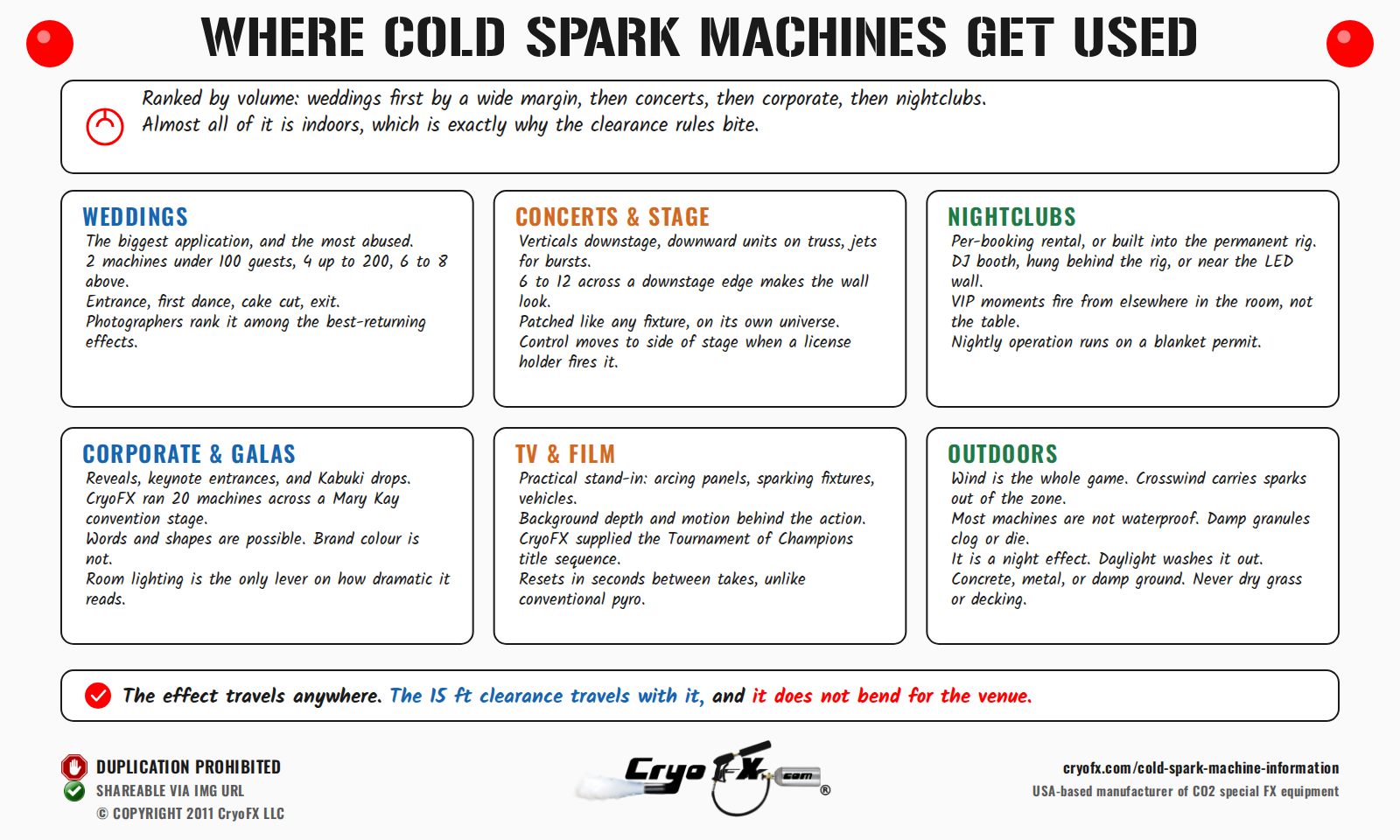
The standard corporate moments are reveals and entrances. Product launches, frequently paired with a Kabuki drop, where the machines fire at the instant the fabric releases. Award announcements. CEO and keynote entrances. Milestone celebrations. We've done multiple major car brand unveilings using vertical, downward, and directional machines together.
Branding is possible in ways people don't expect. We've spelled words with spark machines and combined machine types to build shapes on stage. Colour is a limitation: the spark colour comes from the granule chemistry, not from an electronic setting, so you can't dial in a brand colour. What you can control is the lighting environment. Brighter room lighting washes the sparks out. Darker rooms make them dramatic. That's the lever.
Full detail in the cold spark machine for corporate events guide.
TV and film production
Cold spark machines show up constantly in broadcast, usually for one of two purposes.
The first is as a practical effect standing in for something else: an electrical panel arcing, sparks pouring out of a light fixture, a vehicle throwing sparks. CryoFX has advised most of the major special effects companies on exactly these applications.
The second is as a background element. Machines placed behind the action so the shot has depth and motion.
CryoFX supplied the cold spark machines for the opening sequence of Guy Fieri's Tournament of Champions on Food Network. The machines ran behind the intro on season 3 in 2022, and the look worked well enough that the phrase "let the sparks fly" carried into the promotional campaign for season 4 in 2023. It's a useful reference point for what these machines do on camera, because a broadcast title sequence is about the least forgiving environment there is: repeatable output, consistent framing, and no room for a machine that varies take to take.
Productions choose spark machines over conventional pyrotechnics for practical reasons. Cleaner smoke profile, so the room doesn't need to clear between takes. Faster reset, because you refill a hopper instead of rigging a new device. Lower fire marshal overhead on some productions, though not all.
On permits: if you're on private property, requirements vary by state and you may or may not need one. Check the local jurisdiction rather than assuming.
For camera, the effect can be dialled in during testing and the exposure set before the live take. Sparks are small, very bright point sources against a dark background, which is a difficult exposure. Open up for the room and the sparks blow out to white streaks. Expose for the sparks and the room goes black. A second camera at a different setting is a common solution when the shot has to work both ways.
Outdoor use
Machines run outdoors with real caveats.
Wind is the whole game. A crosswind carries sparks outside the fallout zone you calculated, which means outside the 15 feet the code requires. If wind is up, the effect gets cut. That's a call the operator makes on the day, and any production plan involving outdoor sparks needs a contingency for losing them.
Water is the second issue. Most machines are not waterproof. Some carry an IP rating good enough to sit out in rain during a concert, and a few models are built specifically for it. None of them can get soaked. Granules are worse: moisture ruins them, and damp granules produce weak, inconsistent output or clog the machine outright.
Then there's visibility. On a bright day outdoors you can barely see the effect. It's a night effect. Clients booking outdoor daytime weddings need to hear that before they pay for it.
Surface matters too. Never on dry grass, wood decking, or anything combustible. Concrete, metal, or damp ground.
Cold spark machines for sale
What they cost
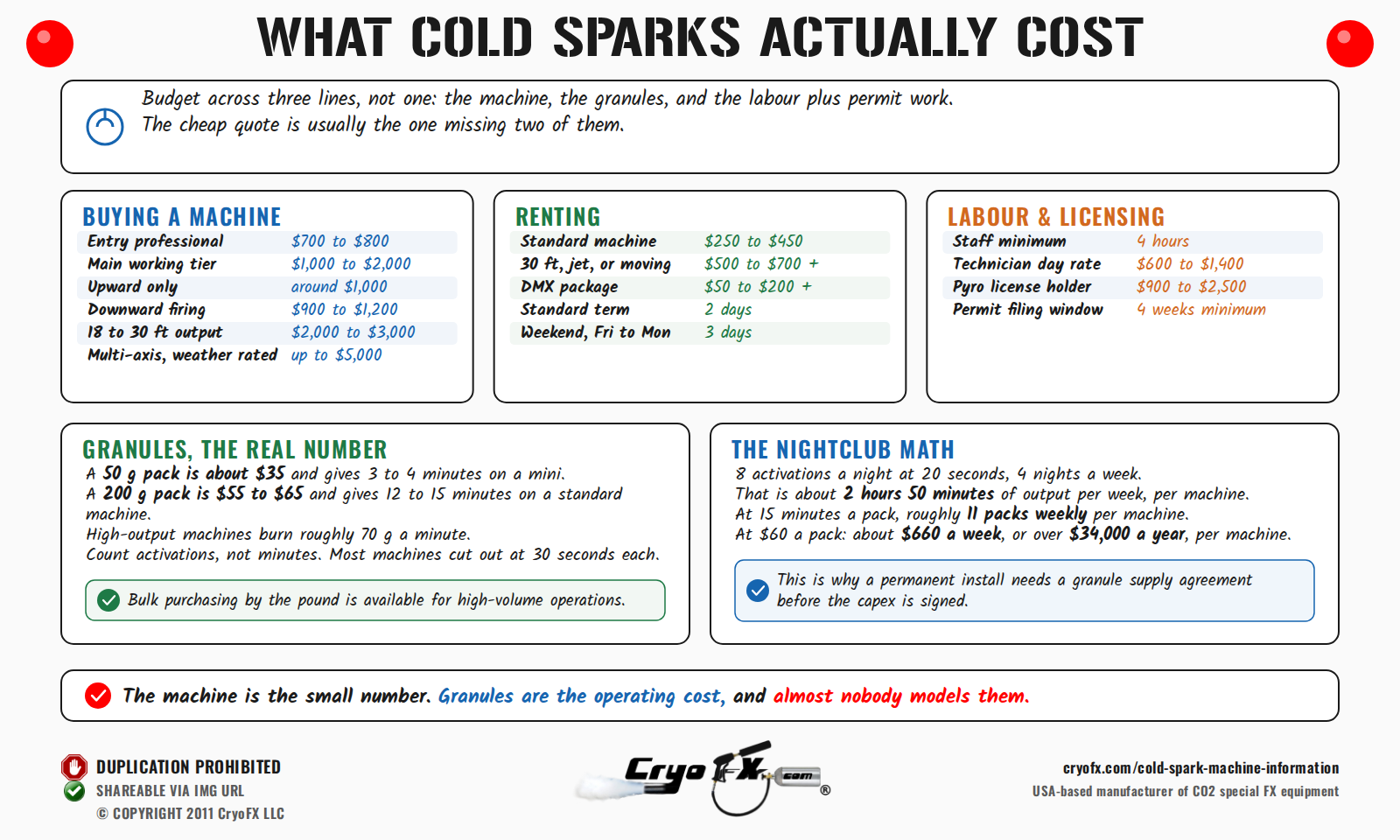
Professional machines run from roughly $700 or $800 at the entry point up to $4,000 or $5,000 at the top, depending on brand, model, and capability.
Price tracks features more than brand. A machine that only sprays upward sits at the bottom of the range, call it around $1,000. A horizontal unit lands about the same, $900 to $1,000. A downward-firing unit runs $900 to $1,200, slightly more because hanging machines are built differently.
Above that, capability drives cost fast. Machines reaching 18 to 22 feet, 25 feet, or 30 feet run $2,000 to $3,000. Machines that move on an X axis or an X and Y axis cost more again. Machines with multiple output ports, three, four, or five holes, cost more. Machines rated to sit outdoors in damp conditions cost more and are usually a newer design.
The sparkular price and sparkular machine price pages break down brand-specific pricing, and cold fireworks price covers the category generally.
Why buy domestically
Two scenarios, both of which we see constantly.
A DJ buys a machine on Amazon for $400. Eight months later the heating element fails. The seller has no US parts inventory, so the element ships from overseas. Freight and duty on a single part runs well over $100 and takes three weeks. He has a booking in nine days. He buys a second machine to cover the gig, and now he's spent more than a professional unit would have cost.
Second scenario. Same machine, same failure, but this time the seller offers a factory repair. The machine ships overseas at the owner's cost, sits in a queue, gets repaired, and ships back at the owner's cost. Freight both ways on a 20 pound machine runs a few hundred dollars, the turnaround is six to ten weeks, and he's lost the entire season.
CryoFX stocks the parts. Cold spark machine heating elements, cold spark machine hoppers, cold spark machine blowers, cold spark machine DMX boards, and cold spark machine electronics boards are all on the shelf. Most of them ship same day, and there's a video showing how to fit them.
That's the real argument for buying domestically. Not patriotism, logistics.
What to look for
DMX 512 with configurable addressing. Not a proprietary control scheme. If it doesn't patch into a standard console as a normal fixture, it doesn't belong in a production environment.
Real height control. Adjustable output height via DMX in real time, rather than a fixed setting you choose before the show.
Granule compatibility. Understand whether the machine takes only the manufacturer's granules or accepts third-party material, and whether there's an RFID card metering your runtime.
Duty cycle. How many continuous minutes before the machine needs to cool. Professional machines tolerate more.
Parts availability and repairability. The single most predictive factor for total cost of ownership. Ask the seller which parts they stock before you buy.
Weight and footprint. Machines run 15 to 80 pounds. If you're loading in up stairs at four venues a week, that number matters.
What comes in the box
Usually the machine, a power cable, and a controller. Granules are sometimes included and often not. A DMX cable is sometimes included and usually not. A flight case is nearly always an upsell.
Assume you're buying granules, cables, and a case separately unless the listing explicitly says otherwise.
Warranty, and what it doesn't cover
Most manufacturer warranties in this category run 90 days. iSparkFX runs a full year with 2 and 3 year extensions available.
The distinction that catches people out is manufacturer defect versus operator fault. A warranty covers a failed board that failed on its own, or a motor that burned out without a mechanical cause. It does not cover a clog, a jam, a power fault from the wrong outlet, moisture damage, contaminated granules, or a machine that was never cleaned.
Here's the uncomfortable number: 95 to 98% of the time a customer reports a machine fault, it turns out to be operator error. Wrong plug or wrong power. A bad DMX or power cable. A controller fault. RF interference on the control frequency. Wrong granule type. Sand or debris in the granules. Granules left in the machine between events until they compacted or drew moisture. A machine never cleared after a show. Granules poured into the wrong opening.
That's why the repair process starts with an intake audit rather than a quote. We diagnose what actually caused the failure. If it's a genuine defect, it's covered. If it's operator fault, the customer gets a price and decides whether to pay or take the machine back as-is.
It's also why we publish diagnostic videos. An owner who can identify the fault himself doesn't ship a machine across the country to be told a hopper was clogged.
Used machines
We don't recommend buying used from a private seller. Motor and impeller wear isn't visible from the outside, granule history is unknown, and the wrong granules run through a machine damage the chamber in ways you won't see until it underperforms at a show.
If you want used, buy B-stock or C-stock from CryoFX. We strip the machine, clear the heating element, empty the hoppers, blow everything through, verify the augers, and confirm it runs at full output before it's resold. Most sellers move a used machine as-is.
Full purchase guidance is in the cold spark machine buyer guide, and specific model availability is covered under sparkular machine for sale, cold fireworks for sale, and indoor wedding fireworks for sale.
When you're ready to compare specific models and pricing, the full range of cold spark machines for sale is on the CryoFX product catalogue.
Cold spark machine rental
What it costs
Machine rental runs $250 to $450 per machine, driven by duration, quantity, dates, and whether it's part of a larger effects package. A machine bundled into a multi-effect rental typically prices lower than the same machine standing alone.
Higher-capability machines cost more. Units throwing 30 feet, jet machines firing bursts, and machines rotating on an X or X-Y axis run $500 to $700 or more for a 24 to 48 hour period.
DMX packages are separate: $50 to $200 plus, depending on cable count, cable lengths, and controller type. Most production companies bring their own.
Granules are at cost. A 50 gram pack runs about $35. A 200 gram pack runs $55 to $65 depending on brand and grain.
Standard rental is 2 days. A weekend is 3 days, out Friday and back Monday. If you only need 24 hours and can return on time, that prices below the standard 2 day rate. Booking further out reduces cost.
Full rental detail is on the cold spark machine rental page and sparkular machine rental.
What's included
Machines, power cables, DMX cables, DMX controller, granules calculated for the agreed activation plan, and flight cases where needed. Wireless controllers are generally reserved for two-machine wedding setups rather than production rentals.
Labour and licensing
CryoFX books staff at a 4 hour minimum, the same way a labour union would. If a setup takes an hour, it's still a 4 hour booking.
Technician day rates run $600 to $1,400 depending on junior versus senior tech, block length, and date. Anything past 10 hours bills additional. Premium dates carry premium rates: New Year's Eve and July 4th are top-tier requested dates and price accordingly.
A pyrotechnic license holder on site runs $900 to $2,500 for a half or full day depending on the event. That's separate from the permit package. One is administrative work to get the permit filed. The other is a licensed professional standing in your venue running the show.
In Nevada, the law requires two people: the license holder whose license covers that machine type and use case, and a second operator actually running the machines. That way the license holder can watch the room while someone else handles the equipment. Other states and counties allow the license holder to also be the operator, meaning one person can set up, run, and strike the whole thing.
Self-operated rental
Possible under certain circumstances, with strict limits.
Before we release machines without an operator, we need the event date and time, location, who's operating, whether it's public or private, activation count and timing, blast duration, and a plot diagram of the venue. That lets us underwrite the rental and determine whether a pyrotechnic license is required.
This isn't bureaucracy. A rental company that hands machines to someone circumventing fire code is liable downstream when something happens. Any company renting cold spark machines without checking whether code is being followed carries that exposure. We check because we're on the hook.
CryoFX also offers training on use, fire code compliance, rental operations, and general machine care, by request. There's a certificate at the end, and several fire departments and fire prevention bureaus have accepted it as recognised professional training in their jurisdictions.
Permit coordination
We run a permit coordination package covering the admin and technical work of filing, because a licensed operator has to file the permit.
CryoFX assembles the packet, interfaces with fire prevention, marks up the plot diagram with whatever detail the AHJ needs, and submits. The packet includes cut sheets, product documentation, MSDS, insurance, license details, runtime, showtime, and blast duration.
We need this 4 weeks out. Rush fees apply inside 4 weeks and escalate as the date approaches. Inside 2 weeks it becomes uncertain whether a permit is achievable at all. A few days out, it usually isn't, and no amount of money changes that.
How many machines
Most clients book in even numbers: 2, 4, 6, 8. Odd configurations happen when the design calls for it, four on the floor and three above spraying down, or an asymmetric layout to build a crisscross of top, bottom, and side sparks.
As a rough guide: 2 machines for a wedding entrance or first dance gateway. 4 for a full dance floor surround or stage flank. 6 to 8 for a festival stage or large concert. Anything beyond that is a custom design conversation.
The fire watch misconception
This one comes up constantly and it costs people money.
A client says the venue has a fire watch on duty, so no permit is needed. The venue often says the same thing. Both are wrong.
A general fire watch covers the venue's own operations. It does not substitute for a permit covering the use of pyrotechnic devices at that event, and it does not check the box for the specific requirements attached to spark machines. The permit is still required, and it still has to go through the fire department.
Hotels tell clients this regularly, sometimes in good faith. It doesn't matter. A venue cannot override the code of the jurisdiction it sits in. The building is on city, county, and state land, and the code applies to whatever happens inside it. A hotel saying a permit isn't needed has no authority to make that true.
We had this exact conversation recently with a large national hotel chain property in San Diego. They were collecting rental proposals for spark machines from several companies. CryoFX came in higher than the others, and the client asked why we had line items for permit coordination and a license holder when nobody else did.
The answer was that the other companies weren't doing it correctly. We walked the client through what code required, what the liability exposure looked like if something happened, and what a violation would mean for the venue's own standing with the fire department. Cheaper wasn't cheaper. It was uninsured.
They took the information to their internal team, and the outcome was that the property listed CryoFX as their approved vendor going forward, specifically because of it.
That's the pattern across this whole category. The companies quoting lowest are usually the ones leaving out the compliance work, and the client doesn't find out until there's an incident or an inspection.
Cold spark machine pricing
Rather than repeat the numbers above, here's how to think about total cost.
Purchase
The machine is a capital expense. Entry-level professional units start around $700 to $800. The main working tier runs $1,000 to $2,000. High-output, multi-axis, multi-port, and weather-rated machines run $2,000 to $5,000.
Buying 2, 4, or 6 machines together typically gets you volume pricing over single-unit purchases.
Granules
Granules are the operating cost, and this is where owners underestimate.
A 200 gram pack at $55 to $65 gives roughly 12 to 15 minutes of cumulative output on a standard machine. A 50 gram pack at around $35 gives 3 to 4 minutes on a mini.
Work the math on activations, not minutes. A club firing 8 activations a night at 20 seconds each, 4 nights a week, burns about 2 hours 50 minutes of output per week per machine. On a 200 gram pack at 15 minutes, that's roughly 11 packs weekly per machine. At $60 a pack, one machine costs about $660 a week to run, or over $34,000 a year.
That number is why permanent nightclub installations need a granule supply agreement before anyone signs off on the capex. Nobody builds it into the operating model and then it shows up as a surprise line item in month three.
Bulk purchasing by the pound is available for high-volume operations. That's a special order and depends on volume and lead time.
Full breakdown on the cold spark granules page and the how much does a cold spark machine cost guide.
Rental
Base machine rate, plus granules consumed, plus operator staffing if applicable, plus travel and delivery, plus permit documentation preparation. Get all five quoted before comparing two proposals, because the cheap quote is usually the one missing three of them.
How cold spark machines work: technical detail
The mechanical path was covered earlier. Here's what's happening at the material level.
The granules
Cold spark granules are a metal alloy, principally zirconium and titanium. Some formulations include magnesium. Manufacturers don't publish the exact ratio, and the safety data sheets list the contents simply as "metal alloy" with no percentages.
That's not evasion so much as regulatory reality. Physical-hazard-only components don't require disclosure under GHS, so no commercial granule SDS in this category publishes a breakdown. Distributors publish contradictory numbers, with some claiming titanium-dominant and others zirconium-dominant. The density figure on the manufacturer's own SDS points toward zirconium-dominant. Treat any specific percentage you see quoted as unverified.
There's no gunpowder, no oxidiser, and no explosive composition of any kind.
Zirconium and titanium are used for a specific physical reason: both have low thermal conductivity, which makes them unusually good at holding heat in a small particle long enough to glow visibly through an arc of travel. Copper, which conducts heat away fast, is poor at producing sparks. That property is why this category exists at all.
The white-gold colour is a consequence of the same physics. A spark is an incandescent solid particle emitting black-body radiation, not a vapour-phase emitter like a firework star. That constrains the colour range to red-orange through gold through white-silver, and it's why you'll never see a blue or green cold spark. The chemistry sets the colour, and no electronic setting changes it.
Grain size
Granules come in small, medium, and large grain, and some manufacturers extend the range further for specific machines.
Larger grain goes higher. Smaller grain goes lower and is generally the indoor choice. This is separate from operator height control. The operator can dial anywhere from about 5 feet to the machine's maximum. The grain determines where that maximum lands. When a machine is specified at 16 to 18 feet, the spread across that range is the granule, not the motor.
Manufacturers key their required standoff distance to grain size for the same reason, calling for more clearance on large grain than small.
Granule condition matters as much as grade. Old or moisture-exposed material underperforms, clumps, and clogs the feed. Store it sealed, cool, and dry, and discard anything showing clumping or discolouration.
Why manufacturers specify their own granules
This is a real engineering constraint, not just a lock-in play.
Granules differ in grain size, in alloy composition, and in density. Heating elements and feed geometry are designed around a specific range of both. Run material that's the wrong size or the wrong density and you get inconsistent feed, poor output, incomplete heating, or a clog that damages the auger.
That's why we sell granules matched to each machine we supply, including granules for machines we didn't build. CryoFX stocks granules for most of the brands in the market, with and without cards.
Temperature and duty cycle
The chamber runs 500 to 620°C depending on the machine, taking about 3 to 8 minutes to reach temperature from cold.
The motor and heating element both generate heat during operation. Most machines cap continuous runtime, commonly with a 30 second per-activation timeout, and require a cooldown between sequences. Exceeding the duty cycle is the most common cause of motor failure in this category and it will shorten machine life substantially.
CryoFX has a full teardown and operation video on the YouTube channel if you want to see the airflow path and the chamber assembly with the housing off.
DMX control and show programming
Yes, cold spark machines are DMX controlled, and yes, that's the industry standard.
Channels
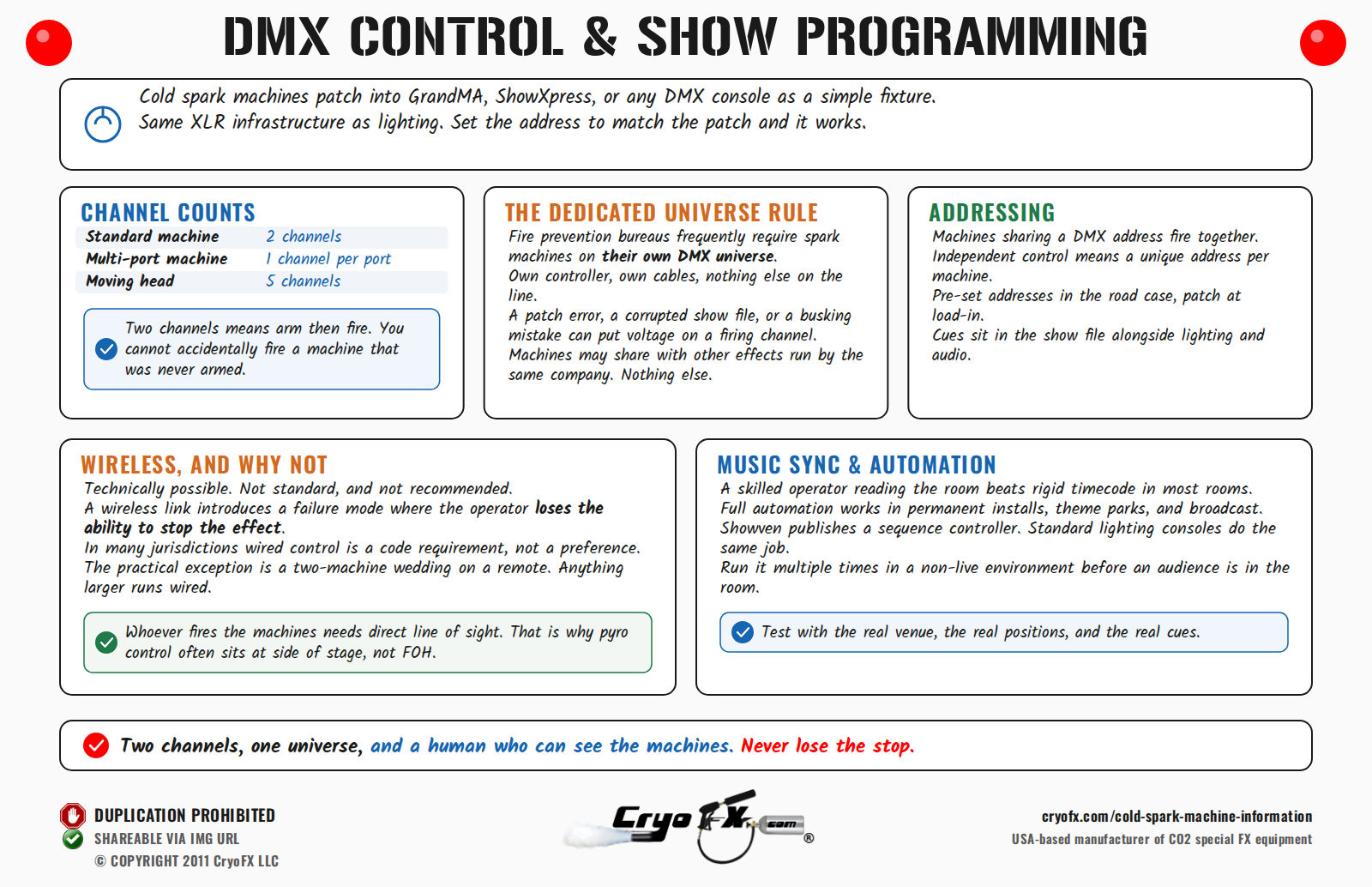
Most machines use 2 channels. One is a safety and heat channel: it has to be raised to power the machine, confirm it's live, and bring the chamber to temperature. The other is the firing channel that actually triggers the effect.
That two-stage design is deliberate. You can't accidentally fire a machine that hasn't been armed.
Machines with multiple output ports use more channels, one per port. Moving-head units use five: warm-up and emergency stop, height, X axis, Y axis, and rotation speed.
The dedicated universe rule
Fire prevention bureaus frequently require cold spark machines to run on their own DMX universe. Own controller, own cables, nothing else on the line.
The reason is accidental firing. If your spark machines share a universe with lighting, a patch error, a corrupted show file, or a busking mistake can put voltage on a firing channel at the wrong moment. Isolating them removes the failure mode entirely.
In practice, that means special effects equipment gets its own DMX system. Spark machines can share a universe with other effects equipment operated by the same company, and nothing else.
Console integration
Cold spark machines patch into GrandMA, ShowXpress, or any DMX console as a simple fixture. Same XLR infrastructure as lighting. Set the address on the machine to match the patch and it works.
Machines sharing a DMX address fire together. Independent control means a unique address per machine.
Wireless
Technically possible. Not standard, and not recommended.
Machines need to be wired and directly controlled, and in many jurisdictions that's a code and safety requirement rather than a preference. A wireless link introduces a failure mode where the operator loses the ability to stop the effect, which is the one thing you can never lose.
Weddings are the practical exception. A two-machine setup with a wireless remote is common and generally acceptable. Anything larger, and anything on a production, runs wired.
Line of sight
Whoever fires the machines needs direct line of sight to them. That's not optional. The operator has to be able to see what's actually happening in the room and stop the effect if something changes.
This is why on concert productions the pyro control position often sits at the side of stage rather than at front of house, even though every other DMX cue runs from FOH.
Music sync and automation
Machines can be triggered to music, either manually by an operator following the song or through a timecode-driven show controller. We advise against tight music sync in most cases. A skilled operator reading the room produces better-feeling results than rigid timecode, and manual control keeps a human in the loop.
Full automation is possible and is used in permanent club installations, theme park attractions, and broadcast. Showven publishes a controller that programs sequences directly, and standard lighting controllers do the same.
Whatever the method, run it multiple times in a non-live environment before an audience is in the room. Confirm when the machines fire, how they fire, and what happens when a cue is missed. Test with the real venue, the real positions, and the real cues.
More detail in the cold spark machine DMX control guide.
Cold spark machine safety
Here's the distinction that matters more than anything else on this page.
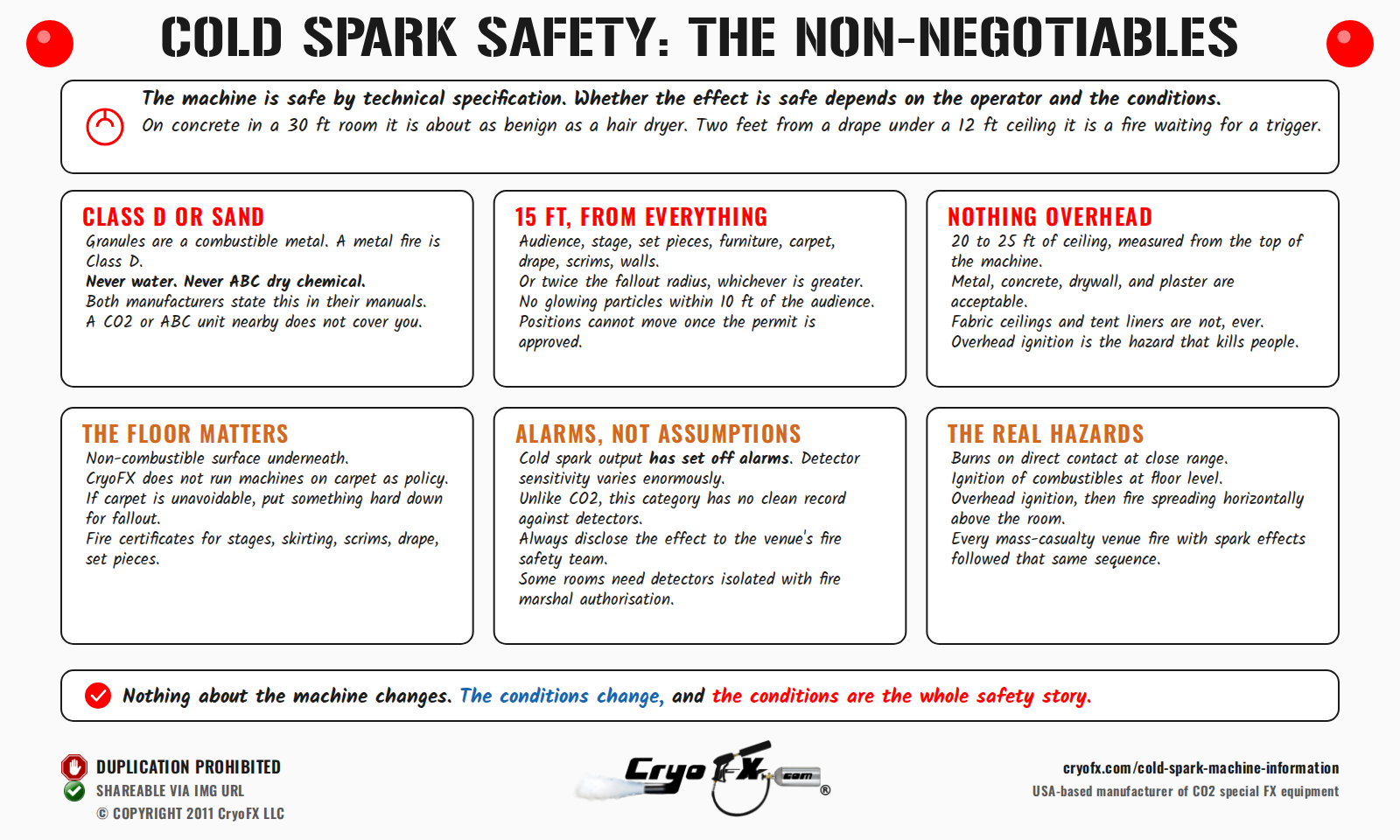
The machine is safe by technical specification. Whether the effect is safe depends entirely on the operator and the conditions.
A cold spark machine sitting on a concrete floor in a 30 foot room with nothing combustible in the fallout zone is about as benign as a hair dryer. The same machine two feet from a fabric drape under a 12 foot ceiling is a fire waiting for a trigger. Nothing about the machine changed. The conditions did.
That's the entire safety story. Read the rest of this section with that framing.
Can they start fires?
Yes. CryoFX has video on the YouTube channel of us intentionally starting fires with these machines. We built those conditions on purpose to demonstrate the material's behaviour, because the category's marketing had convinced too many people it wasn't possible.
The point of that video is not that the machines are dangerous. It's that the same conditions we constructed deliberately get constructed accidentally, by negligence, by oversight, or by an operator who didn't check what was overhead. The machine doesn't distinguish between an intentional test and a mistake.
Real hazards
Burns on direct contact. Particles are hot at emission. Skin contact at close range burns. The likelihood of a particle reaching a standing adult at proper distance is low, and it isn't zero.
Ignition of flammable material at floor level. Stray particles landing on combustible material near the base. Managed by keeping the machine on a non-combustible surface with a clear zone around it.
Overhead ignition. This is the one that kills people. Sparks travelling upward into fabric, ceiling decoration, acoustic treatment, or suspended combustibles. Every mass-casualty venue fire involving spark effects has followed this mechanism: sparks reach a combustible ceiling, the ceiling ignites, and fire spreads horizontally across the room above everyone's heads faster than they can reach an exit.
The Kočani nightclub fire in North Macedonia in March 2025 killed 63 people exactly this way. That incident involved conventional gerbs rather than cold spark machines, and the ignition mechanism was identical: titanium sparks reaching flammable ceiling material. There's no reason to believe a cold spark machine in the same position would have produced a different outcome.
In December 2025, 25 people died in a fire at a nightclub in Arpora, Goa. Investigators attributed the fire to improperly used indoor electrical firecrackers. Eyewitnesses described performers using cold pyro devices during a dance routine, with the effect contacting a ceiling built from bamboo, fibre, and palm-leaf material. Fire then spread horizontally along that ceiling. The exact device class was never established in the official finding.
In September 2023, a wedding hall fire in Qaraqosh, Iraq killed more than 100 people. The Iraqi Interior Ministry identified four pyrotechnic devices positioned in the centre of the hall, with sparks reaching roughly 4 metres. Some observers who reviewed the footage described the devices as cold pyrotechnics. The formal investigation stopped at "a fiery source touched flammable materials," and put most of its emphasis on the building's flammable sandwich-panel cladding.
At a wedding reception in the Philippines, an electric spark machine ignited dried pampas grass decoration placed next to the dance floor during the couple's first dance. Nobody was hurt. The decoration was inside the fallout zone and it shouldn't have been.
Here's the honest reading of that record. No fatal fire anywhere has been definitively attributed by investigators to a cold spark machine by name. In several of the worst incidents the device was never conclusively identified, and in others it was clearly conventional pyrotechnics or handheld sparklers. Machines catching fire, producing injurious fallout, and setting off fire alarms are documented by the American Pyrotechnics Association, which is part of why the standards changed in the first place.
The device class is the part people argue about. The mechanism is the part that matters, and it never varies. Hot metal particles reach a combustible ceiling. The ceiling ignites. Fire crosses the room overhead faster than a packed venue can empty. Every one of these fires ran that same sequence, and a cold spark machine placed under a bamboo ceiling produces the same physics as a gerb placed under one.
Required conditions
Fifteen feet of clearance. From the audience, and from everything else: stages, set pieces, furniture, carpet, drape, scrims, walls. This is a code requirement, covered in detail in the next section, and it isn't negotiable. Ceiling clearance of 20 to 25 feet. That's the CryoFX recommendation, measured from the top of the machine. Some fire departments accept 15 or less. We want enough room that the effect never approaches the ceiling under any granule size or output setting.
We've walked through venues where nightclubs are running machines that visibly hit the ceiling, with no permits and no protocols in place. That's not a code violation waiting to happen. That's a fatality waiting to happen, and it's the reason the regulatory environment keeps tightening.
Nothing combustible overhead. No fabric, paper, wood, or any other combustible material within the fallout zone. Metal, concrete, drywall, and plaster ceilings are acceptable. Stretched fabric ceilings and tent liners are not, ever.
Non-combustible surface underneath. We don't run machines on carpet as a matter of policy. If carpet is unavoidable, put something hard down underneath for fallout. Then check whether the carpet is treated, whether anything flammable is near it, and whether anything on it could ignite.
Fire certificates for everything in the zone. Stages, floors, skirting, scrims, drape, furniture, set pieces. All of it needs to be fire treated and documented.
A Class D fire extinguisher. This is the part people get wrong, and it's important enough to have its own section.
The extinguisher inversion
Cold spark granules are a combustible metal. A metal fire is a Class D fire, and it needs a Class D extinguisher, the yellow one, or clean dry sand.
Do not use water. Do not use an ABC dry chemical extinguisher. Both manufacturers state this explicitly in their manuals. Showven's says burning consumable can only be extinguished with sand. Sparktacular's says do not use water-based or ABC extinguishers on granules.
Now compare that to a conventional pyrotechnic gerb. Its safety data sheet says the exact opposite: flood the area with water, and do not use a suffocation method, because the device contains its own oxygen supply.
These two products require opposite fire responses. A gerb self-oxidises, so smothering does nothing and you drown it. Cold spark granules draw oxygen from the air, so water reacts with hot metal and makes the situation worse.
If your venue has a CO2 or ABC extinguisher near the machines and thinks it's covered, it isn't. A CO2 extinguisher nearby is useful for other things. The Class D unit is the one the code requires for this material.
That single distinction is worth more than the rest of the safety literature in this category combined, and almost nobody publishes it.
Smoke and fire alarms
Cold spark machines don't produce meaningful smoke under normal use. There's a slight fallout that becomes apparent only after multiple activations, and in most rooms it isn't visible at all.
How much fallout you get depends on grain size rather than quantity. A pack of small grain produces different fallout characteristics than the same weight of large grain.
The fire alarm question is more serious. Unlike CO2, which CryoFX has tested against photoelectric, ionisation, and laser detectors and confirmed does not trigger them, cold spark machines don't have a clean record. Detector sensitivity varies enormously between buildings, and cold spark output has set off alarms.
Always disclose spark machine use to the venue's fire safety team. Never assume the alarms won't trip. In some venues, detectors near the machine positions need temporary isolation with fire marshal authorisation, which is another reason the permit process exists.
Full safety detail is in the cold spark machine safety guide.
Permits and regulations
Cold spark machines require permits. In practical terms, everywhere.
The classification question is settled
For years the category's marketing argued these devices weren't pyrotechnics and therefore weren't regulated. That argument is dead.
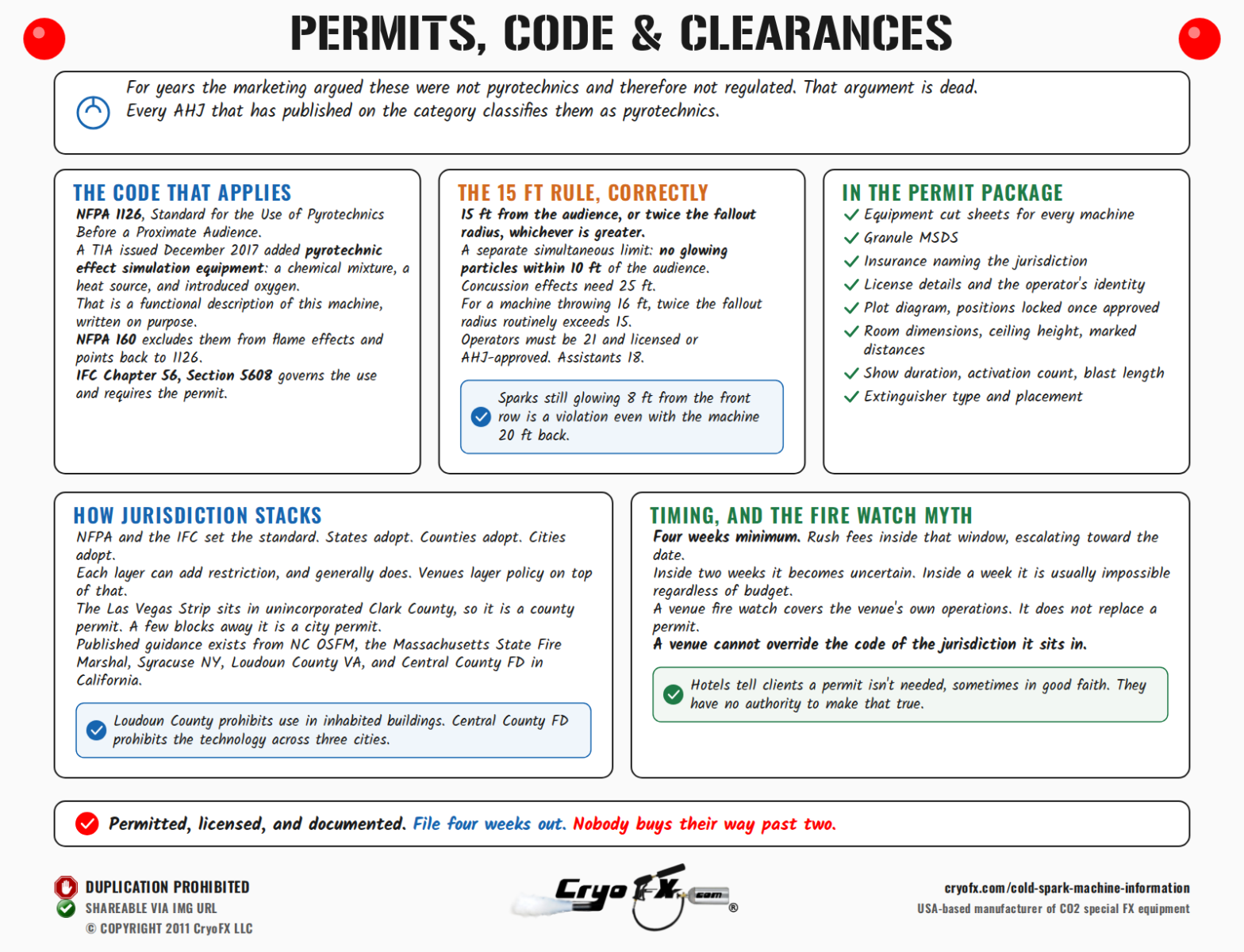
NFPA 1126, the Standard for the Use of Pyrotechnics Before a Proximate Audience, was amended by a Tentative Interim Amendment issued in December 2017 that added a new definition specifically to capture these machines. It defines pyrotechnic effect simulation equipment as equipment using a chemical mixture, a heat source, and the introduction of oxygen to initiate or maintain combustion, used to produce visible or audible effects.
Read that back against the mechanism described earlier in this guide. Metal granules, a heating element, a blower introducing air. It's a functional description of a cold spark machine, written on purpose.
That definition folds into the standard's definition of a pyrotechnic device. The companion standard covering flame effects, NFPA 160, explicitly excludes these machines from its scope and points back to 1126. The American Pyrotechnics Association has published guidance to fire authorities confirming the classification.
On the fire code side, the controlling provision is the International Fire Code, Chapter 56, Section 5608, which governs the use of pyrotechnics before a proximate audience and requires permits and compliance with NFPA 1126.
The practical consequence: a cold spark machine used in front of an audience is a pyrotechnic device, and in most jurisdictions that means a permit and a licensed pyrotechnic operator.
The 15 foot rule, stated correctly
The separation requirement is not a flat 15 feet, and quoting it that way understates it.
NFPA 1126 requires each device fired during a performance to be separated from the audience by a minimum of 15 feet or twice the fallout radius of the device, whichever is greater, unless otherwise approved by the AHJ. Concussion effects require 25 feet.
There's a separate simultaneous limit: no glowing or flaming particles within 10 feet of the audience. That one applies regardless of where the machine sits. If sparks are still visibly glowing 8 feet from the front row, you're in violation even if the machine is 20 feet back.
For a machine throwing 16 feet, twice the fallout radius routinely exceeds 15. Run the calculation for your specific machine and granule rather than defaulting to the minimum.
Operators must be at least 21 and licensed or approved by the AHJ. Assistants must be at least 18.
Code section text and clearance diagrams are reproduced in the CryoFX permit reference materials, and the full permit process is on the fire permit information for cold spark machines page.
How jurisdiction stacks
NFPA and the IFC set the standard. States adopt them. Counties adopt them. Cities adopt them. Each layer can add restriction, and generally does. It goes from less restrictive to more restrictive as you go down.
Then venues layer their own policy on top, which can be stricter still.
Las Vegas is a useful example of why you have to know which layer applies. The Strip sits in unincorporated Clark County rather than the City of Las Vegas, so it's typically a county permit. Move a few blocks and it becomes a city permit with a different process.
Buildings on state land, and schools, frequently follow state guidelines and may need city or county filing on top.
Jurisdictions that have published specific guidance on cold spark machines include the North Carolina Office of State Fire Marshal, which requires a proximate audience license. The Massachusetts State Fire Marshal issued an advisory in January 2026 stating that cold spark pyrotechnics are illegal to possess, sell, or use without licensing and permitting. Syracuse, New York requires a state pyrotechnician license plus a sprinklered building, a Class D extinguisher, a tip-over test, and 10 foot clearance to all combustibles. Loudoun County, Virginia prohibits their use in inhabited buildings entirely. Central County Fire Department in California prohibits the technology outright across three cities, citing California Health and Safety Code Section 12505, which classifies titanium and zirconium ignitable compounds as Dangerous Fireworks.
Every AHJ that has published on this classifies the devices as pyrotechnics. Not one treats them as unregulated.
Public versus private
The permit line generally follows public versus private use, and the definitions vary by jurisdiction.
Broadly: a private event on private property with no public admission may not require a permit in some jurisdictions. The moment you hire a company to bring machines in and operate them, you're generally into permit territory regardless.
This is a jurisdictional question with real legal consequences, and the definitions differ enough that we won't state a universal rule. Confirm with your local fire authority. California in particular treats this more strictly than most states.
What a permit package contains
Equipment cut sheets for every machine. Granule MSDS. Insurance certificate naming the jurisdiction. Pyrotechnic license details and the identity of the license holder and operator. A plot diagram showing exact machine positions, which cannot change once approved. Room dimensions and ceiling height. Marked distances from the machines to the stage, audience, furniture, and set pieces, demonstrating 15 feet of clearance. Show duration, activation count, blast length, and timing. Fire extinguisher type and placement. Air exchange information where the AHJ requests it.
CryoFX assembles all of it and interfaces with fire prevention directly.
Timing
Four weeks minimum. Rush fees inside that window, escalating toward the date. Inside two weeks it becomes uncertain. Inside a week it's usually impossible regardless of budget.
Are they legal everywhere?
Broadly yes, with the exception of specific jurisdictions that have prohibited them outright, like the three California cities mentioned above and Loudoun County, Virginia.
What is not legal anywhere is using them without a permit in a public setting. That's a code violation everywhere the code has been adopted, which is essentially everywhere in the United States.
Insurance requirements
Anyone providing rental or operator services with cold spark machines needs insurance, and it needs to specifically cover this activity.
What CryoFX carries
Operating insurance. Manufacturer's insurance. Professional liability covering effects design and any CAD or engineered documentation we produce. And coverage specifically for the operation, use, and sale of cold spark machines.
That last one is the piece most people don't have.
The DJ problem
A DJ running spark machines under a standard DJ policy is almost certainly uncovered. DJ insurance covers DJ activity. It does not typically extend to pyrotechnic-adjacent effects, and many carriers explicitly exclude them.
That means every time that DJ fires a machine, even if a third party filed the permit, he's personally exposed for anything that goes wrong. Most of them don't know this until something happens.
Some carriers go further. At least one insurer in the hospitality space classifies cold spark machines as an unacceptable exposure with a mandatory requirement that the insured discontinue their use.
Check your policy for explicit coverage of pyrotechnic or pyrotechnic-adjacent effects. If it isn't named, assume it isn't covered and get it in writing from your carrier.
Limits and endorsements
Typical requirements run $1 million to $2 million per occurrence for smaller events. Major venues, Las Vegas properties, and large productions commonly require $5 million per occurrence with a $10 million umbrella.
Venue, event organiser, and sometimes the client should be listed as additional insured. Confirm with each party before the event, because a COI naming the wrong entity is the same as no COI on load-in day.
Both products liability and general liability matter. Products liability covers granule-related issues. General liability covers operations and third-party property damage.
Operator versus event insurance
The operator carries their own coverage, because the operation is being performed under a pyrotechnic license by a licensed individual. That's separate from the event's own insurance, which covers the event.
Both are typically required, and the permit filing itself requires insurance naming the jurisdiction where it's filed. More detail on the cold spark machine insurance page.
Maintenance and servicing
Maintenance is what separates a machine that lasts years from one that fails in a season.
After every single use
Run the clear-out function. Most machines have a dedicated function on the DMX controller that activates only the heating element auger and the blower, without introducing new granules. That clears whatever material is sitting in the hot chamber.
CryoFX goes further. We tip the machine to empty the hopper completely, then run a full activation cycle so nothing remains anywhere in the feed path. Every machine goes back into storage in effectively new condition.
That's the whole discipline. Granules left in a machine between events compact, absorb moisture, and collect debris. Then the next show starts with a clog.
Full service every 5 to 8 uses
If the machine is being cleared properly after every use, a full teardown clean every 8 to 10 uses is fine. If it isn't, tighten that to 5.
Full service means opening the machine, clearing and wiping the heating element auger, blowing out the chamber and feed path, inspecting the augers, and confirming everything moves freely.
Never use water or liquid cleaners inside the machine. Moisture in the granule path causes both feed problems and electrical problems.
Before every show
Check that granules flow freely from the hopper without clumping. Inspect the DMX cable and connectors, which take a lot of abuse from repeated connect and disconnect cycles at venues. Check the power cable jacket for damage.
Common faults and causes
No output or weak output. Empty or moisture-damaged granules, blocked hopper feed, or auger damage.
Inconsistent output. Partially blocked feed, worn auger, or insufficient fill.
Won't power on. Power cable fault, blown fuse, or no DMX signal reaching the set address.
Height lower than normal. Motor or auger wear, low motor speed on the controller, or the wrong granule grade.
More fallout than usual. Granule overload in the chamber, wrong granule type, or the motor running hot.
Behind almost all of these sits one of the operator faults listed earlier: wrong power, wrong DMX, bad cables, control interference, contaminated granules, or a machine that never got cleaned.
Repair
Every component in these machines is replaceable. Heating elements, hoppers, blowers, boards, augers. CryoFX stocks all of them and sells them for multiple brands.
If a board fails, the board gets replaced. If a heating element fails, only the element usually needs replacing, and those are on the CryoFX site for a range of brands.
We publish repair and diagnostic videos on the CryoFX YouTube channel covering how to test a machine, what to test, how to identify a fault, and how to carry out the repair. As far as we know we're the only company doing that. It costs us some service revenue and it saves owners a great deal more, which is a trade we're happy with.
Full procedures on the cold spark machine maintenance page.
Cold spark machines vs conventional pyrotechnics
What's actually different
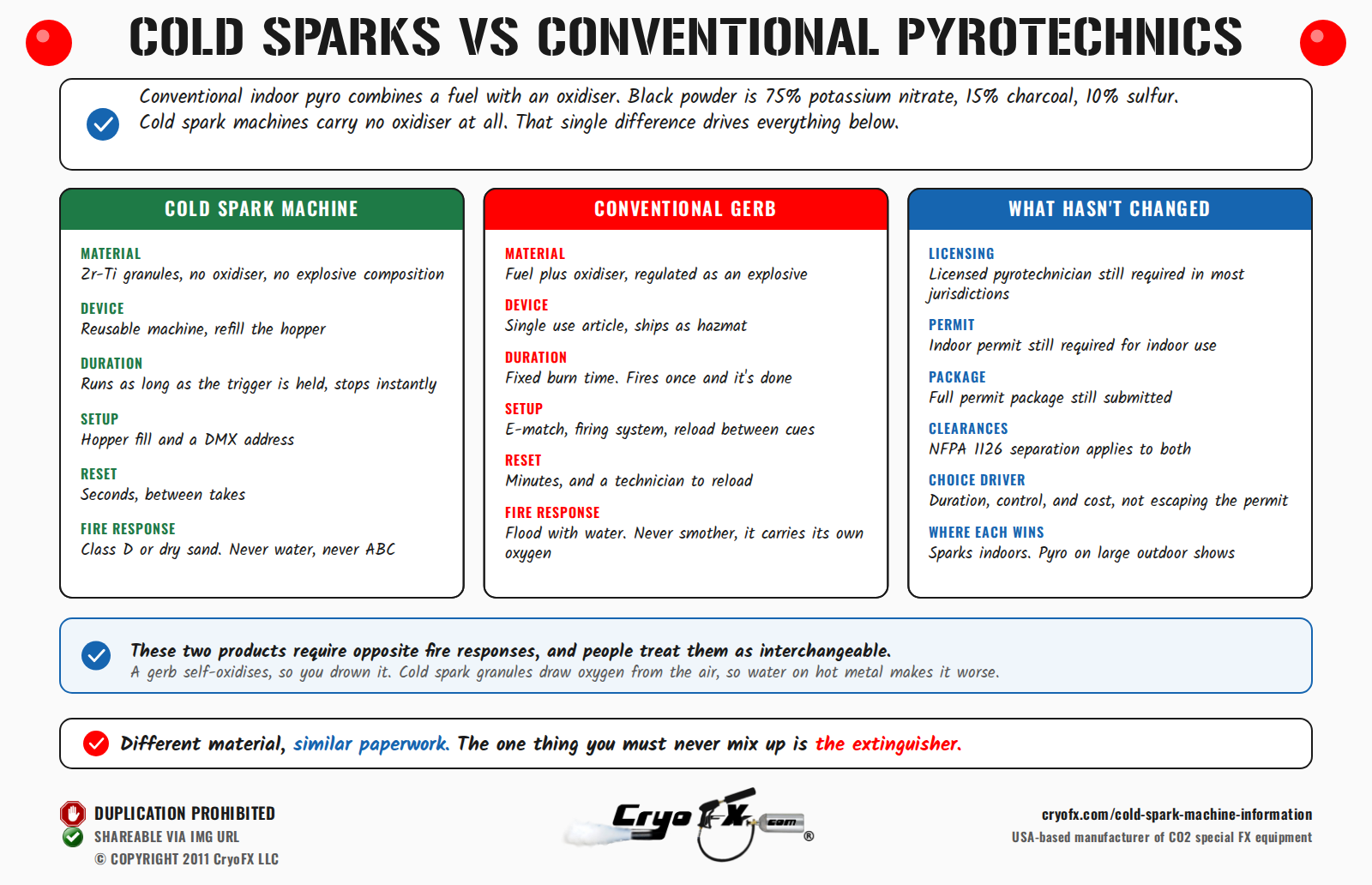
Conventional indoor pyrotechnics, mines, gerbs, and indoor sparkle effects, use a chemical composition combining a fuel with an oxidiser. Black powder, for reference, is 75% potassium nitrate, 15% charcoal, and 10% sulfur, where the nitrate is the oxygen source. Those devices are regulated as explosives, ship under a hazardous materials classification, and require licensed operators and permits with advance approval.
Cold spark machines use metal granules with no oxidiser, no explosive composition, and no gunpowder. The device is a reusable machine rather than a single-use article. Permitting is generally simpler, though it is absolutely still permitting.
The four differences that matter operationally
Duration and control. A gerb has a fixed burn time. It fires once and it's done. A cold spark machine runs as long as the operator holds the trigger, stops instantly, and re-fires immediately. Getting the equivalent of one spark machine cycling repeatedly through a show would take multiple gerbs and multiple e-match setups.
Setup overhead. Indoor pyro needs electric matches, firing systems, and physical device loading between cues. A spark machine needs a hopper fill and a DMX address.
Reset time. On a TV set, a spark machine resets between takes in seconds. Pyro resets in minutes and needs a technician to reload.
Fire response. Already covered above and worth repeating: gerbs get flooded with water and must never be smothered. Cold spark granules need Class D or sand and must never get water or ABC. Opposite responses for products people treat as interchangeable.
What hasn't changed
The compliance overhead is closer than the marketing suggests. In most jurisdictions, you still need a licensed pyrotechnician, still need an indoor permit for indoor use, still need the operator licensed for indoor pyro, and still need to submit a full permit package.
Which means the choice between a machine and conventional pyro usually comes down to how long you want the effect to run, how much control you want, how many times it fires during the show, and cost. It rarely comes down to escaping the permit.
Where each one wins
Cold spark machines win indoors, where conventional pyro permitting would be prohibitive, where ceiling height and structure make conventional indoor pyro impractical, and on productions that want a repeatable pyrotechnic-style visual without single-use consumables.
Conventional pyrotechnics win on large outdoor shows where scale and brightness are the point, where the artistic specification calls for a specific colour, flash, or concussion that granules can't produce, and where a production specifically wants the visual character of real pyro.
Detail on the cold spark machines vs pyrotechnics comparison page.
Terminology: cold sparks, cold fireworks, and everything else
Every one of these terms refers to the same category of device: cold spark machine, cold sparks, cold fireworks, cold fireworks machine, Sparkular, Sparktacular, cold pyro machine, spark fountain, cold spark fountain, indoor fireworks machine, wedding sparks.
Why there are so many names
The category reached mass market around 2015 and 2016, which is recent. No industry-standard name got established early, so manufacturers and markets each adopted their own.
Sparkular achieved brand dominance in the US wedding market. Cold fireworks became the common term internationally. Cold pyro is preferred on touring production riders. Spark fountain shows up in venue and planner conversations.
Underneath it, there's a deliberate marketing motive. Companies coin their own name to look distinct, capture their own search traffic, and avoid competing directly on a term someone else already owns. That's normal product marketing and it's the reason this particular category ended up with a dozen labels for one box.
Brand versus category
Sparkular is a brand. Cold spark machine is the category. Every Sparkular is a cold spark machine. Not every cold spark machine is a Sparkular.
Same logic for Sparktacular and every other brand name in this space.
One more overlap to know
"Cold sparks" occasionally gets used to mean the handheld sparklers people hold at weddings. It's not common, and it's not correct, but it happens. If a client says cold sparks, confirm which one they mean before you quote.
What buyers should actually ask
The name matters far less than the specifics. Ask the supplier what specific machine model is being provided, what its output height is, what DMX integration it has, what granule it takes, and whether they stock parts for it.
A supplier who can answer all five is a supplier worth using. One who only wants to talk about the brand name isn't.
More at cold fireworks wiki.
Cold spark machines for weddings
Which machine
Regular or mini. Mini machines are the most common wedding choice: easy to place, easy to control, and sized correctly for reception rooms. Two or four of them, on DMX or a wireless remote.
How many, and where
Two to four covers almost every wedding.
For the ceremony, machines flanking the wedding party. For the reception, the grand entrance is the highest-impact placement: two machines on either side of the entrance path, roughly 6 to 8 feet apart, fired simultaneously as the couple walks through. The two fountains form a visual archway and it's the shot that ends up on every wall.
For the first dance, either four machines at the corners of the dance floor or two flanking the couple, timed to a climax in the song. The couple framed between two spark fountains is among the most-captured moments in wedding photography.
Cake cutting takes two machines flanking the cake table, fired at the moment of the first cut. The exit takes machines lining the departure path.
Roughly by guest count: under 100 guests, 2 machines. 100 to 200, 4 machines. Over 200, 6 to 8 with multiple activation points.
Every position has to clear 15 feet from guests and from everything else, and the machines can't move once the permit is approved. That constraint drives the design more than aesthetics do, and it's why the walkthrough happens before the plan is finalised.
Combining with other effects
Cold sparks pair well with almost everything. Ground fog or dry ice under the first dance puts low-lying cloud beneath the couple with spark fountains above. Confetti on a finale. A CO2 cannon on the entrance. Handheld sparklers for the exit.
The layered look is what separates a wedding that had an effect from a wedding that was designed.
Venue reality
Some venues allow it with a permit and a COI. Some prohibit it outright regardless of what the fire department says, because their insurance or their internal policy says no. Some have low ceilings or fire suppression systems that can't be isolated.
Most venues don't understand the permit requirements at all, which cuts both ways. Sometimes they wrongly say a permit isn't needed. Sometimes they wrongly say the effect isn't allowed.
Confirm with the venue coordinator at least 4 weeks out. If the answer is no, CO2 effects have no fire or flame component at all and are the appropriate alternative for a venue that won't approve sparks.
Full planning guidance in the cold spark machine for weddings guide.
Cold spark machines for concerts and stage
Covered partly above. The specifics that matter for production:
Positioning. Downstage edge flanking the artist, drum riser, or mid-stage for a wall effect. Six to twelve machines across a full downstage edge produces the wall-of-sparks look, and that requires real power planning.
Power. Machines in this category run from 400 watts up to 3,200 watts. Most working machines land between 400 and 800. High-output units run 1,100 to 1,700, and the largest need 220 volt power that a US venue may not have where you want it.
Work the arithmetic before you place anything. Amps equals watts divided by volts. A 500 watt machine on 110 volts draws about 4.5 amps. Four of those puts you at 18 amps, which is the practical ceiling on a 20 amp circuit. A fifth trips it.
We run circuits at 16 to 18 amps as a working maximum rather than pushing to 20, because startup inrush across multiple machines is where breakers actually trip. Add a 20% safety factor to the nameplate figure and plan from there.
A single high-output machine drawing 1,700 watts pulls about 15.5 amps at 110 volts, which needs its own dedicated 20 amp circuit and nothing else on it.
Full worked examples in the cold spark machine power requirements guide.
Show integration. Cues sit in the show file alongside lighting and audio. Timing is usually reserved for song peaks unless the LD wants heavier use, which happens more on rock shows. Productions typically run a cue-by-cue pass identifying which effects fire in which songs, so the operator knows the show.
If the operator doesn't know the material, someone from the touring production cues them. That's normal and it works.
Wind outdoors. If wind is high enough that sparks could leave the 15 foot radius, the effect gets cut. That's a safety call and it isn't negotiable.
Cold spark machines for nightclubs
Detail beyond the earlier section:
Two operating models. Per-booking rental for a specific headliner, or built into the permanent production. Clubs running them nightly generally employ a license holder and maintain a running permit for nightly activation.
Typical positions. DJ booth, hanging units behind the production rig, near the LED wall.
VIP service. The effect highlights the table. The machines usually aren't at the table, because a club floor rarely has 15 feet of clearance anywhere near a table. Some clubs do install at VIP positions, and where they do, the position holds proper distance from patrons.
DMX. Machines link to each other and run from the booth on their own universe, separate from house lighting.
Granule supply. Nightclubs buy granules in bulk, the same way they buy confetti. Build the consumption number into the operating model before committing to permanent installation, using the weekly math from the pricing section.
Permits. Same requirements as any other use. Some jurisdictions issue a blanket permit for ongoing nightly operation, renewed periodically and requiring fire prevention oversight on the planning and review.
More in the cold spark machine for nightclubs guide.
Choosing the right machine
Answer these before you look at any product page.
What's the primary use: wedding, club, concert touring, corporate, or permanent installation? Indoor or outdoor? What's the ceiling height at the position you'll actually use? Is DMX control required? How often will it run? What's the budget for the machine and for ongoing granule supply? Does granule sourcing flexibility matter to you, or are you fine with an RFID-metered machine?
Quick guidance by use case:
Weddings, occasional use. A mini or standard machine with DMX and a compact footprint. Ceiling height in typical reception venues is the binding constraint, which is why minis dominate here.
DJ or event production company, weekly use. A standard machine with a high duty cycle and reliable DMX, plus a flight case. The case pays for itself the first time a machine survives a load-out it wouldn't have.
Nightclub permanent installation. Highest duty cycle available, a granule supply agreement, and permanent DMX integration on a dedicated universe.
Touring production. Road-cased machines with a proven track record, spare parts availability, and a manufacturer who answers the phone. Redundancy matters more than peak spec.
Corporate AV. Machines with a complete documentation package available, because hotel and venue fire safety departments will ask for it and the deal stalls if you can't produce it.
Full decision framework in the cold spark machine buyer guide.
Cold fireworks: international terms and markets
Cold fireworks is the term used through much of the world for what the US market calls a cold spark machine.
Demand is enormous in India and across Southeast Asia, especially for weddings, and the search volume around cold fireworks online India and cold fireworks price in India reflects that. Part of the reason is regulatory: several markets have more permissive rules than the US, and access to machines is correspondingly easier.
CryoFX serves international inquiries and advises on sourcing.
The same quality and documentation questions apply anywhere. Cheap unbranded machines from direct importers carry higher risk of inconsistent output, no usable documentation for permits, and no support when something fails. Some certifications transfer between markets, some don't, and some markets won't ask.
A caution for anyone using the phrase
If you describe yourself as a cold fireworks supplier, be explicit that you supply cold spark machines and not fireworks.
Selling fireworks is a separate licensing category with federal oversight. Marketing copy that reads as a claim to sell fireworks can attract attention from the ATF that you don't want and didn't intend. That's worth flagging to anyone in this business, not just as a CryoFX position.
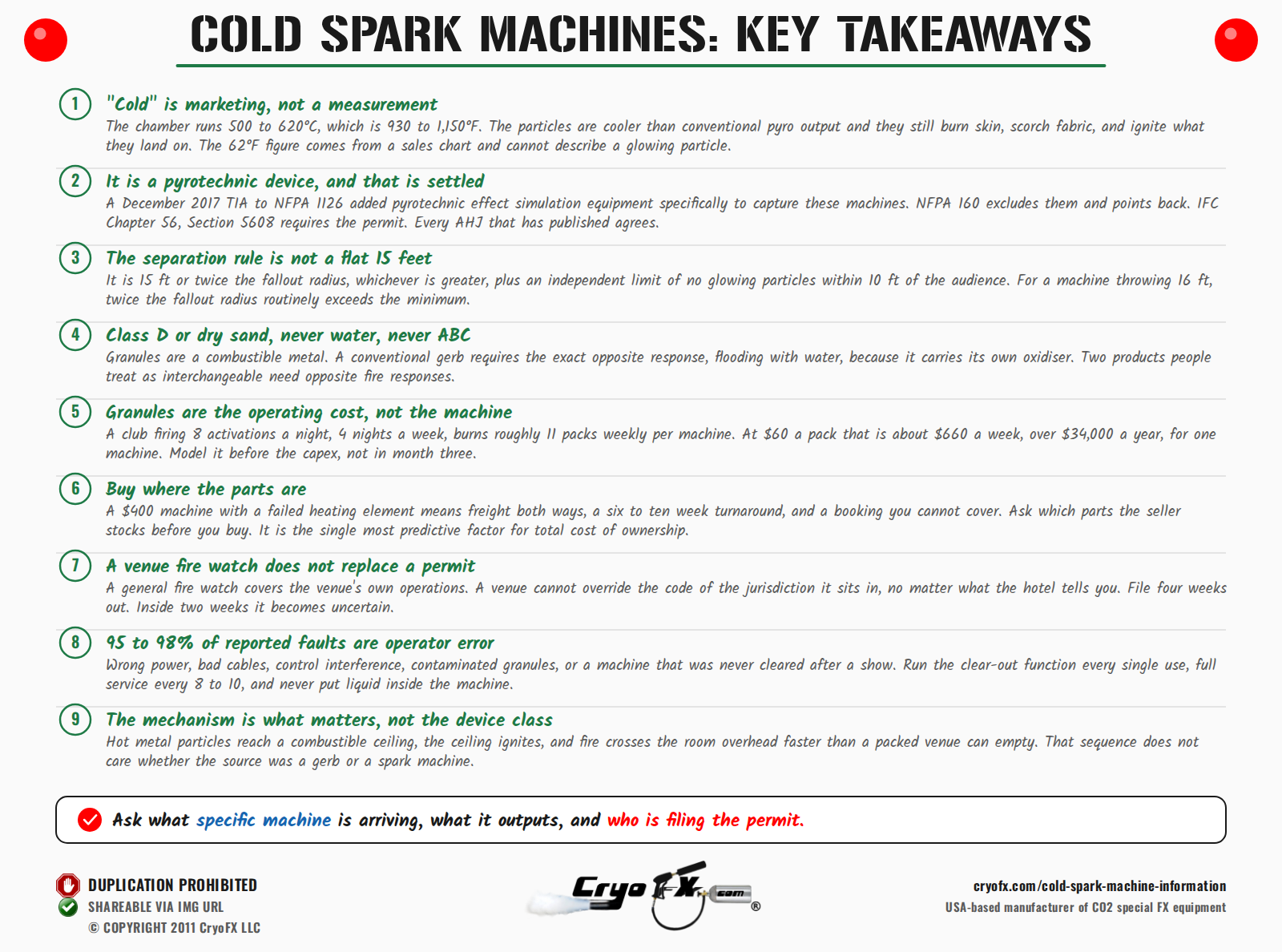
Frequently asked questions
What is the difference between a Sparkular and a cold spark machine? Sparkular is a brand name owned by Showven. Cold spark machine is the category. Every Sparkular is a cold spark machine, and most cold spark machines are not Sparkulars. The brand became a generic term the way Xerox did, which is why people use it to mean any machine in the category.
Do cold spark machines produce real fire? They produce real heat and real glowing metal particles capable of igniting anything flammable they land on. There's no flame front, so it isn't fire in the strict sense. Functionally it behaves the same way. CryoFX has video demonstrating these machines starting fires under controlled conditions.
Are cold spark machines safe indoors? Yes, when operated correctly with proper clearances, a permit, and a licensed operator. The machine is safe by specification. Whether the effect is safe depends on the operator and the conditions. Fifteen feet of clearance from everything, 20 to 25 feet of ceiling height, nothing combustible overhead, and a Class D extinguisher on hand.
Do cold spark machines require a permit? In practical terms, yes, everywhere. NFPA 1126 classifies them as pyrotechnic devices, and the International Fire Code requires permits for pyrotechnics used before a proximate audience. Most jurisdictions also require a licensed pyrotechnic operator. Private events on private property vary by jurisdiction, so confirm with your local fire authority.
How high do cold sparks shoot? Mini machines reach 8 to 12 feet. Standard machines reach 12 to 18 feet. High-output machines exceed 30 feet. Jet-style machines throw a burst 25 to 30 feet rather than a steady stream. Height depends on the machine, the granule grain size, and the operator's output setting.
What temperature do cold spark machines run at? The heating chamber runs between roughly 500 and 620 degrees Celsius, which is 930 to 1,150 Fahrenheit. Emitted particles are cooler than conventional pyrotechnic output and cool rapidly in air, and they're still hot enough to burn skin and ignite flammable material. Any claim that the sparks are near room temperature is marketing, not measurement.
What fire extinguisher do cold spark machines require? A Class D extinguisher, the yellow one, or clean dry sand. Cold spark granules are a combustible metal, and a metal fire is Class D. Never use water or an ABC dry chemical extinguisher on burning granules. Conventional pyrotechnics require the opposite response, water rather than smothering, because they carry their own oxidiser.
How much does a cold spark machine cost? Professional machines run from around $700 or $800 at the entry point up to $4,000 or $5,000 at the top, depending on output height, features, and build. Rental runs $250 to $450 per machine for standard units, more for high-output or moving machines. Granules run about $35 for a 50 gram pack and $55 to $65 for 200 grams.
How long does a bag of cold spark granules last? A 200 gram pack gives roughly 12 to 15 minutes of cumulative effect on a standard machine. A 50 gram pack gives 3 to 4 minutes on a mini. High-output machines burn material much faster, around 70 grams a minute. Most machines time out at 30 seconds per activation, so plan by activation count rather than total minutes.
Do cold spark machines need electricity, and can they run on battery? They need AC power. Battery bases are available and CryoFX supplies them on request even where they aren't listed on the site. Use the battery base designed for the machine rather than a generic pack from Amazon, because the purpose-built units match the amperage and watt draw, hold runtime, and physically seat the machine on top.
Can cold spark machines be used on carpet? They can, with care, and CryoFX generally doesn't. If carpet is unavoidable, put a hard non-combustible surface down underneath for fallout, then confirm the carpet is fire treated and that nothing flammable sits near it.
Can cold spark machines be used near children? No. Children reach into the sparks and get burned. Keep them away from the machines and the fallout zone entirely.
Do cold spark machines set off fire alarms? They can. Unlike CO2, which CryoFX has tested and confirmed does not trigger photoelectric, ionisation, or laser detectors, cold spark output has set off alarms in some venues. Detector sensitivity varies enormously. Always disclose the effect to the venue's fire safety team rather than assuming.
How many cold spark machines can run on one circuit? Divide the machine's wattage by the voltage to get amps. A 500 watt machine on 110 volts draws about 4.5 amps, so four machines put you at 18 amps, which is the working maximum on a 20 amp circuit. We run circuits at 16 to 18 amps rather than pushing to 20, because startup inrush across multiple machines is where breakers trip.
Can I rent a cold spark machine without an operator? Sometimes, under specific conditions. CryoFX needs the event date and time, location, who's operating, whether it's public or private, activation count and timing, blast duration, and a venue plot diagram. That determines whether a pyrotechnic license is required and whether self-operation is legal at that location.
Buyer checklist
Work through this before you request a quote. It's the same list we work through on a call, and having answers ready shortens the process considerably.
Intended use: wedding, nightclub, touring, corporate, or permanent installation.
Indoor or outdoor.
Ceiling height at the exact position the machine will sit, measured rather than estimated.
Number of machines and their positions, with 15 feet of clearance confirmed from guests and from every set piece, drape, and surface.
DMX control required, or wireless acceptable.
Power availability at each position, and the circuit capacity feeding it.
Permit requirements for the jurisdiction, and confirmation of the venue's own policy.
Granule supply: through CryoFX or self-sourced, and whether the machine has an RFID card requirement.
Operator: self-operated or CryoFX-staffed, and whether a pyrotechnic license holder is required in that jurisdiction.
Documentation the venue's fire safety department will require.
Delivery timeline, working backward from the 4-week permit window.
Budget across three lines rather than one: machine purchase or rental, granule consumption, and labour plus permit coordination.
When you've got those answers, Sparkular machine pricing and availability along with the full iSparkFX range is on the CryoFX product catalogue, and our team can size a package to the venue and the show.
Request a quote, schedule a consultation, or view current rental availability. If you're not sure which direction to go, the consultation is the faster path, because the answer usually turns on the venue rather than the machine.
Updated - 07/29/2026.