Cold Spark Machine Power Requirements: Watts, Amps, And Circuits That Hold
Cold Spark Machine Power Requirements and Amp Draw | CryoFX
Cold Spark Machine Power Requirements: Watts, Amps, And Circuits That Hold
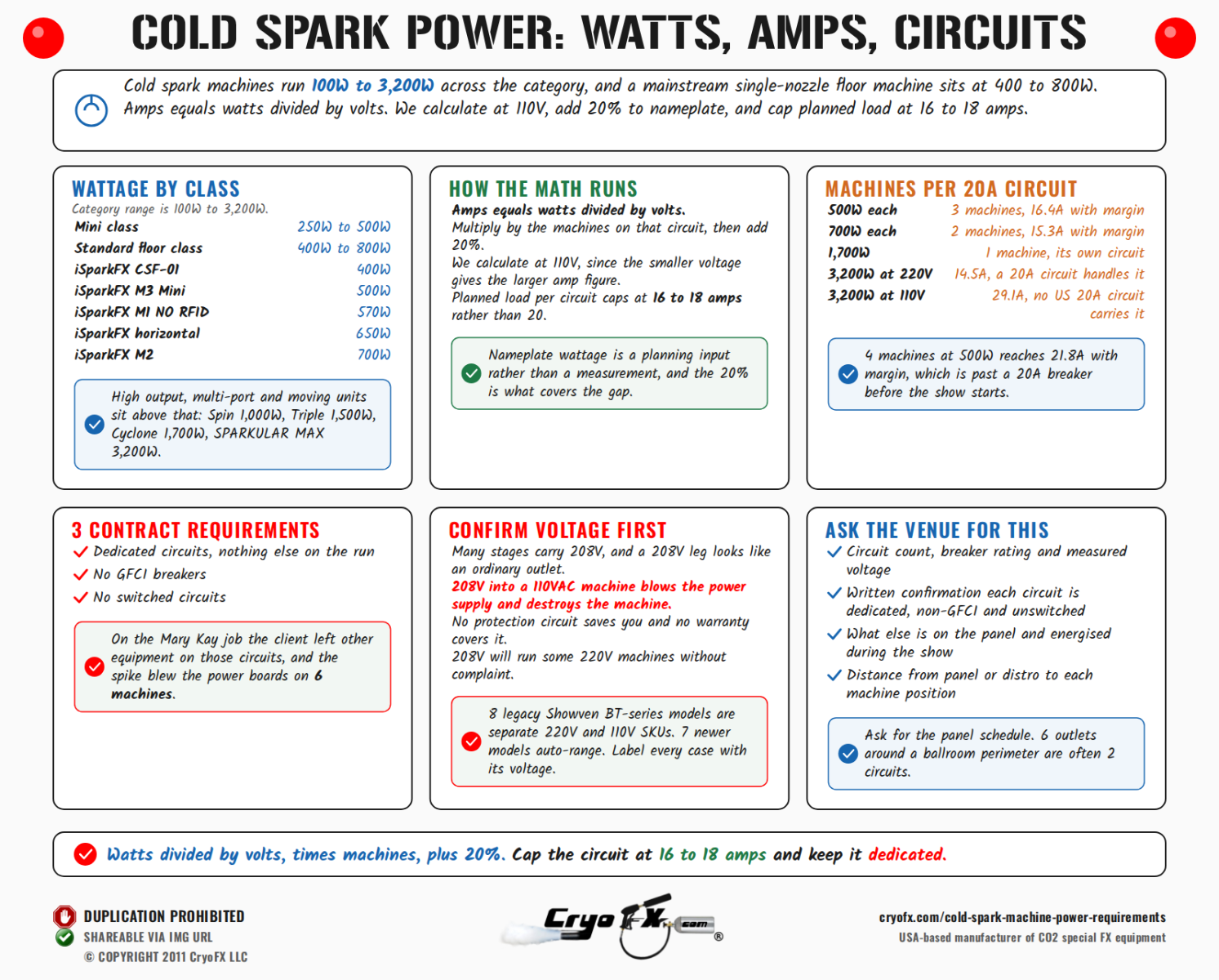
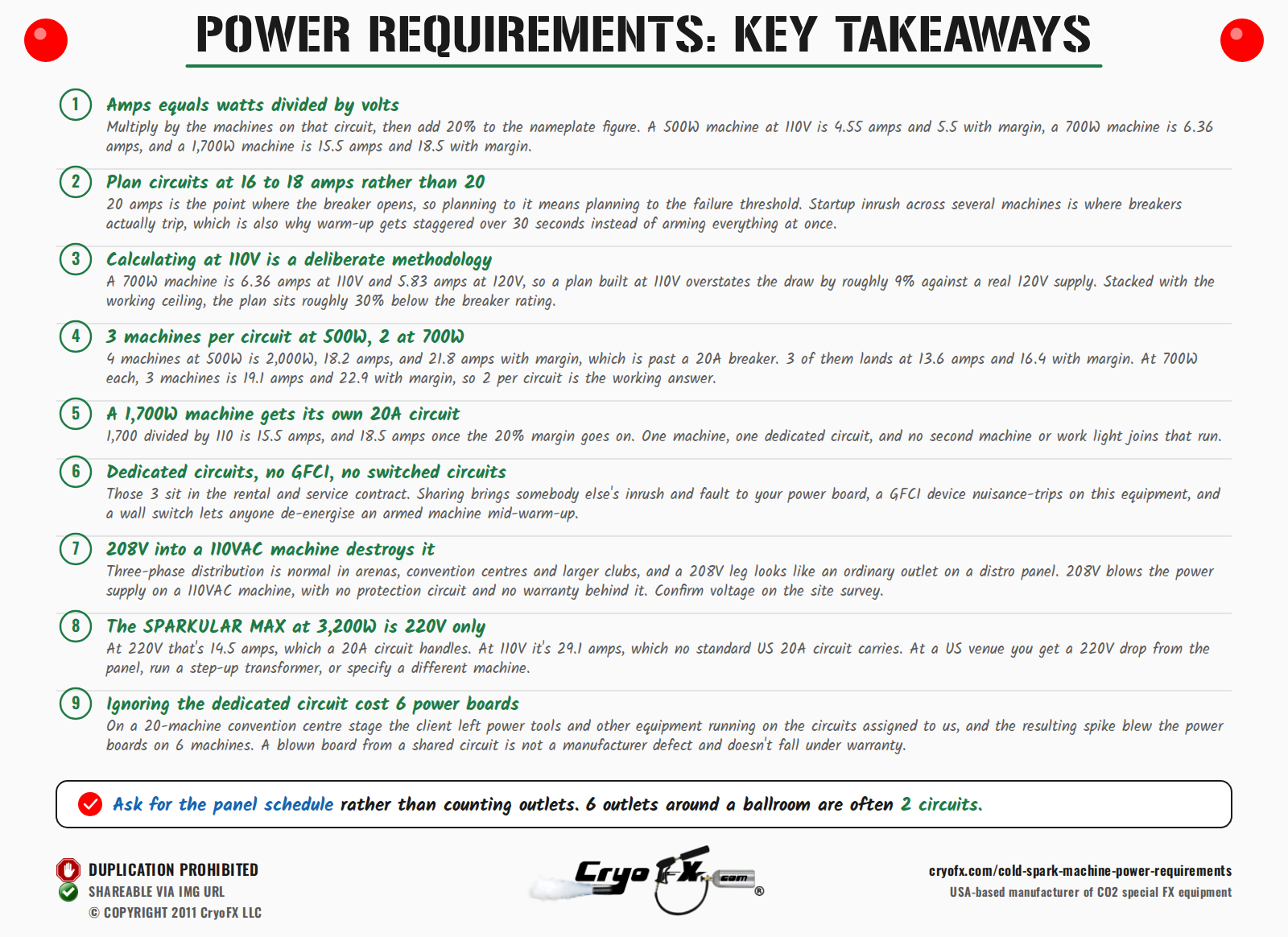
Cold spark machines run from 100W to 3,200W across the category, and a mainstream single-nozzle floor machine sits at 400 to 800W. Amps equals watts divided by volts, we calculate at 110V, and we add 20% to nameplate. Planned load per circuit is capped at 16 to 18 amps rather than 20.
Every number below is shown with the arithmetic, because the arithmetic is what a venue electrician and a plan reviewer both want to see.
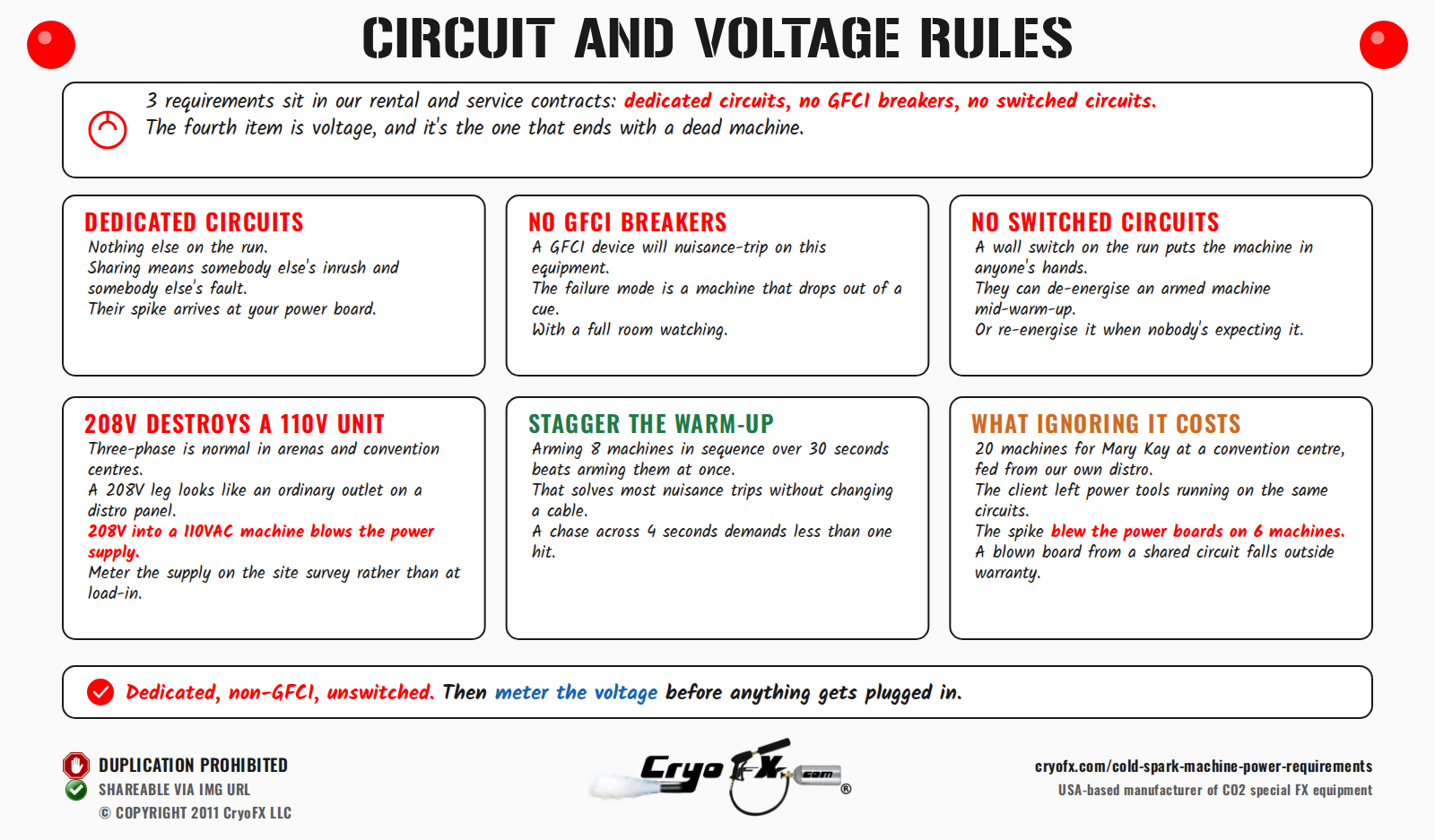
3 requirements sit in our rental and service contracts and they aren't negotiable. Dedicated circuits with nothing else on the run. No GFCI breakers. No switched circuits. The rest of this page is the reasoning behind them, including the job where the requirement was ignored and it cost 6 power boards.
Wattage by machine class
Mini class, 250W to 500W. The iSparkFX M3 Mini is 500W. The discontinued M4 Mini was also 500W, and the M3 Mini has taken its place. Showven's Mini Fall is 250W and the Sparkular Mini is 380W.
Standard floor class, 400W to 800W. iSparkFX CSF-01 at 400W, M1 NO RFID at 570W, horizontal side-spark at 650W, M2 at 700W. Showven's base SPARKULAR is 500W, the Fall is 500W, the Pro is 600 or 700W depending on configuration, and the Jet is 350W.
High-output, multi-port and moving units, 1,000W to 3,200W. Showven's Spin is 1,000W, the Triple is 1,500W with 3 nozzles, the Wheel is 500W despite rotating 360 degrees, the Cyclone is 1,700W, and the SPARKULAR MAX is 3,200W.
Two loads inside the machine account for nearly all of it. The heating element holds the chamber at temperature, and the blower motor throws the material out. The augers draw very little by comparison. The pillar guide on how cold spark machines work covers the internals, and the practical consequence for power planning is that a machine's heaviest draw is during warm-up and the first seconds of each activation.
Treat nameplate wattage as a planning input rather than a measurement. It's a nominal figure that doesn't account for supply voltage variation at the venue, cable length, or the surge when a cold element and a stopped motor both start at once. That's what the 20% margin is for.
The amps calculation
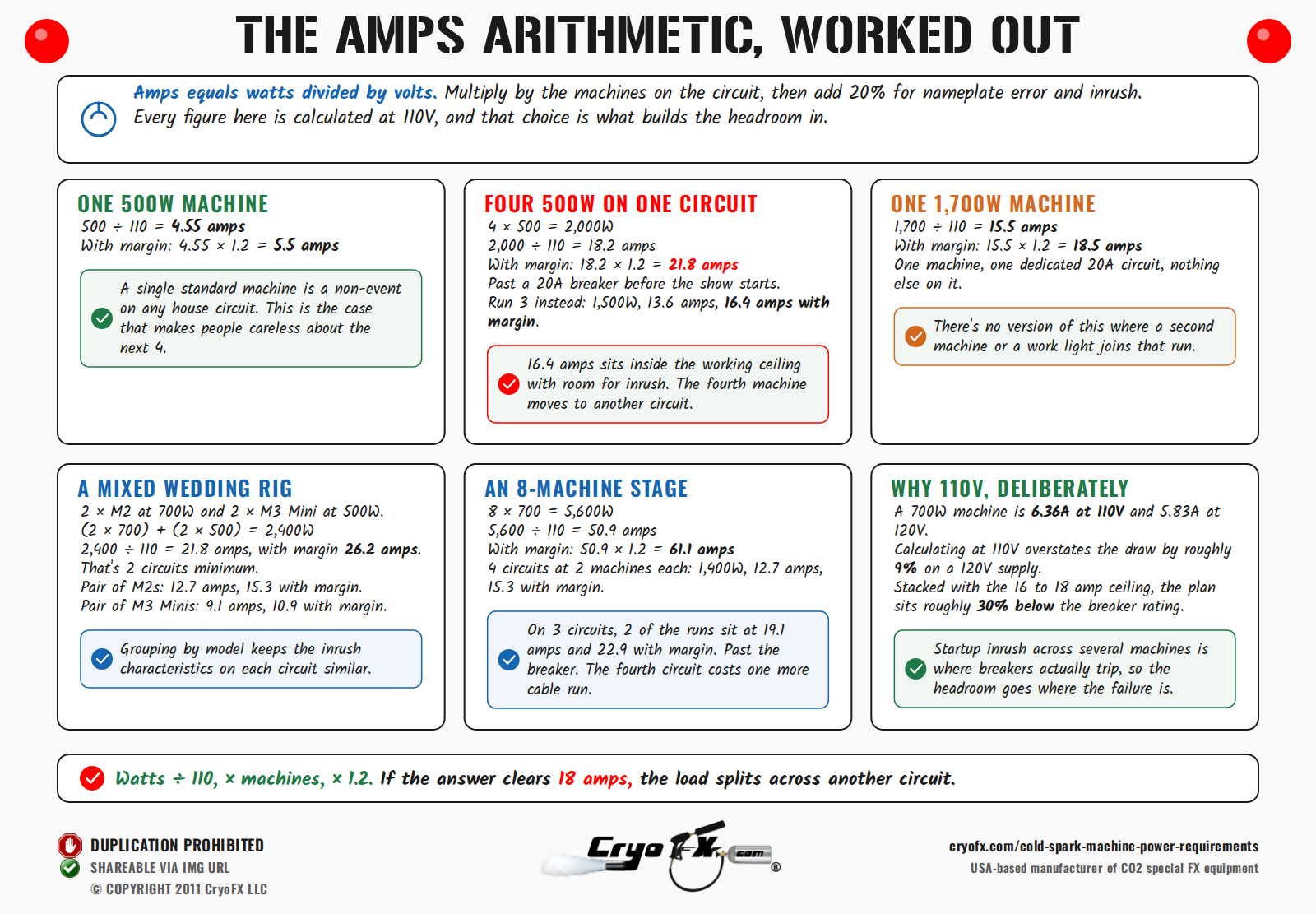
Amps equals watts divided by volts. Then multiply by the number of machines on the circuit, then add 20%.
Why we calculate at 110V, deliberately
Dividing by the smaller voltage gives the larger amp figure. A 700W machine is 6.36A at 110V and 5.83A at 120V, so calculating at 110V overstates the draw by roughly 9% against a real 120V supply.
That error runs in the direction we want. Every circuit plan built at 110V carries about 9% of hidden headroom on a 120V house circuit before the 20% margin is even applied. Stacked with the 16-to-18-amp working ceiling, we're planning to roughly 30% below the breaker rating.
This is a deliberate methodology rather than a rule of thumb, and it's the reason our circuit plans survive contact with venues whose supply sags under a full lighting rig.
Worked example 1, one standard machine
A 500W machine on 110V.
- 500 ÷ 110 = 4.55 amps
- With margin: 4.55 × 1.2 = 5.5 amps
A single standard machine is a non-event on any house circuit. This is the case that makes people careless about the next 4.
Worked example 2, four machines on one 20A circuit
4 machines at 500W each.
- 4 × 500 = 2,000W
- 2,000 ÷ 110 = 18.2 amps
- With margin: 18.2 × 1.2 = 21.8 amps
21.8 amps is past a 20A breaker before the show starts. The load we'd actually run on that circuit is 3 machines:
- 3 × 500 = 1,500W
- 1,500 ÷ 110 = 13.6 amps
- With margin: 13.6 × 1.2 = 16.4 amps
16.4 amps sits inside the working ceiling with room for inrush. The fourth machine moves to another circuit.
Worked example 3, a high-wattage machine on its own circuit
A 1,700W machine, which is the Cyclone class.
- 1,700 ÷ 110 = 15.5 amps
- With margin: 15.5 × 1.2 = 18.5 amps
One machine, one dedicated 20A circuit, nothing else on it. There's no version of this where a second machine or a work light joins that run.
Worked example 4, a mixed rig
2 × M2 at 700W and 2 × M3 Mini at 500W, which is a common wedding or corporate package.
- Total: (2 × 700) + (2 × 500) = 2,400W
- 2,400 ÷ 110 = 21.8 amps
- With margin: 21.8 × 1.2 = 26.2 amps
That's 2 circuits minimum. The split:
- Pair of M2s: 1,400 ÷ 110 = 12.7 amps, with margin 15.3 amps
- Pair of M3 Minis: 1,000 ÷ 110 = 9.1 amps, with margin 10.9 amps
Both inside the ceiling, and grouping by model keeps the inrush characteristics on each circuit similar.
Worked example 5, an 8-machine stage
8 machines at 700W, a festival stage flank or a dance floor surround.
- 8 × 700 = 5,600W
- 5,600 ÷ 110 = 50.9 amps
- With margin: 50.9 × 1.2 = 61.1 amps
Split across 4 circuits at 2 machines each: 1,400W per circuit, 12.7 amps, 15.3 amps with margin.
Running it off 3 circuits would put 2 circuits at 3 machines and 1 at 2 machines, so the loaded circuits sit at 19.1 amps with margin 22.9 amps. Past the breaker. The fourth circuit costs one more run of cable and removes the failure entirely.
[INSERT WATTAGE-TO-AMPS TABLE INFOGRAPHIC BY ISPARKFX MODEL, WITH MACHINES-PER-20A-CIRCUIT COLUMN HERE]
Why we cap circuits at 16 to 18 amps
A 20A breaker rating is the point at which the breaker opens. Planning to it means planning to the failure threshold.
Startup inrush across multiple machines is where breakers actually trip. Steady-state draw during a 20-second activation is rarely the problem. The problem is 4 cold elements and 4 stopped blower motors all pulling their heaviest current in the same 2 seconds because somebody armed the rig from a single console command.
Venue circuits are also rarely as dedicated as the drawing suggests. The outlet you're using is on a run that may already carry a vending machine, a beer cooler, a cleaner's vacuum at 6am, or the AV company's laptop cart. Capping planned load at 16 to 18 amps absorbs both the surge and whatever the building quietly plugged in.
Cable length adds to it. Long extension runs at load-in drop voltage, and a machine seeing less voltage draws more current to hold the same power. 100 feet of undersized cable turns a comfortable plan into a nuisance trip.
Dedicated circuits, no GFCI, no switched circuits
These 3 requirements are in the contract for a reason each.
Dedicated circuits. Nothing else on the run. Sharing means somebody else's inrush, somebody else's fault, and somebody else's spike arriving at your power board.
No GFCI breakers. A GFCI device will nuisance-trip on this equipment, and the failure mode is a machine that drops out of a cue with a full room watching.
No switched circuits. A circuit fed through a wall switch means anyone in the room can de-energise an armed machine mid-warm-up, or re-energise it when nobody's expecting it. Neither belongs anywhere near a spark rig.
The Mary Kay job, and what ignoring this costs
We ran 20 machines for Mary Kay at a convention centre, 8 minis with the rest full size, minis centre and full size outer, across a stage roughly 100 feet side to side plus a 20-foot runway 4 feet wide. Power was specified the way it always is: dedicated circuits with their own distro pulled from the main.
The client didn't hold the dedicated-circuit requirement. Power tools and other equipment were left running on the same circuits. The resulting spike blew the power boards on 6 machines.
[INSERT MARY KAY 20-MACHINE CONVENTION CENTRE STAGE IMAGE HERE]
6 boards is a real number attached to a real invoice. It's also the most avoidable fault in this entire category, because a blown board from a shared circuit is not a manufacturer defect and doesn't fall under warranty. Fault-by-fault diagnosis, including power-related board failure, is covered on the maintenance and fault diagnosis page.
Inrush on simultaneous startup
Stagger warm-up. Arming 8 machines in sequence over 30 seconds instead of all at once solves most nuisance trips without changing a single cable.
The same logic applies at cue level. Firing 8 machines on one hit is a bigger instantaneous demand than running them as a chase across 4 seconds, and the chase often looks better anyway on a wide stage.
Where the design does need all machines on one hit, that's a reason to spread them across more circuits rather than fewer, and to say so in the power request rather than discovering it during the first full run.
Voltage: the warning that destroys machines
Confirm machine voltage against the venue supply before anything is plugged in. This is a site survey item and it does not belong at load-in.
Many stages carry 208V. Three-phase distribution is normal in arenas, convention centres and larger clubs, and a 208V leg looks like an ordinary outlet on a distro panel.
208V will run some 220V machines without complaint. 208V into a 110VAC machine will blow the power supply and destroy the machine. There's no protection circuit that saves you and no warranty that covers it.
The Showven range makes this worse than it needs to be. 8 of the legacy BT-series models, which is SPARKULAR, mini, FALL, TRIPLE, Cyclone, SPIN, JET and SPARKULAR II, are not dual-voltage units. They're separate 220V and 110V SKUs and voltage has to be specified at order. 7 of the newer models auto-range. If you own a mixed fleet, label every machine with its voltage on the outside of the case.
For international and touring work, ask for the supply spec in writing, ask what's on the leg you've been assigned, and meter it yourself before you plug anything in.
220V-only machines at a US venue
The SPARKULAR MAX at 3,200W is 220V only. It's the one model in the Showven range with no 110V option, and it's also the tallest at 5 to 15 m, roughly 50% above the next-tallest unit.
The arithmetic explains why there's no 110V version:
- At 220V: 3,200 ÷ 220 = 14.5 amps, which a 20A circuit handles
- At 110V: 3,200 ÷ 110 = 29.1 amps, which no standard US 20A circuit carries
At a US venue running 110V house circuits you have 3 options: get a 220V drop from the panel, run a step-up transformer, or specify a different machine. We supply and rent step-up transformers and distros, and for most indoor US work choosing a 110V machine from the cold spark machines for sale range is the cleaner answer than transforming up to feed one fixture.
Sort this on the site survey. Finding out at load-in usually ends with the effect cut from the show, and the client asking why nobody checked.
Power distribution for a full stage
Ask for the panel schedule. Counting outlets on a wall tells you nothing about which breaker they're on, and 6 outlets around a ballroom perimeter are often 2 circuits.
What to request in writing from the venue's electrician before the truck leaves:
- Circuit count available, each with its breaker rating and measured voltage
- Confirmation that each circuit assigned to us is dedicated, non-GFCI and not switched
- What else is on the panel and what's likely to be energised during the show
- Distance from panel or distro to each machine position, so cable can be cut to length
On larger deployments we bring our own distro and pull from the main, which is how the Mary Kay stage was fed. That removes the venue's outlet map from the equation and gives one point where load is measured and verified.
Keep spark power off any circuit carrying something the show depends on. A trip that takes out 3 machines is a bad moment. A trip that takes out 3 machines plus the wireless mic rack ends the segment.
Keep power and control physically separate as well. Spark power runs its own circuits, and spark DMX runs its own cables and frequently its own universe, which the DMX control page covers along with the reasoning fire prevention bureaus give for it.
Frequently asked questions
How much power does a cold spark machine use?
Between 100W and 3,200W across the category. A mainstream single-nozzle floor machine sits at 400 to 800W. For reference, the iSparkFX CSF-01 is 400W, the M3 Mini is 500W, the M1 is 570W, the horizontal side-spark is 650W, and the M2 is 700W. High-output, multi-port, and moving units climb well above that range.
How many amps does a cold spark machine draw?
Divide watts by volts. A 500W machine on 110V draws about 4.5 amps. A 700W machine draws about 6.4 amps. A 1,700W machine draws about 15.5 amps and needs a dedicated 20A circuit with nothing else on it. Add 20% to the nameplate figure when you plan, because nameplate is a nominal number rather than a measured one.
How many cold spark machines can I run on one circuit?
4 machines at 500W each lands at roughly 18 amps on a 20A circuit, which is the practical ceiling and leaves no room for inrush. We'd run 3 there and move the fourth. At 700W each, 2 machines is 12.7 amps and 3 is 19.1 amps, so 2 per circuit is the working answer for that class.
How do I calculate amps from watts?
Amps equals watts divided by volts. A 700W machine at 110V is 700 ÷ 110 = 6.36 amps. Multiply by the machines on that circuit, then add 20%: 3 × 6.36 = 19.1 amps, and 19.1 × 1.2 = 22.9 amps, which is past a 20A breaker before the show starts. That arithmetic is why 3 of those machines don't share a circuit.
Why do you run circuits at 16 to 18 amps instead of 20?
20 amps is where the breaker opens, so planning to it leaves no margin at all. Startup inrush across multiple machines is where breakers actually trip, since every machine on that circuit draws its heaviest current in the first seconds. Capping planned load at 16 to 18 amps absorbs that surge and whatever else the venue quietly plugged into the same run.
What happens if I overload a circuit mid-show?
The breaker opens and everything on that circuit stops at once, which usually means several machines drop out of the same cue. Machines that were warming lose another 3 to 8 minutes coming back. On a shared house circuit you may take lighting or audio with you, and finding and resetting a panel mid-set is rarely quick.
Which cold spark machines need 220 volts?
The Sparkular MAX at 3,200W is 220V only, which is a real constraint at a US venue running 110V house circuits. You need a 220V drop, a transformer, or a different machine. Confirm it before the truck leaves, because discovering it at load-in usually ends with the effect cut from the show.
How do I plan power for a full stage of machines?
Total the wattage, convert to amps at the venue's voltage, add 20%, then split across circuits so no circuit exceeds 16 to 18 amps. 8 machines at 700W is 5,600W, which is 50.9 amps at 110V and 61 amps with margin, so 4 circuits at roughly 15.3 amps each. Ask for the panel schedule rather than counting outlets on a wall.
___
CryoFX® is the leading manufacturer, designer, and global supplier of CO2 special effects equipment and custom special effects systems
for Theme Parks, Sporting Arenas, Mega Nightclubs & Day Clubs , TV/FILM & large scale events & installs in any industry requiring Co2 Systems.
CryoFX LLC Global Headquarters • 3859 S Valley View Blvd, Suite 2, Las Vegas, NV 89103 • 1.855.527.9639
Updated - 08/13/2026.