
Cold Spark Granules: What They're Made Of
Cold Spark Granules: Composition, Grain Size, Runtime | CryoFX
Cold Spark Granules: What They're Made Of And How Grain Size Changes The Effect
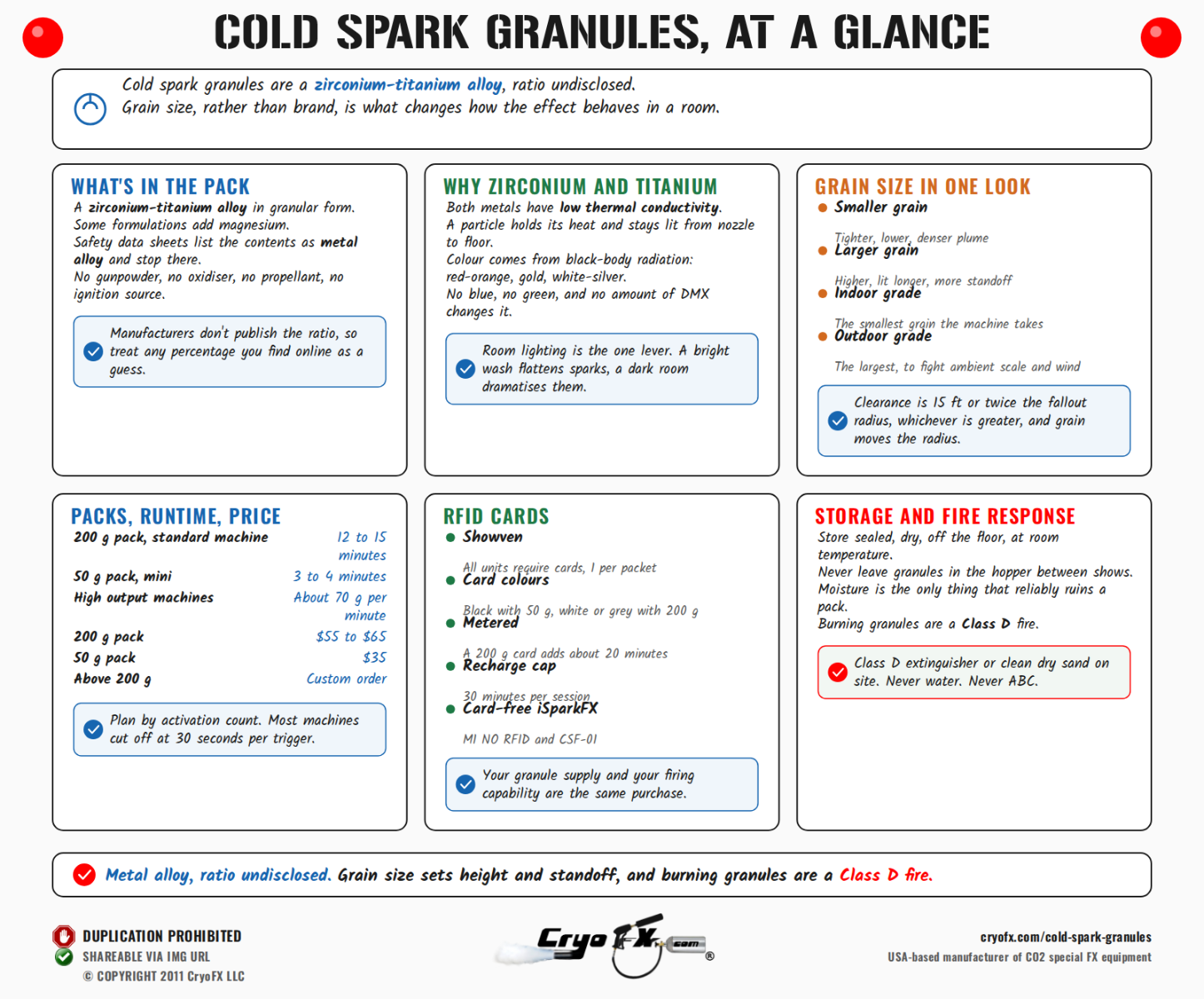
Cold spark granules are a zirconium-titanium alloy in granular form, with magnesium in some formulations. There's no gunpowder, no oxidiser and no propellant in the pack. The granules give light only after a heating chamber brings the metal to incandescence and a blower throws the glowing particles out of the nozzle. Grain size, rather than brand, is what changes how the effect behaves in a room.
That last point is where most purchasing mistakes start. Operators shop granules on price per pack, load whatever arrived, and then wonder why the plume overshot the clearance they drew on the plot.
What cold spark granules actually are
Everything sold as cold spark granules, cold spark powder or Sparkular granules is a metal alloy, predominantly zirconium and titanium, and some formulations add magnesium.
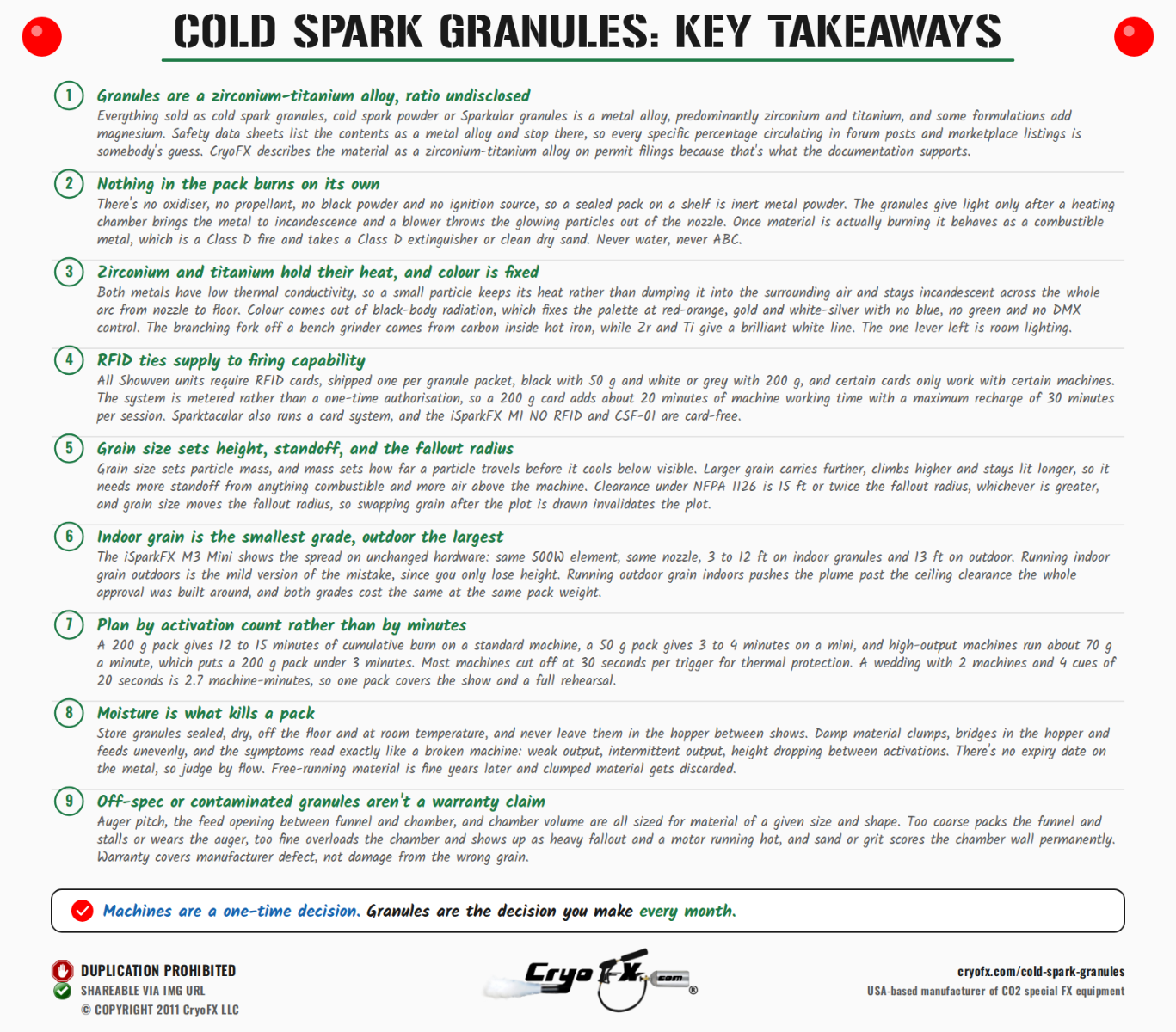
Manufacturers don't disclose the exact ratio. Safety data sheets list the contents as a metal alloy and stop there, which is normal for a proprietary powder metallurgy product and also means every specific percentage circulating in forum posts and marketplace listings is somebody's guess. We describe the material as a zirconium-titanium alloy on permit filings because that's what the documentation supports. A plan reviewer who asks for the source of a figure you can't produce is a bad afternoon at the fire marshal's counter.
Nothing in the pack burns on its own. No oxidiser, no propellant, no black powder, no ignition source. A sealed pack sitting on a shelf is inert metal powder.
The granules do nothing until the machine heats them. An auger drives material through a metal funnel into a cylindrical chamber wrapped in a heating element, and a blower underneath throws the glowing particles out of the nozzle; how cold spark machines work covers the internals, the second auger, and the RFID reader in full.
[EMBED youtu.be/emL_Okl-P0s, how a cold spark machine works, with VideoObject schema]
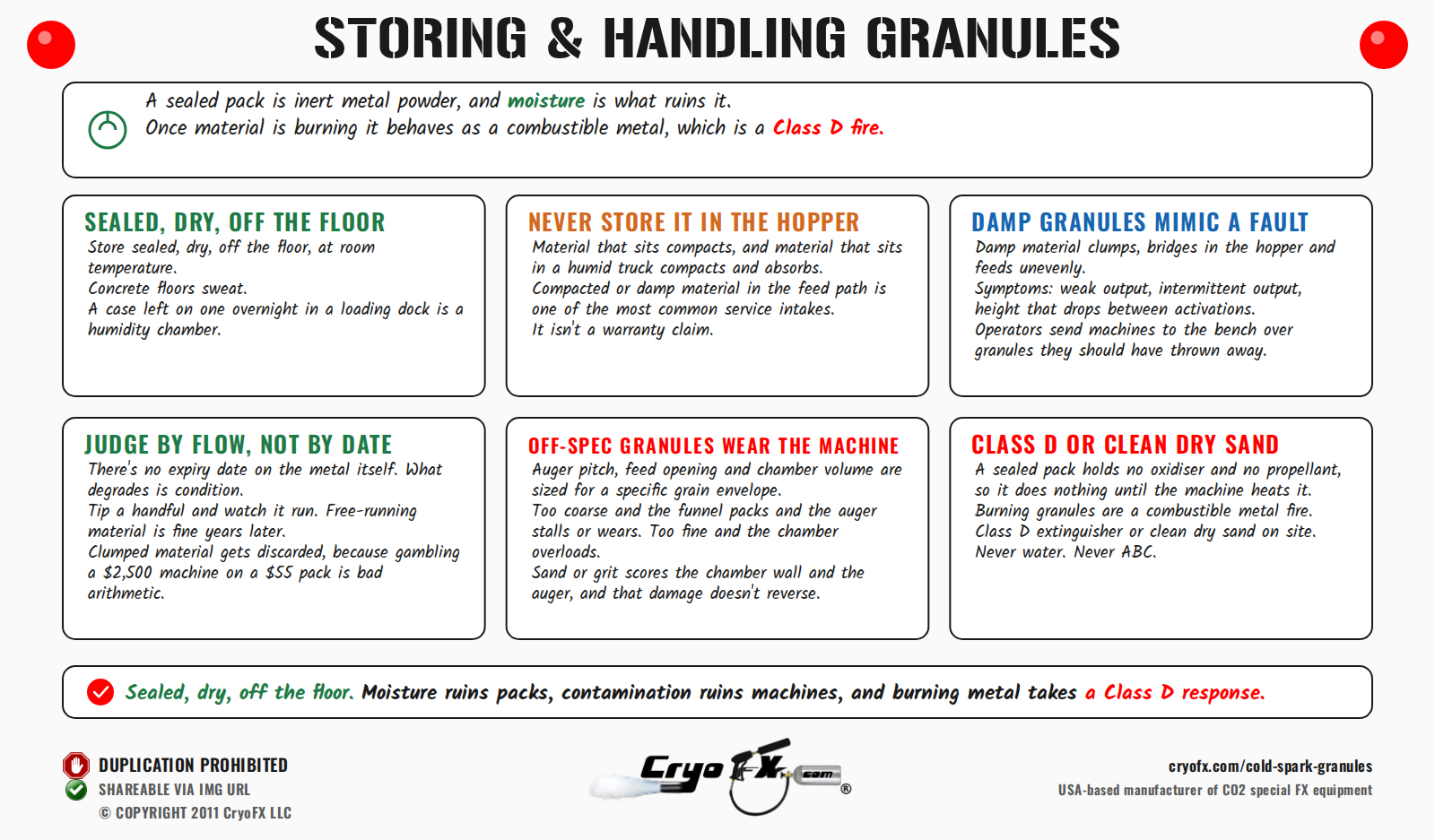
Once the material is actually burning it behaves as a combustible metal, which is a Class D fire and takes a Class D extinguisher. Agent selection and the NFPA 1126 extinguisher count sit on the cold spark machine safety guide.
Why zirconium and titanium and not something cheaper
Both metals have low thermal conductivity. A small particle of either holds its heat rather than dumping it into the surrounding air, so it stays incandescent across the whole arc from nozzle to floor instead of going dark 2 feet out. That property is the entire reason the effect reads as a fountain rather than a puff.
Colour comes out of black-body radiation, which means it's fixed by temperature and can't be dialled. The palette is red-orange, gold and white-silver. No spark machine on the market produces blue or green, and no amount of DMX changes that, because there's no dye, phosphor or gel involved anywhere in the process.
Zirconium and titanium also burn clean. The branching, forking spark you get off a bench grinder comes from carbon inside hot iron throwing secondary bursts. Zr and Ti give a brilliant white line instead, which is what makes the effect photograph and broadcast well.
The one lever you have over how the effect reads is room lighting. A bright wash flattens sparks toward invisible, and pulling the room down dramatises them. Brand colour matching isn't available at the granule level.
[INSERT GRAIN SIZE VERSUS OUTPUT HEIGHT AND REQUIRED STANDOFF INFOGRAPHIC HERE]
Grain size and what it changes
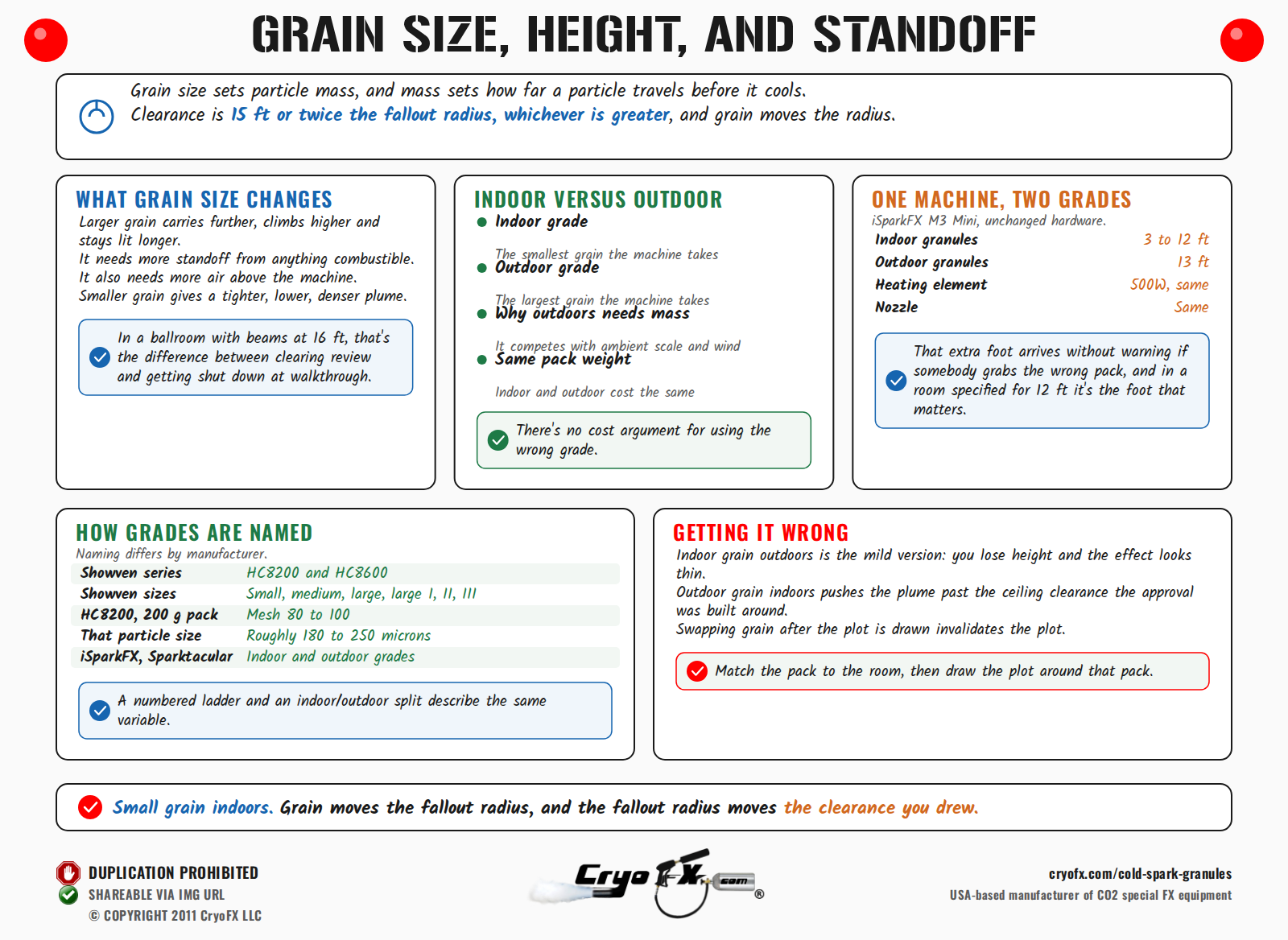
Showven grades its material as HC8200 and HC8600 in 6 sizes: SMALL, MEDIUM, LARGE, LARGE I, LARGE II and LARGE III. HC8200 in the 200g pack runs mesh 80 to 100, which is roughly 180 to 250 µm particle size. Other manufacturers use their own naming, and iSparkFX and Sparktacular both sell indoor and outdoor grades rather than a numbered ladder.
Height and standoff
Grain size sets particle mass, and mass sets how far a particle travels before it cools below visible. Larger grain carries further, climbs higher and stays lit longer, so it needs more standoff from anything combustible and more air above the machine.
Smaller grain gives a tighter, lower, denser plume. In a hotel ballroom with beams at 16 feet, that's the difference between an effect that clears review and one the inspector shuts down at walkthrough.
The knock-on effect is on clearance arithmetic. Clearance under NFPA 1126 is 15 feet or twice the fallout radius, whichever is greater, and grain size moves the fallout radius. Swapping grain after the plot is drawn invalidates the plot.
Indoor versus outdoor grain
Indoor is the smallest grain the machine takes. Outdoor is the largest. The reason is competition: outdoors the effect is fighting ambient scale and, on a stage, wind, so it needs mass and height to read at all.
The iSparkFX M3 Mini is the cleanest illustration of the spread. Same machine, same 500W element, same nozzle: 3 to 12 feet on indoor granules, 13 feet on outdoor. That extra foot arrives without warning if somebody grabs the wrong pack out of the case, and in a room specified for 12 feet it's the foot that matters.
Running indoor grain outdoors is the harmless version of the mistake. You lose height and the effect looks thin. Running outdoor grain indoors pushes the plume past the ceiling clearance the whole approval was built around.
Pack sizes, runtime, and buying for a specific show
Granules come in 200g and 50g packs. Anything larger than 200g is a custom order, which is worth setting up if you're running a club 3 or 4 nights a week rather than reordering 200g packs weekly.
A 200g pack runs $53 to $69 depending on brand and whether an RFID card is included in the box. A 50g pack runs $35 to $45. Indoor and outdoor grain at the same pack weight cost the same, so there's no cost argument for using the wrong grade.
Runtime by machine class:
- 200g pack: 12 to 15 minutes of cumulative burn on a standard machine
- 50g pack: 3 to 4 minutes on a mini
- High-output machines: roughly 70 g/min, so a 200g pack is under 3 minutes
- Sparktacular Pro units: 20 to 25 g/min on a 150g hopper, so 6 to 7.5 minutes per fill
Plan by activation count rather than by minutes, because most machines cut off at 30 seconds per trigger for thermal protection and nobody fires continuously anyway.
Worked example for a wedding. 2 machines, 4 cues, 20 seconds each. That's 4 × 20 × 2 = 160 machine-seconds, which is 2.7 machine-minutes against 12 to 15 minutes in a single 200g pack. One pack covers the show and a full rehearsal with material left over.
Worked example for a festival stage. 8 machines, 6 cues of 25 seconds across a headline set, is 20 machine-minutes, so you're ordering 2 packs and carrying a third. On high-output units at 70 g/min the same cue list is closer to 8 packs, which is the number that catches people out when they scale up from minis.
Storage, moisture, and what kills a pack
Sealed, dry, off the floor, at room temperature. Concrete floors sweat, and a case left on one overnight in a loading dock is a humidity chamber.
Moisture is the only thing that reliably ruins granules. Damp material clumps, bridges in the hopper and feeds unevenly, and the symptoms it produces read exactly like a broken machine: weak output, intermittent output, height that drops between activations. Operators send machines to the bench over granules they should have thrown away.
Never leave granules in the hopper between shows. Material that sits compacts, and material that sits in a humid truck compacts and absorbs. Compacted or damp material in the feed path is one of the most common intakes we see, and it isn't a warranty claim.
There's no expiry date on the metal itself. What degrades is condition, so judge by flow rather than by date: tip a handful and watch it run. Free-running material is fine years later. Clumped material gets discarded, because gambling a $2,500 machine on a $55 pack is bad arithmetic.
Why manufacturer-matched granules matter mechanically
The machine is built around a specific grain envelope. Auger pitch, the diameter of the feed opening between the funnel and the chamber, and chamber volume are all sized for material of a given size and shape.
Off-spec granules fail in predictable ways. Too coarse and the funnel packs and the auger stalls or wears. Too fine and the chamber overloads, which shows up as heavy fallout and a motor running hot. Irregular shape binds in the auger flights.
Contamination is worse than sizing. Sand or grit riding along in cheap material scores the chamber wall and the auger, and that damage doesn't reverse.
Warranty covers manufacturer defect. It doesn't cover a chamber scored by contaminated material or an auger worn by the wrong grain, so the maintenance and fault diagnosis page is worth reading before you experiment with an unknown supply.
RFID and granule lock-in
Many machines carry an RFID reader, and the card is what authorises firing.
All Showven units require RFID cards. Cards ship one per granule packet: black cards with 50g packets, white or grey with 200g. Certain cards only work with certain machines. The system is metered rather than a one-time authorisation, so a 200g card adds about 20 minutes of machine working time, with a maximum recharge of 30 minutes per session.
Two consequences follow. Your granule supply and your firing capability are the same purchase, and your runtime is capped by cards on hand rather than by material in the hopper. Sparktacular also runs an RFID card system.
iSparkFX splits the difference: some models require cards and some don't. The M1 NO RFID and the CSF-01 are the card-free options. On rentals we sometimes front-load working time onto the machine and supply granules separately, which keeps a DJ from being stranded by a missing card at 10pm.
If you run a mixed fleet, track cards by machine. A card that fires one unit and not the one next to it is a normal Friday, and it's the single most common "the machine is broken" call that turns out to be nothing.
[INSERT RFID CARD SET, BLACK 50G AND WHITE 200G, PHOTOGRAPHED WITH PACKETS HERE]
Buying granules for any brand through CryoFX
We stock granules cross-brand in indoor and outdoor grain, with same-day to 2-day shipment on most orders, so a machine bought somewhere else still gets fed. iSparkFX granules work in other machines including JMaz and Blitzz, and iSparkFX sells granules without RFID cards that run in almost any machine that doesn't demand authentication.
That's the practical case for buying cold spark granules for sale domestically rather than by the container: continuity. A machine with no material is a paperweight, and a supply chain that runs 6 weeks from overseas turns a Thursday reorder into a cancelled Saturday.
Granule availability belongs in the buying decision rather than after it. Before you commit to a platform, ask who stocks its material in the country you work in, whether its cards are tied to its own packets, and what happens to your Saturday if a pack arrives damp. Machines are a one-time decision. Granules are the decision you make every month.
Frequently asked questions
What are cold spark granules made of?
A zirconium-titanium alloy, with some formulations including magnesium. Manufacturers don't publish the ratio, and SDS sheets list only "metal alloy," so treat any specific percentage you find online as a guess. There's no gunpowder, no oxidiser and no propellant. The granules produce light only once a heating chamber brings them to incandescence.
Why do cold spark machines use zirconium and titanium?
Both metals have low thermal conductivity, so a small particle holds its heat long enough to stay glowing across the whole arc from nozzle to floor. They also burn to a brilliant white rather than the branching orange fork you get from carbon inside hot iron, which is what gives the effect its clean look on camera.
What is the difference between small, medium, and large grain granules?
Grain size sets particle mass, and mass sets how far a particle travels before it cools. Larger grain goes higher and stays lit longer, so it needs more standoff from anything combustible and more ceiling above the machine. Smaller grain gives a tighter, lower plume that's easier to contain in a low room.
Which grain size should I use indoors?
Small grain indoors. It keeps the plume lower and shortens the fallout radius, which matters because clearance is calculated as 15 feet or twice the fallout radius, whichever is greater. Loading outdoor granules into a machine indoors pushes the effect past the ceiling clearance the plot was drawn around. The safety guide covers clearance in full.
How long does a 200 gram pack last?
12 to 15 minutes of cumulative burn on a standard machine. A 50 gram pack gives 3 to 4 minutes on a mini. High-output machines consume around 70 grams a minute, so a 200 gram pack is under 3 minutes on those. Plan by activation count rather than minutes, since most machines cut off at 30 seconds per trigger.
Can I use third-party granules in my machine?
Mechanically it's a risk worth understanding. Grain size and shape have to match the auger pitch and the feed opening the machine was built around, and off-spec material packs the funnel, overloads the chamber, or accelerates auger wear. Granules carrying sand or debris score the chamber. Warranty covers manufacturer defect and won't cover damage from either.
How should granules be stored?
Sealed, dry, off the floor, at room temperature. Moisture is what ruins them: damp granules clump, feed unevenly, and give weak or intermittent output that operators usually misdiagnose as a machine fault. Never leave granules sitting in the hopper between shows, because compacted or damp material in the feed path is one of the most common service intakes we see.
Do granules expire?
There's no shelf-life date on the metal itself. What degrades is condition. A pack that stays sealed and dry performs the same years later, and an open pack that's lived in a humid truck or garage can be unusable inside a season. Judge by flow: free-running granules are fine, clumped ones get discarded rather than gambled on.
Can I buy granules for a machine I didn't buy from CryoFX?
Yes. CryoFX stocks granules across brands in indoor and outdoor grain, not only for iSparkFX machines. The one hard limit is RFID: machines shipped with an RFID reader require an authenticated card before they'll fire, which ties them to their manufacturer's supply and meters runtime. Several iSparkFX models have no RFID requirement at all.
___
CryoFX® is the leading manufacturer, designer, and global supplier of CO2 special effects equipment and custom special effects systems
for Theme Parks, Sporting Arenas, Mega Nightclubs & Day Clubs , TV/FILM & large scale events & installs in any industry requiring Co2 Systems.
CryoFX LLC Global Headquarters • 3859 S Valley View Blvd, Suite 2, Las Vegas, NV 89103 • 1.855.527.9639
Updated - 08/12/2026.