Cold Spark Machine Maintenance, Cleaning, And Fault Diagnosis
Cold Spark Machine Maintenance and Troubleshooting | CryoFX
Cold Spark Machine Maintenance, Cleaning, And Fault Diagnosis
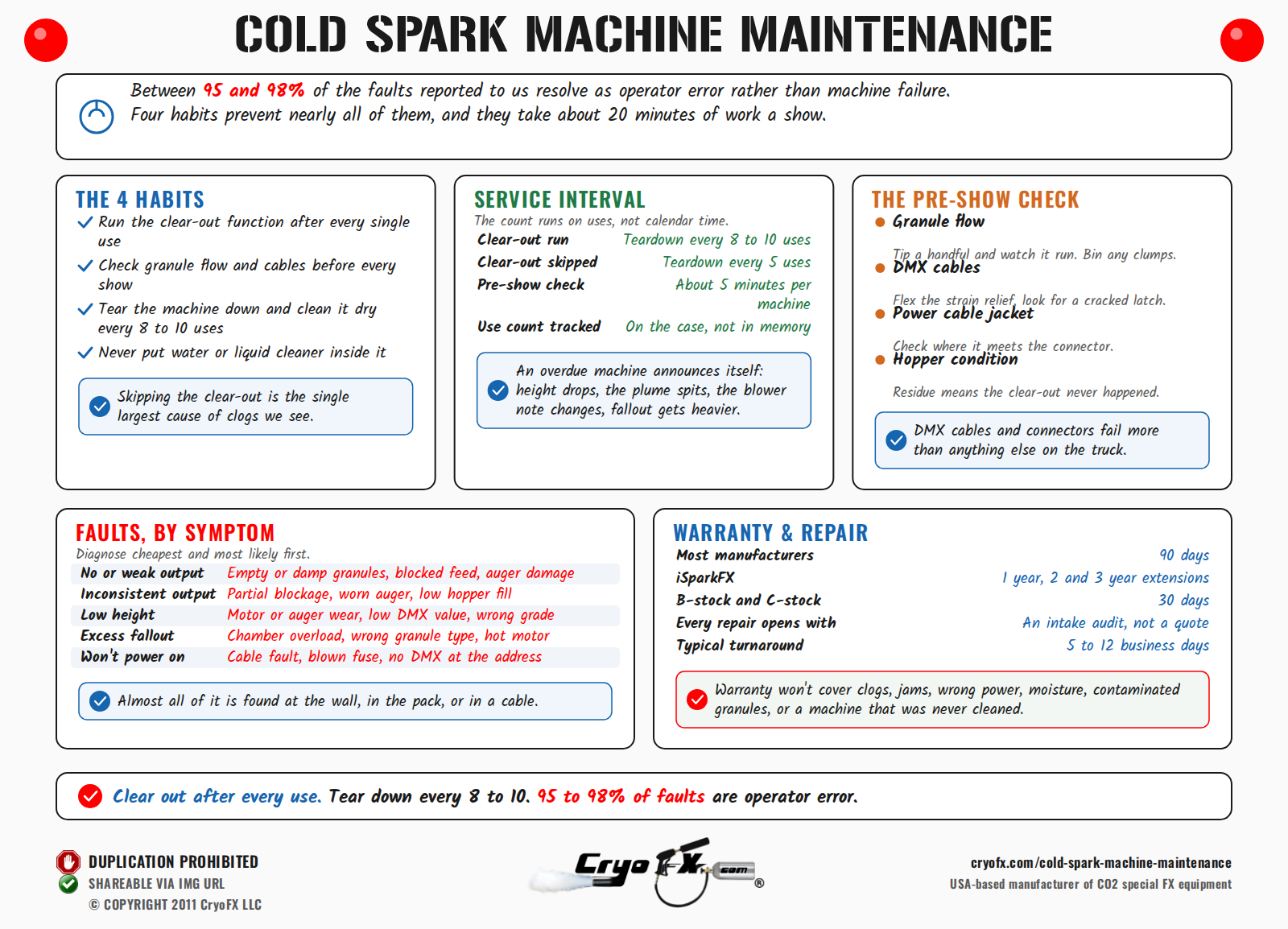
Cold spark machine maintenance is 4 habits. Run the clear-out function after every single use. Check granule flow and cables before every show. Tear the machine down and clean it dry every 8 to 10 uses if you clear out properly, every 5 if you don't. Never put water or liquid cleaner inside it. Do those and the machine outlasts the business plan.
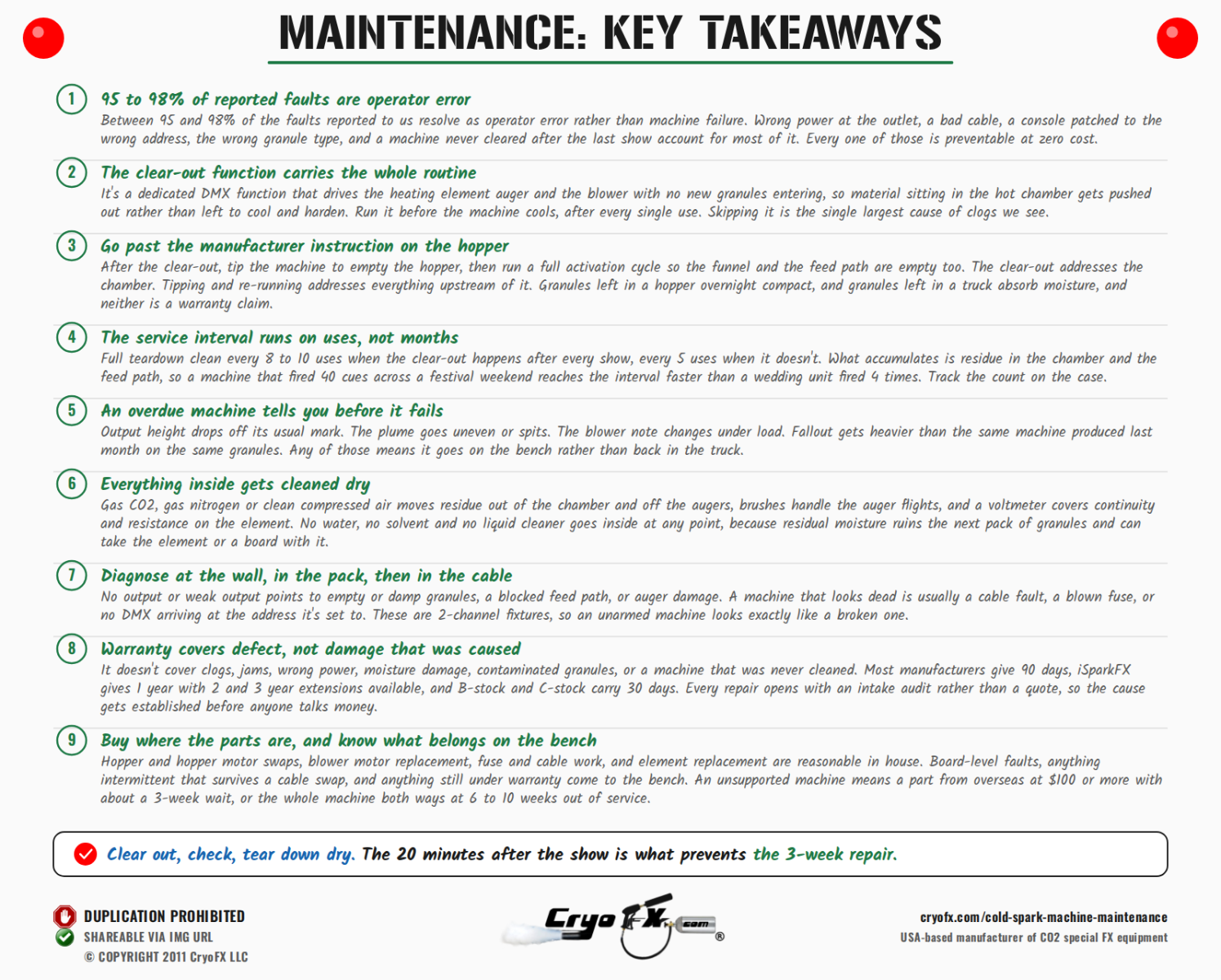
Here's the number that shapes everything below. Between 95 and 98% of the faults reported to us resolve as operator error rather than machine failure. Read that as a statement about which 20 minutes of work prevent a 3-week repair, and about how much money gets spent shipping healthy machines across the country.
The cold spark machine information guide covers what's inside the casing. This page covers keeping it working and finding out what's wrong when it isn't.
After every single use
Run the clear-out function before the machine cools. It's a dedicated DMX function that drives the heating element auger and the blower with no new granules entering, so material still sitting in the hot chamber gets pushed out rather than left to cool and harden in place.
Skipping it is the single largest cause of clogs we see. Residue that cools inside the chamber doesn't come out with air, and the machine that needed 90 seconds of clear-out at midnight now needs a full teardown on the bench.
We go past the manufacturer instruction here, and it's worth copying. After the clear-out, tip the machine to empty the hopper, then run a full activation cycle so the funnel and the feed path between hopper and chamber are empty too. The clear-out addresses the chamber. Tipping and re-running addresses everything upstream of it.
Granules that stay in the hopper overnight compact. Granules that stay in the hopper in a truck absorb moisture and compact. Either one gives you a machine that reads as broken at the next load-in, and neither is a warranty claim. Storage rules for the material itself sit on the cold spark granules page.
[EMBED youtu.be/eEEAJ91B3jg, cold spark machine cleaning walkthrough, with VideoObject schema]
The pre-show check
4 items, and they take about 5 minutes per machine.
Granule flow. Tip a handful from the pack and watch it run. Free-running material is fine. Clumped material gets binned, because it will produce weak or intermittent output and you'll spend the show diagnosing the machine.
DMX cables and connectors. These fail more than anything else on the truck, because they get connected and disconnected at every venue by whoever's closest. Flex the strain relief, check the shell for a cracked latch, and carry more spares than you think you need.
Power cable jacket. Look at where the cable meets the connector and anywhere a road case lid has closed on it. Power Con leads take repeated abuse at load-in.
Hopper condition. Open it and look for residue from the last show. A hopper with material still in it tells you the clear-out didn't happen, which tells you the chamber needs attention before this show rather than after it.
The service interval and what sets it
Full teardown clean every 8 to 10 uses when the clear-out happens after every show. Every 5 uses when it doesn't.
The interval runs on use count rather than calendar time, because what accumulates is residue in the chamber and the feed path. A machine that sat in a case for 8 months is in the same condition it went in. A machine that fired 40 cues across a festival weekend has done 3 weddings' worth of work in 2 days.
For rental and touring inventory, track the count on the case rather than in someone's memory. We log uses per unit, and it's the reason a rental fleet holds output over years instead of quietly degrading until customers start complaining about height.
An overdue machine announces itself. Output height drops off its usual mark. The plume goes uneven or spits. The blower note changes under load. Fallout gets heavier than the same machine produced last month on the same granules. Any of those means it goes on the bench rather than back in the truck.
Full teardown clean
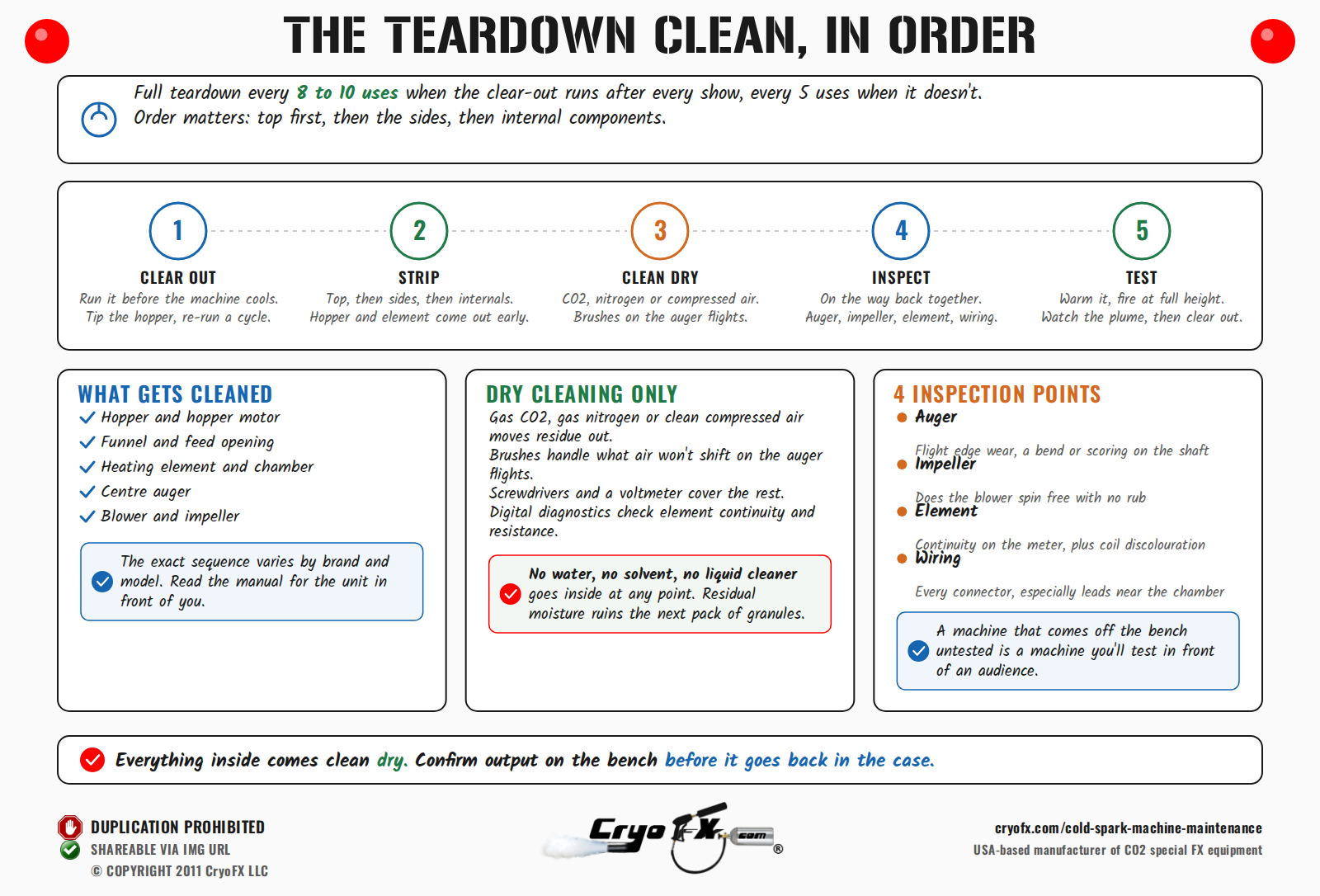
Order: top first, then the sides, then internal components. Some parts come out early to make room for the rest, typically the hopper and the heating element. The exact sequence varies by machine, brand and model, so read the manual for the unit in front of you rather than applying one procedure across a mixed fleet.
What gets cleaned, in the order it usually comes apart: hopper and hopper motor, the funnel and feed opening, the heating element and the chamber, the centre auger, the blower and impeller.
Everything is dry. Gas CO2 or gas nitrogen, or clean compressed air, moves residue out of the chamber and off the augers. Brushes handle what air won't shift on the auger flights. Screwdrivers and a voltmeter cover the rest, plus whatever digital diagnostics you have for continuity and resistance checks on the element.
No water, no solvent, no liquid cleaner goes inside a cold spark machine at any point. Residual moisture ruins the next pack of granules and can take the element or a board with it.
Inspect on the way back together rather than on the way apart. 4 things to look at:
- Auger wear along the flight edges, and any bend or scoring on the shaft
- Impeller condition and whether the blower spins free with no rub
- Element continuity on the meter, and any discolouration or deformation on the coil
- Wiring at every connector, especially where a lead passes near the chamber
Then confirm output before it goes back in the case. Warm it, fire it at full height, watch the plume for evenness, and run the clear-out. A machine that comes off the bench untested is a machine you'll test in front of an audience.
Fault-by-fault troubleshooting
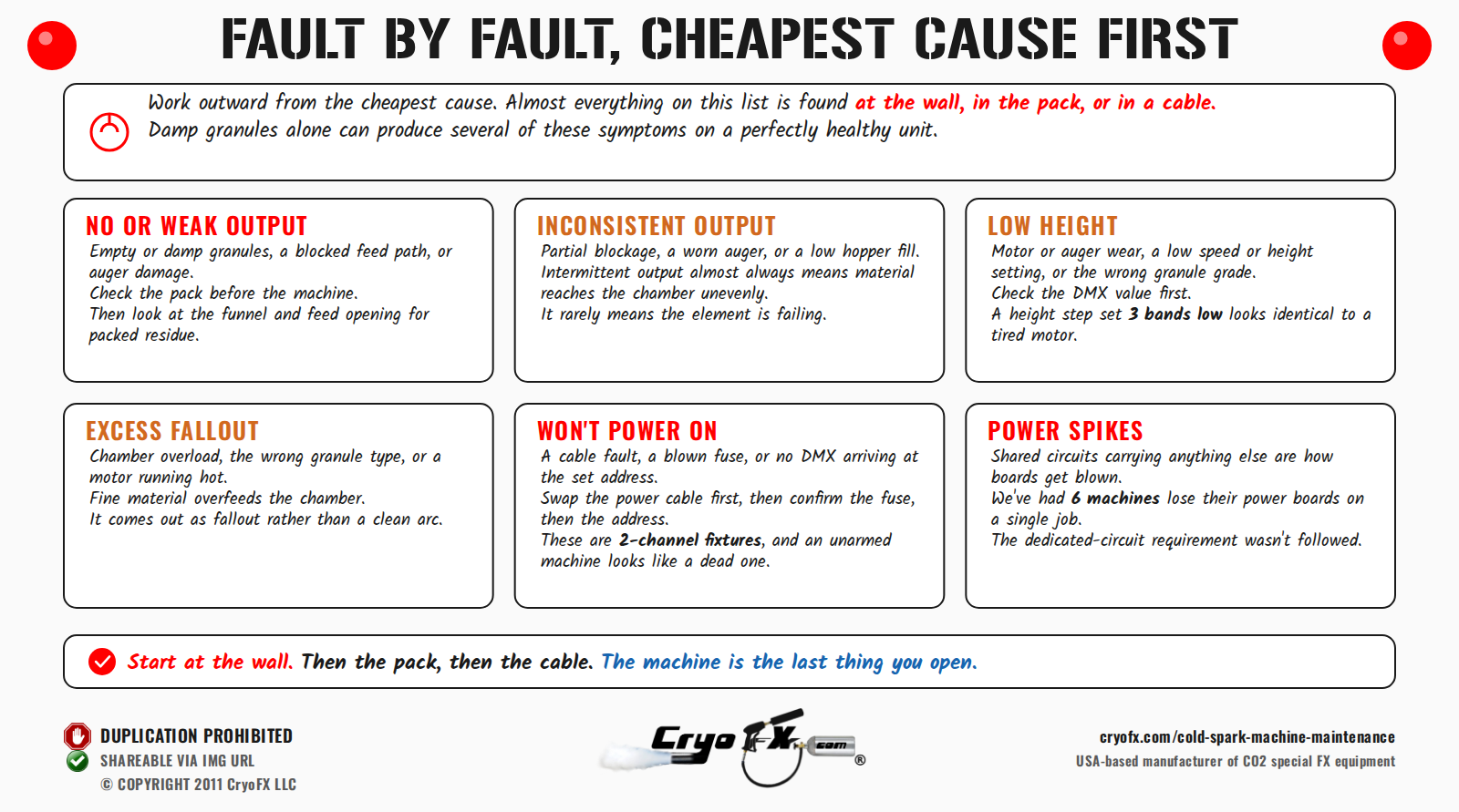
Diagnose cheapest and most likely first. Almost everything on this list is found at the wall, in the pack, or in a cable.
[EMBED youtu.be/aMaMYAOry9M, diagnosing cold spark machine faults, with VideoObject schema]
No output or weak output
Empty or damp granules, a blocked feed path, or auger damage. Check the pack before the machine: damp material alone produces this symptom on a perfectly healthy unit. Then look at the funnel and the feed opening for packed residue.
Inconsistent output
Partial blockage, a worn auger, or a low hopper fill. Intermittent behaviour almost always means material is reaching the chamber unevenly rather than that the element is failing.
Low height
Motor or auger wear, a low speed or height setting on the console, or the wrong granule grade. Check the DMX value first, because a height step set 3 bands low looks identical to a tired motor.
Excess fallout
Chamber overload, the wrong granule type, or a motor running hot. Fine material overfeeds the chamber and comes out as fallout rather than a clean arc.
Won't power on
A cable fault, a blown fuse, or no DMX arriving at the address the machine is set to. Swap the power cable before you open anything. Then confirm the fuse. Then confirm the console is actually sending to that address, because these are 2-channel fixtures and an unarmed machine looks exactly like a dead one.
Power spikes are their own category. Shared circuits carrying anything else are how boards get blown, and we've had 6 machines lose their power boards on a single job because the dedicated-circuit requirement wasn't followed. The power requirements page covers circuits, GFCI and the 208V problem.
[INSERT SYMPTOM-TO-CAUSE DIAGNOSTIC TABLE INFOGRAPHIC HERE]
The 95 to 98% number and what it means for you
The full operator-fault list, in roughly the order we encounter it:
- Wrong plug or wrong power at the outlet
- A bad DMX cable, a bad power cable, or a failed connector
- A controller fault or a console patched to the wrong address
- RF interference on a wireless remote
- The wrong granule type for the machine
- Sand or debris riding along in cheap granules
- Granules left in the hopper until compacted or damp
- A machine never cleared after the last show
- Granules poured into the wrong opening
Every one of those is a customer's Friday night, and every one of them is preventable at zero cost.
Which is why every repair here opens with an intake audit rather than a quote. The audit form is at cryoeffects.com/repairs. It establishes what the machine was plugged into, what granules it was running, when it was last cleared, and what the operator saw before it stopped, so the cause gets identified before anyone talks money.
Where the audit finds a real defect, warranty covers it. Where it finds operator error, you get a price and you decide. Nobody pays for a diagnosis dressed up as a repair.
Send the machine in with the granule pack it was running, the power and DMX cables it was using, and a note on what the console was doing at the moment it stopped. Those 3 items cut audit time roughly in half.
Out of warranty, a bench fee is paid up front. It covers the first hour of diagnosis and credits toward the repair, so a fault found in 20 minutes and a fault found in 2 hours both cost the bench fee. In warranty there's no time charge, and the bench fee credits toward return shipping or other items per the repairs page. Typical turnaround is 5 to 12 business days from receipt depending on parts, given as a recommendation rather than a guarantee, because a board on backorder doesn't care about our schedule.
What voids a warranty
Warranty covers manufacturer defect. It covers condition on arrival and components that fail doing the job they were built for.
It doesn't cover clogs, jams, wrong power, moisture damage, contaminated granules, or a machine that was never cleaned. Each exclusion maps to something on the operator-fault list above, which is the point: they exist because those failures are caused rather than suffered.
Terms across the category: most manufacturers give 90 days. iSparkFX gives 1 year, and 2 and 3 year extensions are available on both iSparkFX and Showven. B-stock and C-stock carry 30 days.
CryoFX performs paid service work on Showven machines, and warranty service is available for machines purchased through us. We're an authorised Showven distributor and the main distributor for a large part of the western United States.
Parts, self-repair, and the video library
Most of what fails on these machines is a replaceable module. We stock heating elements, hoppers, blowers, DMX boards and electronics boards across multiple brands, mostly shipping same day, alongside cold spark machine parts and machines for sale.
[EMBED youtu.be/_xviXn9ouw4, cold spark machine repair, with VideoObject schema]
Showven parts, subject to change. On a Sparkular regular: board $175 to $200, heating coil $130 to $160, hopper with motor $85 to $125, blower motor $60 to $100, top panel with hopper lid $40 to $60. On a Sparkular Mini: main board $140 to $180, heating coil $150 to $180, hopper with motor $90 to $130, blower motor $50 to $90, hopper lid $40 to $70.
iSparkFX equivalents: [INSERT ISPARKFX PART PRICE HERE].
Domestic parts supply is the whole economic argument against a cheap import. When an unsupported machine fails, you're looking at parts from overseas at $100 or more with about a 3-week wait, or shipping the whole machine both ways at a few hundred dollars and 6 to 10 weeks out of service. Either path lands close to the price of a second machine, and neither gets you through the wedding on Saturday.
Reasonable in-house repairs: hopper and hopper motor swaps, blower motor replacement, fuse and cable work, and element replacement if you're comfortable with a meter and the teardown order above. Come to the bench for board-level faults, anything intermittent that survives a cable swap, and anything still under warranty, because opening a warranted machine ends the conversation.
Our B-stock and C-stock process is what a proper service looks like end to end. Each unit is stripped, the chamber cleared, hoppers emptied and blown through, augers verified, and full output confirmed before resale. We also sell non-working machines for parts or self-repair projects, which is a cheap way to learn the teardown on a unit you can't damage.
One more reason to buy where the parts are. We've inspected and rejected factory units, including a batch reported with resettable fuses popping and a separate set where a fuse kept blowing after multiple replacements. That shipment went back to the factory, we stopped accepting units until production fixed it, then took 2 units, tested them hard, and confirmed them good before anything shipped to a customer.
Frequently asked questions
How do I clean a cold spark machine after use?
Run the clear-out function first, a dedicated DMX function that drives the chamber auger and blower without feeding new granules, so hot material leaves the chamber. Then tip the machine to empty the hopper and run a full activation cycle so the feed path is empty too. Nothing wet goes inside the machine at any point.
How often does a cold spark machine need servicing?
Full teardown clean every 8 to 10 uses if you clear out properly after every show, every 5 if you don't. The interval is driven by residue in the chamber and feed path, so a machine worked hard across a festival weekend reaches it faster than a wedding unit fired 4 times. Before every show, check granule flow, DMX cables and connectors, and the power cable jacket.
Why is my cold spark machine not firing?
Work outward from the cheapest cause. Empty or damp granules, a blocked feed path, or auger damage all stop output. A machine that looks dead is usually a cable fault, a blown fuse, or no DMX arriving at the address it's set to. These are 2-channel fixtures, so the safety channel has to be raised before the fire channel does anything.
Why is my cold spark machine output weak or inconsistent?
Inconsistent output points to partial blockage, a worn auger, or a low hopper fill. Low height points to motor or auger wear, a low speed setting, or the wrong granule grade. Heavy fallout points to chamber overload, wrong granule type, or a motor running hot. Damp granules can produce every one of these symptoms at the same time.
Why won't my cold spark machine power on?
Start at the wall and work in. Wrong power at the outlet, a damaged power cable, a blown fuse, and no DMX at the set address account for nearly every dead machine that comes through intake. Swap the power cable before anything else, since Power Con leads take repeated abuse at load-in. A machine that powers but never warms is usually unarmed on the console.
What is a clear-out function and why does it matter?
It's a dedicated DMX function that runs the heating element auger and the blower with no new granules entering, so leftover material is pushed out of the hot chamber before it cools and hardens in place. Skipping it is the largest single cause of clogs, and a clogged chamber turns a 10-minute routine into a full teardown.
Can I repair a cold spark machine myself?
For most of what fails, yes. Heating elements, hoppers, blowers, DMX boards, and electronics boards are all replaceable, and CryoFX stocks them for multiple brands with same-day shipping on most items plus video showing the fit. The repair and teardown videos on the CryoFX channel walk through it. Anything still under warranty should come in before you open it.
What is not covered under warranty?
Warranty covers manufacturer defect. It doesn't cover clogs, jams, wrong power, moisture damage, contaminated granules, or a machine that was never cleaned. Most manufacturers give 90 days; iSparkFX gives 1 year with 2 and 3 year extensions available. Every repair here opens with an intake audit rather than a quote, so the cause gets established before anyone talks money.
Can I use water to clean a cold spark machine?
No. Water and liquid cleaners never go inside the machine. The chamber, augers, and feed path get cleaned dry, and granules are ruined by moisture, so residual damp is a fault waiting for the next show. Water has a separate exclusion here as well: cold spark granules are a combustible metal and take Class D or clean dry sand.
___
CryoFX® is the leading manufacturer, designer, and global supplier of CO2 special effects equipment and custom special effects systems
for Theme Parks, Sporting Arenas, Mega Nightclubs & Day Clubs , TV/FILM & large scale events & installs in any industry requiring Co2 Systems.
CryoFX LLC Global Headquarters • 3859 S Valley View Blvd, Suite 2, Las Vegas, NV 89103 • 1.855.527.9639
Updated - 08/13/2026.