Cold Spark Machine Safety: What The Machine Does, And What The Operator Decides
Cold Spark Machine Safety Guide: Hazards, Clearances & Operating Procedures | CryoFX
Cold Spark Machine Safety: What The Machine Does, And What The Operator Decides
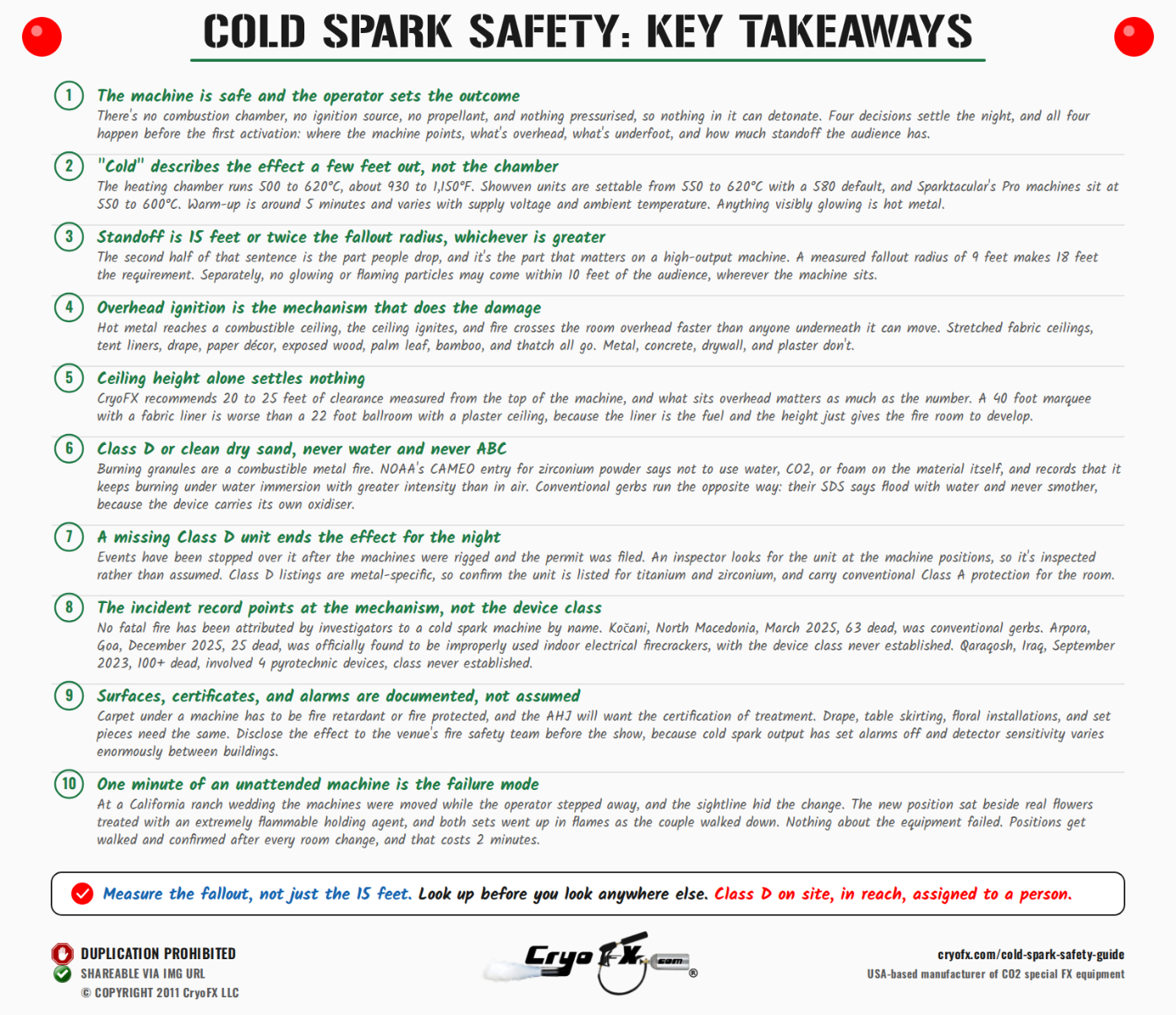
The machine is safe. It has no combustion chamber, no ignition source, no propellant, and nothing pressurised, so there's nothing in it that can detonate. Every real hazard comes from where it's pointed, what's above it, what's under it, and how far back the audience sits. This page covers chamber temperature, clearances, surfaces, extinguishers, alarms, and what the incident record actually shows.
zxzThe machine is safe. The operator determines the outcome
Granules load into a hopper, an auger drives them into a chamber wrapped in a heating element, and a blower throws them out of the nozzle once they're glowing. The complete cold spark machine guide walks through the mechanism in full.
Nothing in that sequence can run away. There's no charge waiting to go off and no fuel store to ignite. Cut the power and the effect stops.
Four operator decisions set the outcome, and all four happen before the first activation: where the machine points, what's overhead, what's underfoot, and how much standoff the audience has. Get those right and the effect behaves the same way every night. Get one wrong and the machine performs exactly as designed while something else in the room burns.
What one minute cost at a California ranch wedding
CryoFX was operating spark machines at a ranch wedding in California. The operator stepped away for one minute. In that minute the machines were moved, and because of the line of sight from where he was standing he couldn't tell they'd been repositioned.
The new position put them close to real flowers and ferns that had been treated with an extremely flammable holding agent. Both flower sets went up in flames as the bride and groom walked down.
The fire was extinguished and nobody was hurt. It could have been catastrophic, in a venue full of seated guests, with a bride in a dress a few feet from the ignition point.
Nothing about the equipment failed. The machines and the granules were correct, the positions had been correct at setup, and the operator was competent. A position changed by somebody who didn't know what the position was for, plus a sightline that hid the change, was the whole of it. That's why CryoFX operators don't leave machines unattended once they're rigged, and why final positions get walked and confirmed after every room change rather than once at setup.
The "cold" in cold spark, and what the chamber actually runs at
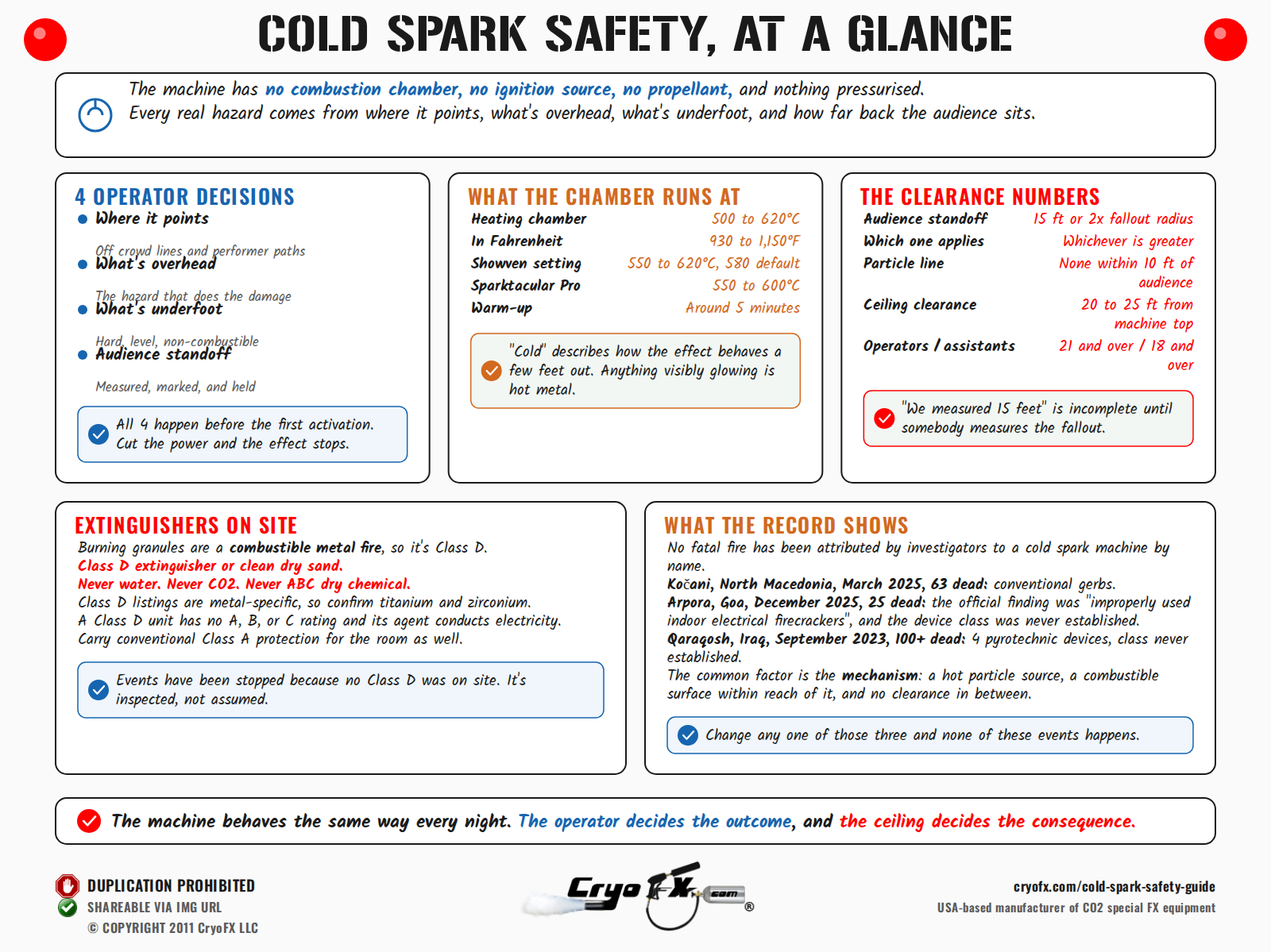
Cold spark machines run a heating chamber at roughly 480 to 650°C, about 900 to 1,200°F. Showven units are settable from 480 to 620 with a 580 default. Sparktacular's Pro machines sit at 550 to 600°C, and their SparkOne runs 520 to 560°C.
Warm-up is around 5 minutes and varies with supply voltage and ambient temperature. A machine mid-warm-up throws lower and less consistently, which is why a cue fired 90 seconds after power-up looks wrong and gets blamed on the machine.
The word "cold" describes how the effect behaves a few feet out from the nozzle. Zirconium and titanium hold heat in a small particle long enough to glow through the arc, then shed it fast in air, because there's very little thermal mass per particle. That rapid cooling is the reason the effect can run closer to people than a conventional gerb, and it's the whole commercial argument for the category.
The 62°F claim
Some manufacturer marketing puts a number on the sparks, usually 62°F. A body at 62°F emits no visible light at all, so the claim is physically impossible. What you're looking at is incandescent metal, and anything visibly glowing is hot. Treat the figure as marketing copy and work from the chamber temperature and the fallout radius instead.
Burn hazard at close range
Skin contact near the nozzle or inside the fallout zone can burn. Fabric inside the fallout zone can scorch, and that includes costumes, drapes, table linen, and anything on a performer path that crosses the effect.
The clearance figures further down exist for this reason. They mark the distance at which incandescent particles have stopped being hot enough to matter.
NFPA 1126 also sets age limits on personnel. Operators are 21 and over, assistants 18 and over. On a wedding or a corporate job, that rules out the venue's youngest AV tech being handed the remote because the operator needed to move a case.
Floor and surface hazards
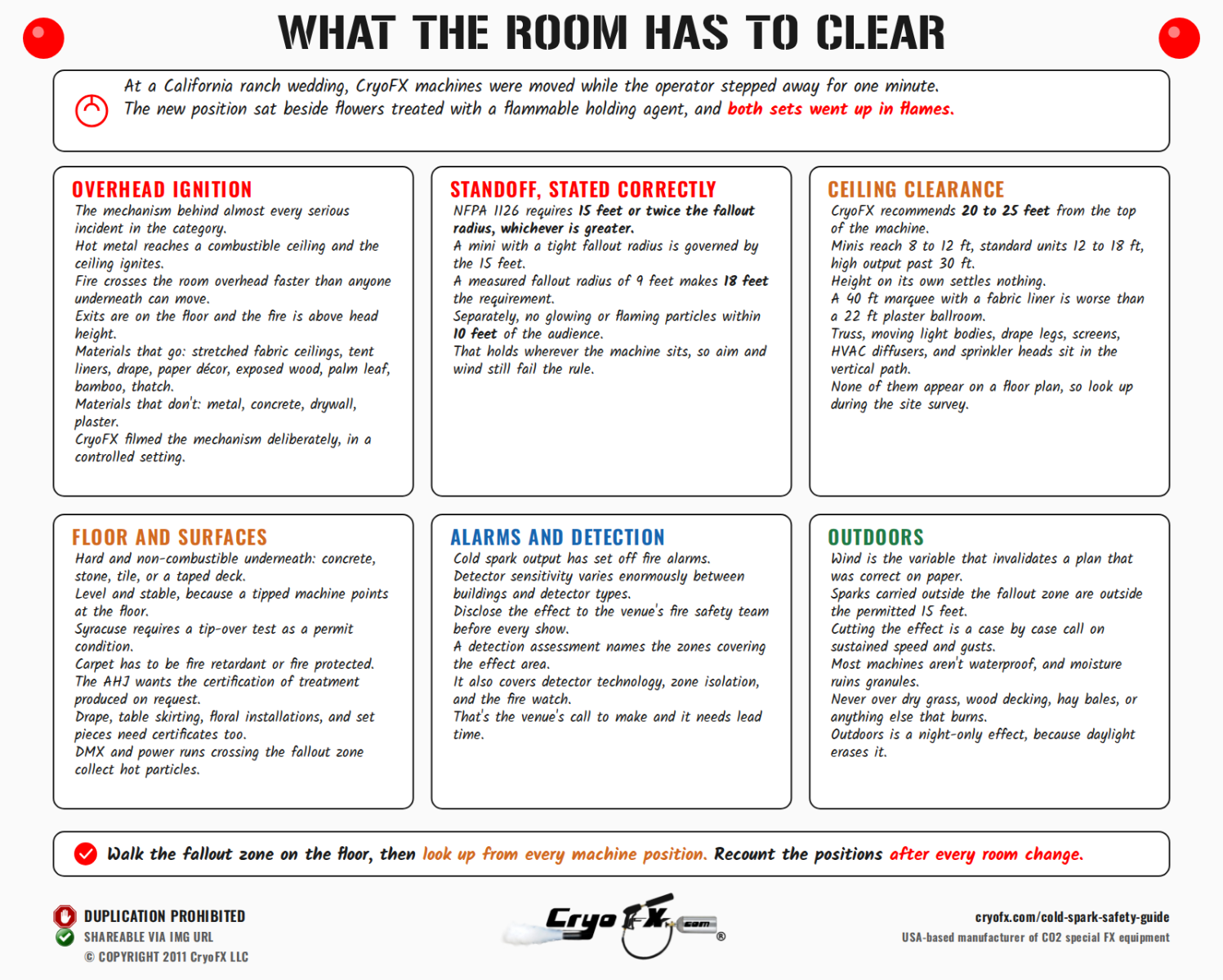
The ideal surface under a machine is hard and non-combustible: concrete, stone, tile, or a taped-down non-combustible deck. Every machine sits level and stable, because a tipped machine points its output at the floor and at whatever's standing on it. Syracuse requires a tip-over test as a permit condition, which tells you how seriously AHJs treat it.
Carpet is a documented condition rather than a judgement call. Where machines are used on carpet, the carpet has to be fire retardant or fire protected, and the AHJ will want to see the certification of treatment. That means a document naming the product and the treatment, produced on request, not a verbal assurance from a venue manager. Where the carpet can't be certified, the machine sits on a non-combustible base large enough to cover the fallout footprint underneath it.
Fire certificates are needed for everything else in the effect zone too. Draping, table skirting, a cake table with fabric or paper trim, floral installations, and set pieces all count. The ranch wedding is the case study: the flowers themselves weren't the problem, the flammable holding agent sprayed on them was, and nobody asks a florist for an SDS.
Cabling gets the same walk, since DMX and power runs crossing the fallout zone collect hot particles.
Overhead ignition, the hazard that does the damage
This is the mechanism behind almost every serious incident in the category. Hot metal reaches a combustible ceiling, the ceiling ignites, and fire crosses the room overhead faster than anyone underneath it can move. Exits are on the floor and the fire is above head height.
Materials that go: stretched fabric ceilings, tent liners, drape, paper décor, exposed wood, palm leaf, bamboo, thatch. Materials that don't: metal, concrete, drywall, plaster.
CryoFX filmed the mechanism deliberately, in a controlled setting, because the effect is easy to argue about and hard to argue with once you've watched it happen on camera.
The time scale is what the footage shows. Ignition to a spreading flame front is quick enough that the difference between a scorch mark and a structure fire was settled hours earlier, when somebody chose the machine position.
The 15 ft rule, stated correctly
NFPA 1126 requires 15 feet or twice the fallout radius, whichever is greater. The second half of that sentence is the part people drop, and it's the part that matters on a high-output machine.
A mini throwing 8 to 12 feet has a tight fallout radius, and 15 feet is comfortably the governing number. A machine throwing 18 feet throws its fallout wider. If the measured fallout radius is 9 feet, twice that is 18 feet, and 18 feet becomes the requirement. "We measured 15 feet" is an incomplete answer until somebody has measured the fallout.
Separately, no glowing or flaming particles may come within 10 feet of the audience. That applies regardless of where the machine sits, which means a machine correctly set back can still fail the rule if it's aimed across a crowd line or if wind carries the fall.
These distances get written into the permit filing as marked measurements on the plot diagram, and the positions on that diagram are commitments. The fire permit information page covers what the package contains.
Ceiling clearance and what's overhead
CryoFX recommends 20 to 25 feet of clearance measured from the top of the machine. Match the machine to the room rather than the room to the machine: minis reach 8 to 12 feet, standard units 12 to 18 feet, and high-output units past 30 feet.
Height on its own settles nothing. A 40-foot marquee with a fabric liner is worse than a 22-foot ballroom with a plaster ceiling, because the liner is the fuel and the height just gives the fire room to develop.
Look up properly during the site survey. Truss, moving light bodies, drape legs and borders, projection screens, HVAC diffusers, and sprinkler heads all sit in the vertical path and none of them appear on a floor plan. A sprinkler head inside the plume is its own conversation with the venue's fire safety team.
Class D extinguisher, and why water makes it worse
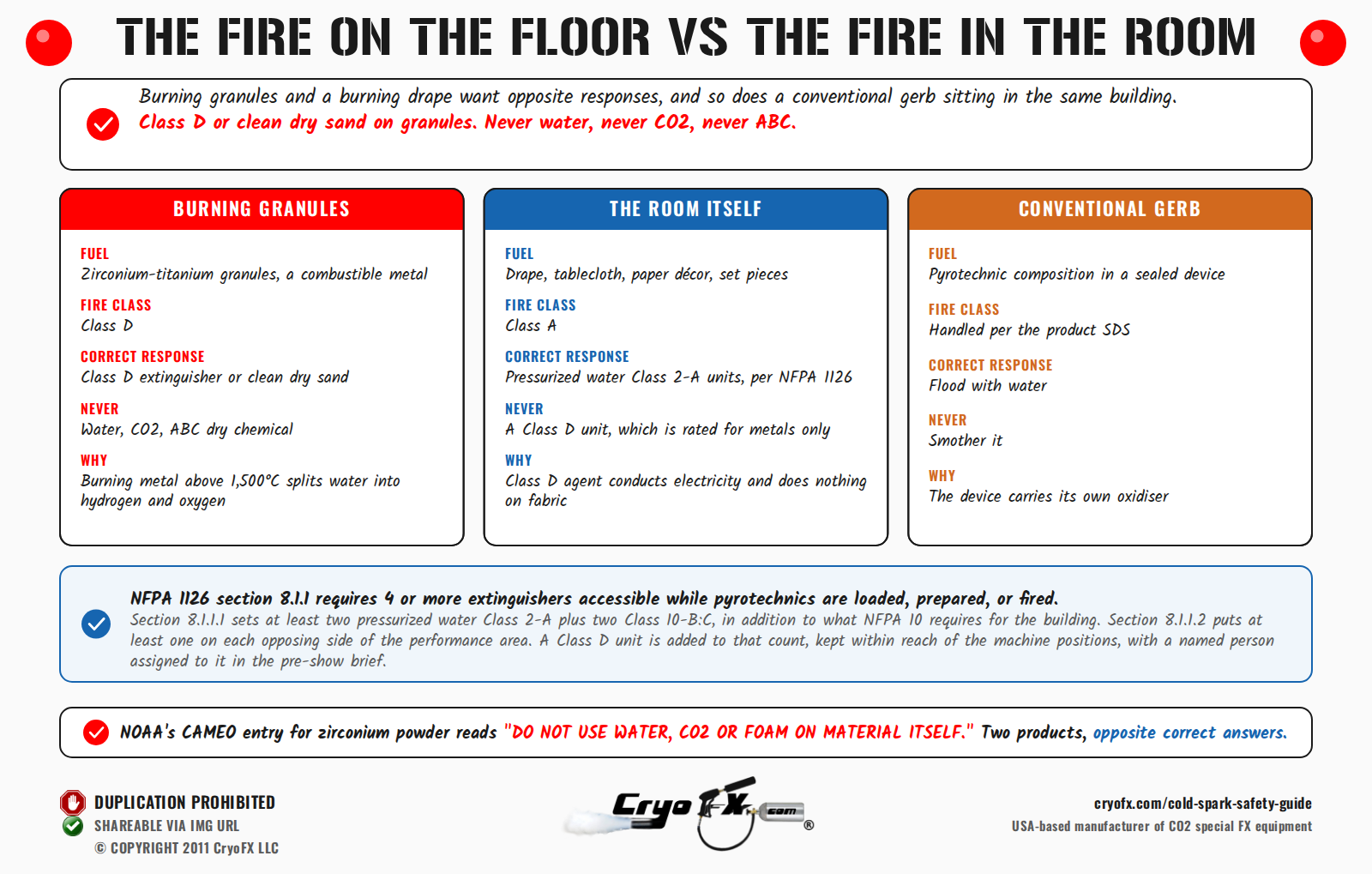
Cold spark granules are a combustible metal, so a burning-granule fire is a Class D fire. Use a Class D extinguisher. Never water, never CO2, never ABC dry chemical.
Events have been stopped because no Class D was on site. An inspector walking the venue after the machines are rigged and the permit is filed will look for the unit at the machine positions, and not finding it is enough to kill the effect for the night. It's inspected, not assumed. Class D listings are also metal-specific, so confirm the unit is listed for titanium and zirconium rather than trusting the yellow label.
A Class D extinguisher is rated for combustible metals only. It has no Class A, B, or C rating, and its agent conducts electricity, so it won't put out a burning drape or tablecloth. Carry conventional Class A protection as well.
Code backs that up. NFPA 1126 section 8.1.1 requires four or more extinguishers accessible while pyrotechnics are loaded, prepared, or fired. Section 8.1.1.1 sets the composition: at least two pressurized water Class 2-A extinguishers and two Class 10-B:C extinguishers, in addition to those required by NFPA 10 for the building. Section 8.1.1.2 puts at least one on each opposing side of the performance area. A Class D unit is added to that count. The water extinguishers cover what's in the room, and they do nothing useful on burning granules.
On the water point, the sourcing is unambiguous. NOAA's CAMEO entry for zirconium powder states "DO NOT USE WATER, CO2 OR FOAM ON MATERIAL ITSELF," and records that zirconium continues burning despite water immersion, with greater intensity than in air. Burning metal above 1,500°C splits water into hydrogen and oxygen, which is why a hose stream on a metal fire makes it larger.
Conventional pyrotechnic gerbs run the opposite way. Their SDS says flood with water and never smother, because the device carries its own oxidiser. Two products in the same building with opposite correct responses, which is covered further on cold spark machines vs pyrotechnics.
Placement follows the code and common sense: one unit on each opposing side of the performance area, Class D units within reach of the machine positions, and a named person assigned to each one in the pre-show brief. An extinguisher nobody has been assigned to is decoration.
Smoke and fire alarms
Cold spark output has set off fire alarms. Detector sensitivity varies enormously between buildings and between detector types in the same building, and there's no reliable way to predict it from the room.
CryoFX has tested CO2 against photoelectric, ionisation, and laser detectors and confirmed it doesn't trigger them. Cold spark output has no such clearance and shouldn't be assumed to behave the same way.
Disclose the effect to the venue's fire safety team before the show, every time. A detection assessment normally means identifying which zones cover the effect area, what detector technology is installed, whether the venue's own procedure calls for a zone to be isolated, and who posts the fire watch during the activation window. That's the venue's decision to make and it needs lead time.
What the incident record actually shows
No fatal fire anywhere has been attributed by investigators to a cold spark machine by name. That's worth stating plainly before the list, because the list gets used carelessly.
Kočani, North Macedonia, March 2025, 63 dead. Conventional gerbs. Trial testimony referred to them as "hot fountains."
Arpora, Goa, India, December 2025, 25 dead. The official finding was "improperly used indoor electrical firecrackers." Eyewitnesses described cold pyro during a dance routine contacting a bamboo and palm-leaf ceiling. The device class was never established.
Qaraqosh, Iraq, September 2023, 100+ dead. The Interior Ministry identified 4 pyrotechnic devices with sparks reaching 4 metres. Some observers described them as cold pyro. The formal finding stopped at "a fiery source touched flammable materials."
A Philippines wedding reception. An electric spark machine was confirmed, and it ignited dried pampas grass. No casualties.
The common factor is the mechanism rather than the device class: a hot particle source, a combustible surface within reach of it, and no clearance in between. Change any one of those and none of these events happens.
The American Pyrotechnics Association separately documents machines catching fire, producing injurious fallout, and setting off alarms. That record is undated and uncounted, so it can't be quantified, and it's still the most relevant industry documentation available.
Outdoor safety variables
Wind is the variable that invalidates a plan that was correct on paper. Sparks carried outside the calculated fallout zone are also outside the 15 feet the permit was issued against. The call to cut the effect is case by case on wind speed and gusts, judged on whether the fall would leave the intended pattern or blow into people, set pieces, or equipment.
Most machines aren't waterproof. Some carry an IP rating for rain exposure, none are soakable, and moisture ruins granules, which is why granules never stay in the hopper between shows.
Never over dry grass, wood decking, hay bales, or anything else that burns. Outdoors is a night-only effect anyway, because daylight erases it.
The pre-show safety check
Walk the fallout zone on the floor and look up from every machine position. Confirm extinguisher type, count, placement, and inspection tags, and assign a person to each unit. Confirm the surface, and collect the treatment certification for anything in the zone that needs one.
Rehearse in a non-live environment before the room fills. Whoever fires needs direct line of sight to the machines, which is why cold spark control sits at the side of stage rather than at front of house, and why the effect stays out of a lighting operator's cue stack on a shared universe. The cold spark machine DMX control page covers the wiring side.
Recount the positions after every room change. That's the lesson from the ranch wedding and it costs 2 minutes.
Training closes the gap that documentation can't. CryoFX runs training on machine use, fire code compliance, and machine care, with a certificate several fire departments have accepted as recognised professional training. Buyers comparing equipment should look for cold spark machines for sale that ship with documented output figures and a manual that states the Class D requirement in writing, because that manual is what an inspector reads when they ask what the machine does.
Frequently asked questions
Are cold spark machines safe?
The machine is safe. There's no combustion chamber, no ignition source, no propellant, and nothing pressurised, so it can't detonate. The operator determines the outcome: where the machine points, what's overhead, what's underfoot, and how far the audience sits. Documented incidents trace to placement and surroundings rather than machine failure. Treat it as pyrotechnic equipment and it behaves predictably.
Are cold spark machines really cold?
No. The word describes how the effect behaves a few feet out. A chamber heats zirconium-titanium granules until they glow, and a blower throws them out incandescent. Anything visibly glowing is hot metal. The sparks shed heat fast in air across a short arc, which is why they can run closer to people than conventional pyrotechnics.
What temperature do cold spark machines run at?
The heating chamber runs roughly 480 to 650°C, about 900 to 1,200°F. Showven units are settable from 480 to 620 with a 580 default. Sparktacular's Pro machines sit at 550 to 600°C. Warm-up is around 5 minutes and varies with voltage and ambient temperature. Particles leave the nozzle glowing and cool quickly in air, though they're hot metal for the length of the arc and wherever they land.
Can cold sparks cause burns?
Yes, at close range. The particles are incandescent metal, so skin contact near the nozzle or inside the fallout zone can burn, and fabric can scorch. The clearance numbers exist for this reason, and it's why operators keep the effect off crowd lines and performer paths. Past the fallout radius the particles have cooled enough that contact is unremarkable.
Can a cold spark machine start a fire?
Yes, when hot particles reach something combustible. The mechanism repeats: glowing metal contacts a surface that burns, that surface ignites, and fire travels overhead or along the floor faster than anyone can reach it. Fabric ceilings, tent liners, palm leaf and bamboo, dried grass, and paper décor are the recurring materials. CryoFX has filmed this deliberately.
How far do cold spark machines need to be from the audience?
NFPA 1126 requires 15 feet or twice the fallout radius, whichever is greater. The second half is the part people drop. A machine throwing 18 feet has a wider fallout radius than a mini, so 15 feet stops being sufficient. Separately, no glowing or flaming particles may come within 10 feet of the audience, wherever the machine sits.
What ceiling height is required?
CryoFX recommends 20 to 25 feet of clearance measured from the top of the machine. What sits overhead matters as much as the number. Nothing combustible can be above the machine: no fabric, paper, wood, stretched fabric ceilings, or tent liners. Metal, concrete, drywall, and plaster are acceptable. A lower ceiling with a hard deck beats a taller one draped in fabric.
What kind of fire extinguisher do cold spark machines need?
A Class D extinguisher, the yellow one. The granules are a combustible metal, so a burning-granule fire is a Class D fire. Never water, never CO2, never ABC dry chemical. A Class D unit is rated for combustible metals only and its agent conducts electricity, so carry conventional Class A protection for the room as well. Conventional pyrotechnic gerbs are the opposite: their SDS says flood with water and never smother, because the device carries its own oxygen.
What happens if there's no Class D extinguisher on site?
The effect gets shut down. Events have been stopped over a missing Class D unit after the machines were rigged and the permit was filed. An inspector looks for it at the machine positions. It's inspected, not assumed.
Do cold spark machines set off fire alarms?
They have. Detector sensitivity varies enormously between buildings. CryoFX has tested CO2 against photoelectric, ionisation, and laser detectors and confirmed it doesn't trigger them; cold spark output has no such clearance and has set alarms off. Disclose the effect to the venue's fire safety team before the show so detection can be assessed.
___
CryoFX® is the leading manufacturer, designer, and global supplier of CO2 special effects equipment and custom special effects systems
for Theme Parks, Sporting Arenas, Meg Nightclubs & Day Clubs , TV/FILM & large scale events & installs in any industry requiring Co2 Systems.
C3ryoFX LLC Global Headquarters • 3859 S Valley View Blvd, Suite 2, Las Vegas, NV 89103 • 1.855.527.9639
Updated - 08/17/2025.