How Much Does A Cold Spark Machine Cost, Counting Everything After The Purchase
How Much Does a Cold Spark Machine Cost to Own? | CryoFX
How Much Does A Cold Spark Machine Cost, Counting Everything After The Purchase
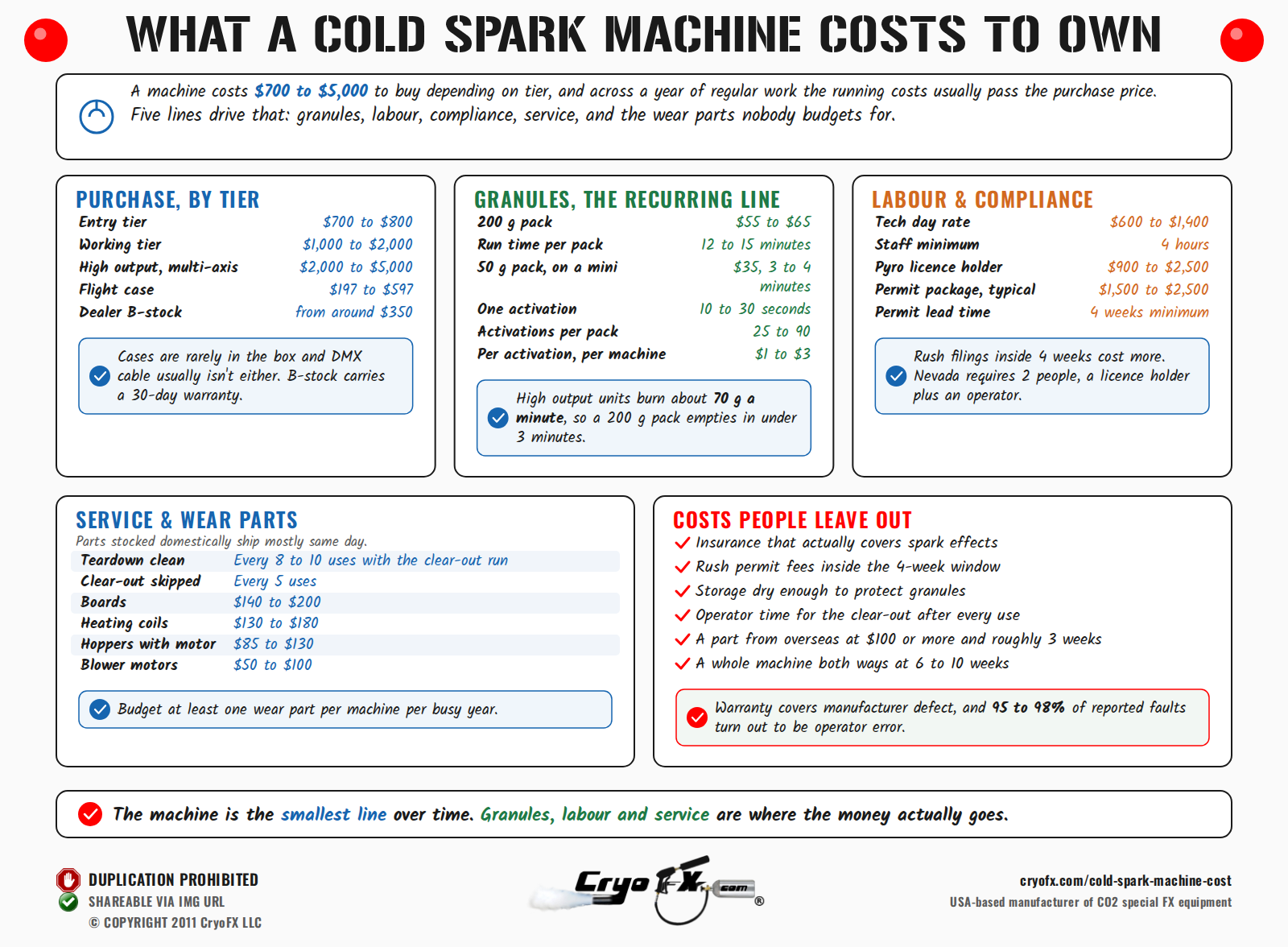
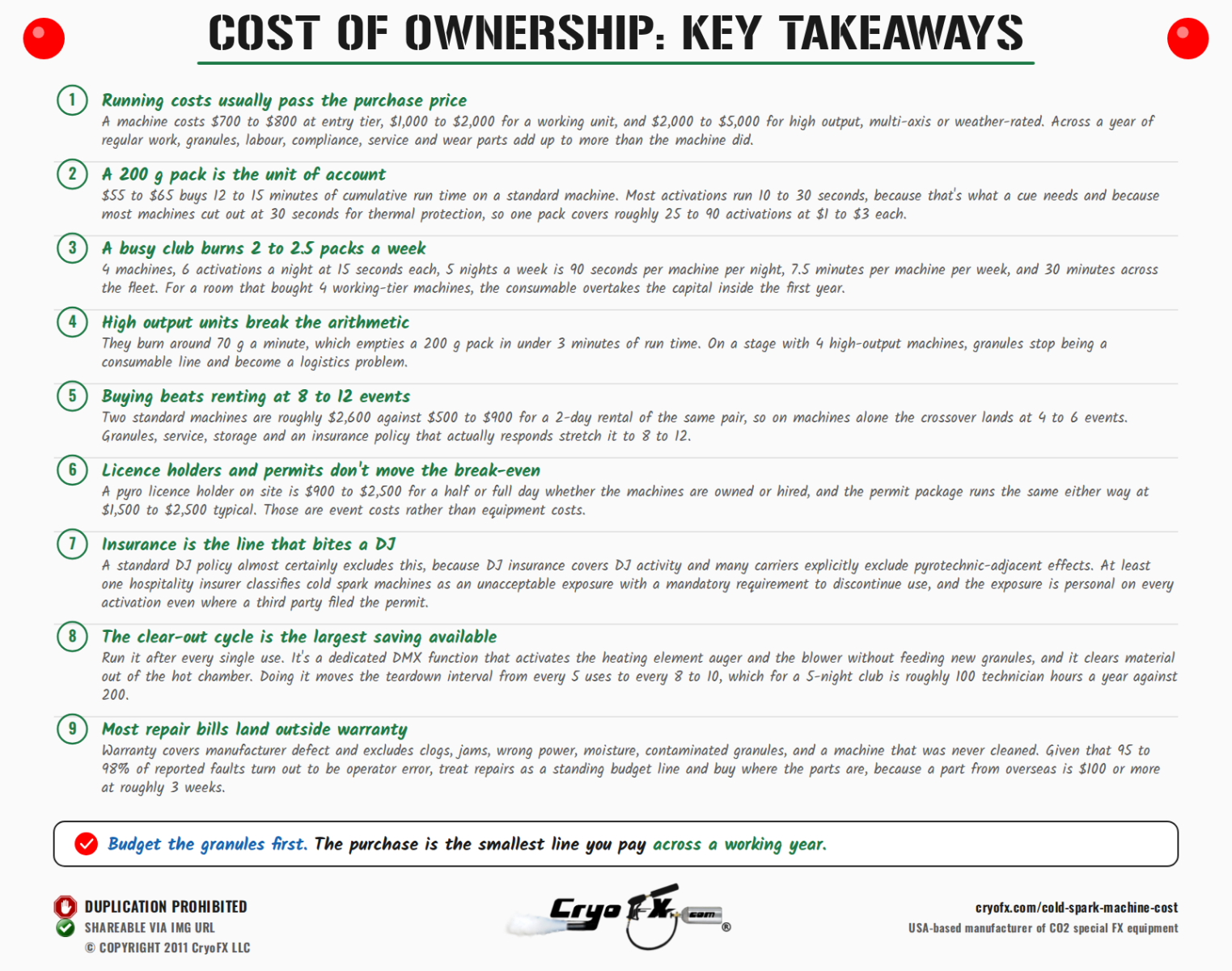
A cold spark machine costs $700 to $5,000 to buy depending on tier, and across a year of regular work the running costs usually pass the purchase price. Five lines drive that: granules, labour, compliance, service, and the wear parts nobody budgets for. A club firing 4 machines five nights a week spends more on granules in a year than it spent on the machines.
The cost model, line by line
| Line | Figure | Frequency |
|---|---|---|
| Machine, entry tier | $700 to $800 | one time |
| Machine, working tier | $1,000 to $2,000 | one time |
| Machine, high output / multi-axis / weather-rated | $2,000 to $5,000 | one time |
| Flight case | $197 to $597 | one time, per machine or pair |
| Granules, 200g (12 to 15 min run time) | $53 to $69 | recurring |
| Granules, 50g (3 to 4 min on a mini) | $35 to $45 | recurring |
| Tech day rate | $900 to $1,200, 4-hour minimum | per call |
| Pyro licence holder on site | $900 to $2,500 half or full day | per event where required |
| Permit package | $1,500 to $2,500 typical, $900 to $2,500 full range | per event where required |
| Wear parts, Showven boards and elements | $40 to $200 per part | as needed |
| Out-of-warranty service | bench fee up front, credits toward repair | as needed |
Machine class and what separates the tiers are covered in the complete guide to cold spark machines. The rest of this page is what happens after the machine arrives.
Granule cost per activation, worked out
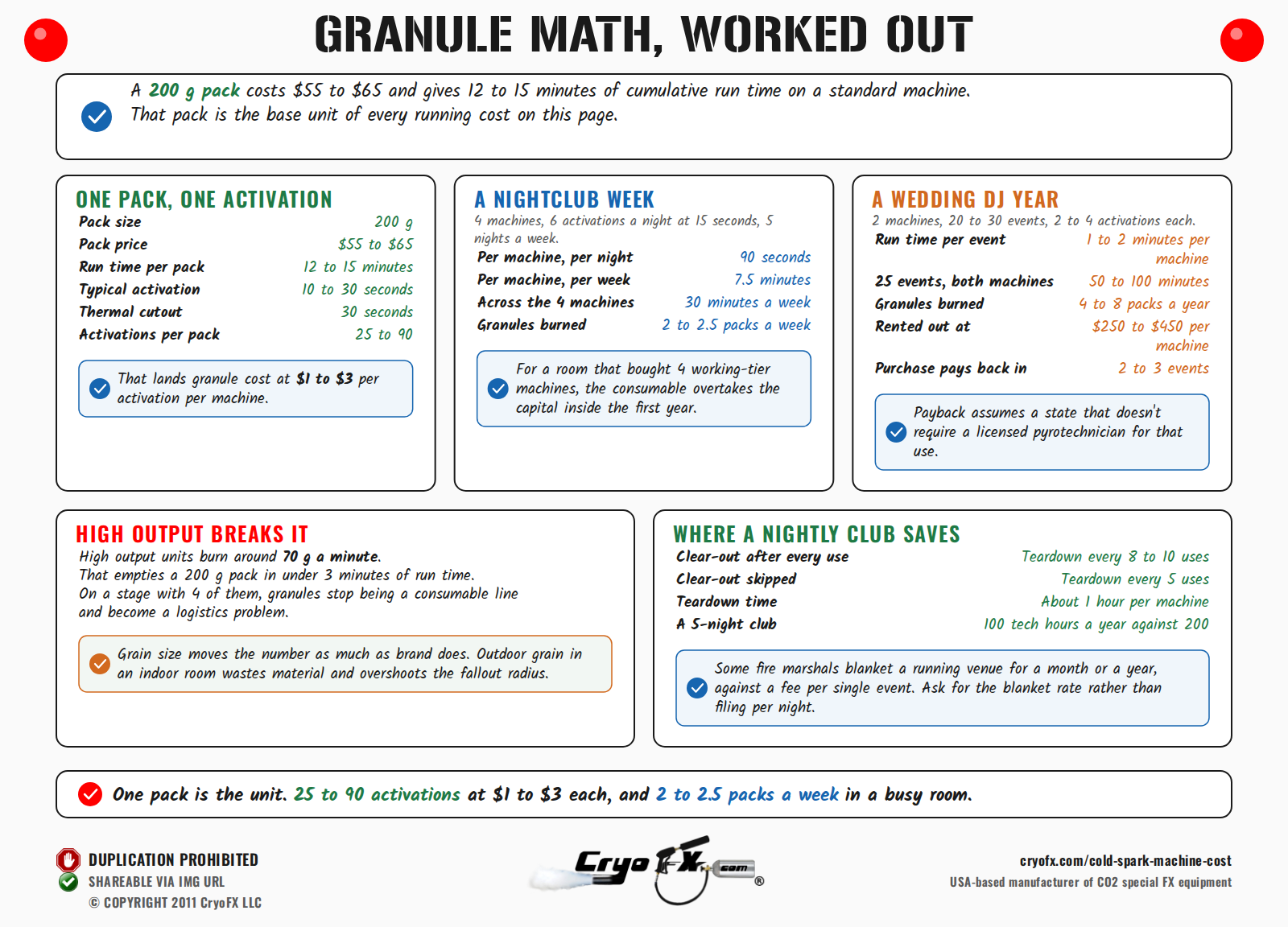
A 200g pack costs $53 to $69 and gives 12 to 15 minutes of cumulative run time on a standard machine. That's the base unit of every calculation here.
Most activations run 10 to 30 seconds, because that's what a cue needs and because most machines cut out at 30 seconds for thermal protection. Divide 12 to 15 minutes by a 10 to 30 second blast and one pack covers roughly 25 to 90 activations.
That lands granule cost at $1 to $3 per activation per machine. It sounds trivial until you multiply it by machine count and by nights.
High-output units break the arithmetic. They burn around 70g a minute, which empties a 200g pack in under 3 minutes of run time. On a stage with 4 high-output machines, granules stop being a consumable line and become a logistics problem.
Grain size and storage change the number as much as brand does. Buying outdoor grain for an indoor room wastes material and blows past the fallout radius you drew on the plot, and moisture ruins a pack outright, which is covered on the cold spark granules page. Nothing gets left in a hopper between shows.
The weekly math for a nightclub
Take a venue running 4 machines, 6 activations a night at 15 seconds each, 5 nights a week.
That's 90 seconds of run time per machine per night, 7.5 minutes per machine per week, 30 minutes across the fleet. At 12 to 15 minutes per pack, the club burns 2 to 2.5 packs of granules a week.
Weekly granule spend: roughly $120 to $150. Annually, $6,000 to $7,500. For a room that bought 4 working-tier machines for maybe $6,000, the consumable overtakes the capital inside the first year.
Service cadence at 5 uses a week matters more than the parts bill. A full teardown clean is due every 8 to 10 uses if the clear-out function is run after every show, and every 5 uses if it isn't. Running the clear-out religiously moves that club from a weekly teardown to a fortnightly one, which is roughly 100 hours of technician time a year against 200.
Permits are where a nightly venue saves real money. Some fire marshals will blanket a running venue at a couple of hundred dollars for a month or a year, against a couple of hundred per single event. A club firing 3 to 5 nights a week should be asking for the blanket or reduced rate rather than filing per night, and the fire permit information page covers how the filing works.
The annual math for a wedding DJ
Two machines, 20 to 30 events a year, typically 2 to 4 activations per event across an entrance, a first dance, and a send-off.
At roughly 1 to 2 minutes of run time per machine per event, 25 events consumes 50 to 100 minutes across the pair. That's 4 to 8 packs a year, or $210 to $550 in granules. Granules are the small line at this volume.
Insurance is the one that bites. A standard DJ policy almost certainly excludes this, because DJ insurance covers DJ activity and many carriers explicitly exclude pyrotechnic-adjacent effects. At least one hospitality insurer classifies cold spark machines as an unacceptable exposure with a mandatory requirement to discontinue use, and the exposure is personal on every activation even where a third party filed the permit. What to look for in policy language sits on the cold spark machine insurance page.
Permits are the second exposure. Public events need one in practical terms everywhere, with a 4-week working minimum and rush fees inside that. A private wedding at a private venue is treated differently by jurisdiction, and the answer varies by city, county, and venue rather than by state.
The number that changes a DJ's arithmetic is on the revenue side. Buy 2 machines plus training, work in a state that doesn't require a licensed pyrotechnician for that use, rent them out at $250 to $400 per machine per event, and the purchase pays back in 2 to 3 events. After that the granule line is a rounding error against the booking fee.
Break-even against renting
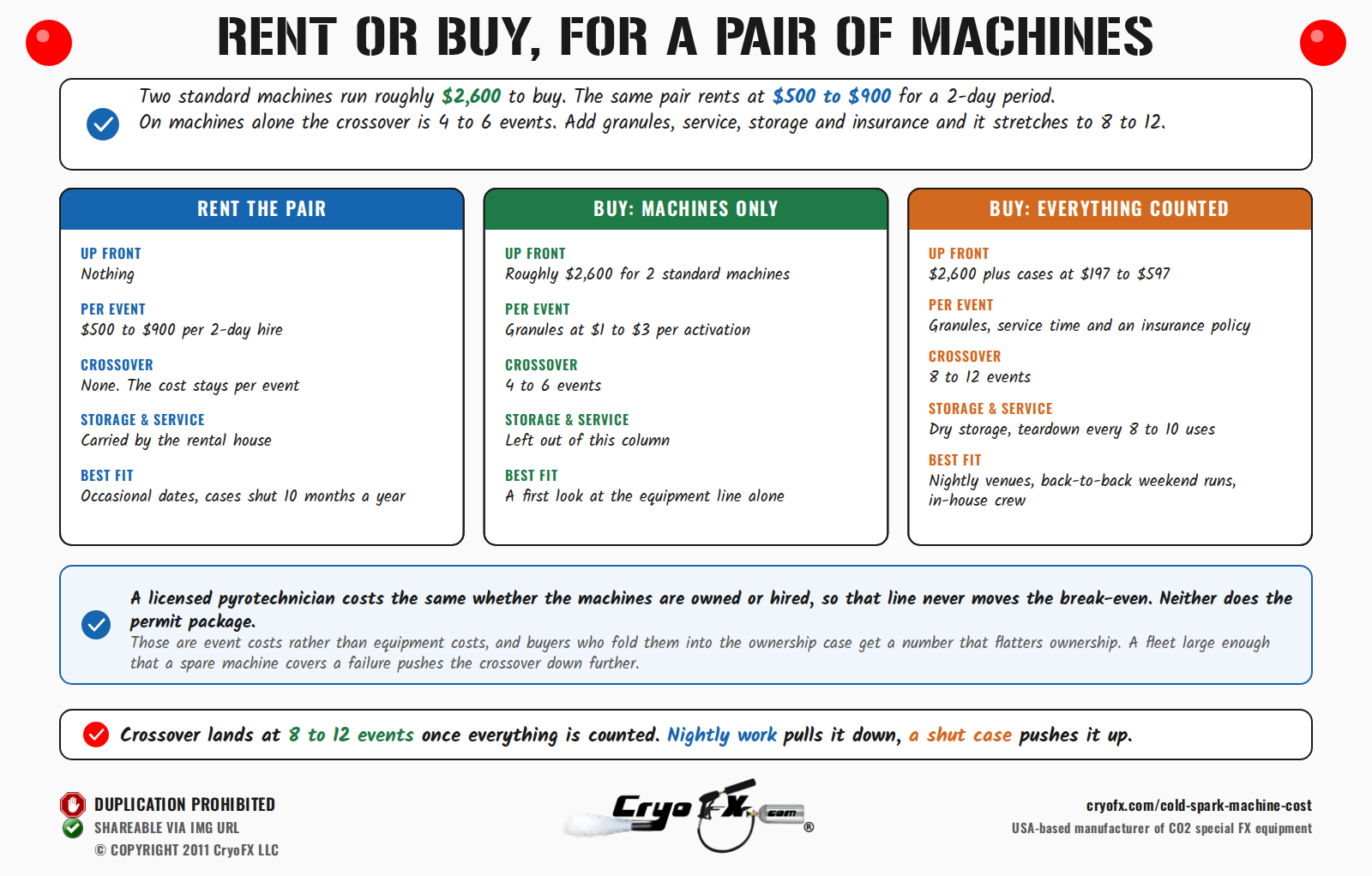
Two standard machines run roughly $2,600 to buy. The same pair rents at $500 to $900 for a 2-day period.
On machines alone the crossover is 4 to 6 events. Add granules, service, storage, and an insurance policy that actually responds, and it stretches to 8 to 12.
A licensed pyrotechnician costs the same whether the machines are owned or hired, so that line never moves the break-even. Neither does the permit package. Those are event costs, not equipment costs, and buyers who fold them into the ownership case get a number that flatters ownership.
What pushes the crossover up: storage that has to stay dry, service time, insurance, and 10 months of the year with the cases shut. What pushes it down: nightly venues, back-to-back weekend runs, an in-house crew already on payroll, and a fleet large enough that a spare machine covers a failure.
Rental rates, staffing minimums, delivery, and deposits sit on the cold spark machine rental page. If you've crossed the line and you're pricing a pair, volume pricing applies on 2, 4, or 6 units bought together with the current stock on cold spark machines for sale.
Costs people leave out of the model
Wear parts. Everything that moves or heats eventually goes. Showven Sparkular parts price at $175 to $200 for a board, $130 to $160 for a heating coil, $85 to $125 for a hopper with motor, $60 to $100 for a blower motor, and $40 to $60 for a top panel with hopper lid. Mini parts run $140 to $180 for a main board, $150 to $180 for a heating coil, $90 to $130 for a hopper with motor, $50 to $90 for a blower motor, and $40 to $70 for a hopper lid. The equivalent iSparkFX parts are [INSERT ISPARKFX PART PRICE HERE]. Budget at least one wear part per machine per busy year.
DMX and electronics boards take the worst of it, because connectors get abused by repeated connect and disconnect at venues, and because a shared circuit that spikes will take boards out wholesale. On one convention centre job where a client left power tools running on the same circuits against a dedicated-power requirement, the resulting spike blew the power boards on 6 machines at once.
[EMBED youtu.be/aMaMYAOry9M, diagnosing cold spark machine faults, with VideoObject schema]
Flight cases and DMX cable. Cases are $197 to $597 and are rarely in the box. DMX cable usually isn't either.
The used-machine trap. A private-party unit hides motor and impeller wear completely, and granule history is unknowable. Wrong granules damage a chamber in ways that don't show up until the first show. Dealer B-stock and C-stock from around $350 has been stripped, chamber cleared, hoppers emptied, blown through, augers verified, and confirmed at full output, on a 30-day warranty.
Import repair economics. A part from overseas is $100 or more at roughly 3 weeks. The whole machine both ways is a few hundred dollars at 6 to 10 weeks. Either route approaches the price of a second machine, and neither covers the booking you already accepted, because there are no loaner machines in this industry.
Warranty scope. Warranty covers manufacturer defect. It excludes clogs, jams, wrong power, moisture, contaminated granules, and a machine that was never cleaned. Given that 95 to 98% of reported faults turn out to be operator error, most repair bills land outside warranty regardless of how long the warranty runs. Treat repairs as a standing budget line.
Where the money is actually saved
Run the clear-out function after every single use. It's a dedicated DMX function that activates the heating element auger and the blower without feeding new granules, and it clears material out of the hot chamber. Doing it moves the teardown interval from every 5 uses to every 8 to 10, which is the single largest cost saving available to an owner. Tipping the machine to empty the hopper and running a full cycle afterwards clears the feed path as well.
[EMBED youtu.be/de9_5Tjn6QE, cleaning a cold spark machine, with VideoObject schema]
Use the correct grain and store it sealed, dry, and off the floor. Damp or compacted granules are the most common cause of weak output, and weak output is the most common reason a working machine gets shipped for repair.
Buy where the parts are. A same-day part against 3 weeks of overseas freight is the difference between a Tuesday fix and a cancelled weekend. The full procedure, the fault-by-fault diagnosis, and what the intake audit checks before a repair quote are on the cold spark machine maintenance page.
Take the extended warranty on a machine that's going to work hard. 1 year is standard on iSparkFX against the 90 days most manufacturers give, and 2 and 3 year extensions are available on both iSparkFX and Showven.
Frequently asked questions
What does a cold spark machine cost in total, not just to buy?
The machine is the smallest line over time. A $1,299 unit picks up granules at $53 to $69 per 200g pack, labour at a 4-hour minimum per call, permit filing on public events, an insurance policy that actually covers spark effects, storage, and service every 5 to 10 uses. Across a year of regular work, running costs usually exceed the purchase price.
How much do granules cost per activation?
A 200g pack at $53 to $69 gives 12 to 15 minutes of cumulative run time on a standard machine. Most activations run 10 to 30 seconds before the thermal timeout, so one pack covers roughly 25 to 90 activations depending on blast length. That works out at $1 to $3 per activation per machine. High-output units burn about 70g a minute, so their cost per second climbs sharply.
What does it cost to run cold spark machines nightly at a club?
Take 4 machines firing 6 activations a night at 15 seconds each, 5 nights a week. That's 7.5 minutes of run time per machine per week, a little over half a 200g pack each, roughly $120 to $150 a week in granules across all 4, or $6,000 to $7,500 a year. Add a full teardown clean every 8 to 10 uses, wear parts, and the operator's time on top.
How many events until buying beats renting?
Compare 2 standard machines at roughly $2,600 to buy against $500 to $900 per 2-day rental. On machines alone the crossover lands around 4 to 6 events. Add granules, service, storage, and insurance to the owned column and it stretches to 8 to 12. A licensed pyrotechnician costs the same either way, so that line doesn't move the break-even.
What are the hidden costs of owning a cold spark machine?
Insurance that actually covers spark effects, which a standard DJ policy almost certainly excludes. Permit filing and rush fees inside the 4-week window. Flight cases at $197 to $597, usually an upsell. Wear parts: heating elements, hoppers, blowers, augers, DMX and electronics boards. Storage dry enough to protect granules, since moisture ruins them. And operator time for the clear-out cycle after every single use.
How much should I budget for permits and labour?
Labour first: staff book at a 4-hour minimum and a regular tech day rate is $900 to $1,200 depending on seniority, block length, and date. A pyro licence holder on site is $900 to $2,500 for a half or full day, separate from permit package fees, which run $1,500 to $2,500 typically. Rush filings inside 4 weeks cost more. Nevada requires 2 people, a licence holder plus an operator.
What does servicing cost per year?
Most of it is time. A full teardown clean every 8 to 10 uses, or every 5 if the clear-out function gets skipped after shows, takes about an hour per machine. Parts are the cash line: boards at $140 to $200, heating coils at $130 to $180, hoppers with motor at $85 to $130, blower motors at $50 to $100, stocked domestically and mostly shipping same day. Budget at least one wear part per machine per busy year.
___
CryoFX® is the leading manufacturer, designer, and global supplier of CO2 special effects equipment and custom special effects systems
for Theme Parks, Sporting Arenas, Mega Nightclubs & Day Clubs , TV/FILM & large scale events & installs in any industry requiring Co2 Systems.
CryoFX LLC Global Headquarters • 3859 S Valley View Blvd, Suite 2, Las Vegas, NV 89103 • 1.855.527.9639
Updated - 08/12/2026.