Fire Permit Information for Cold Spark Machines & Pyro / Flames
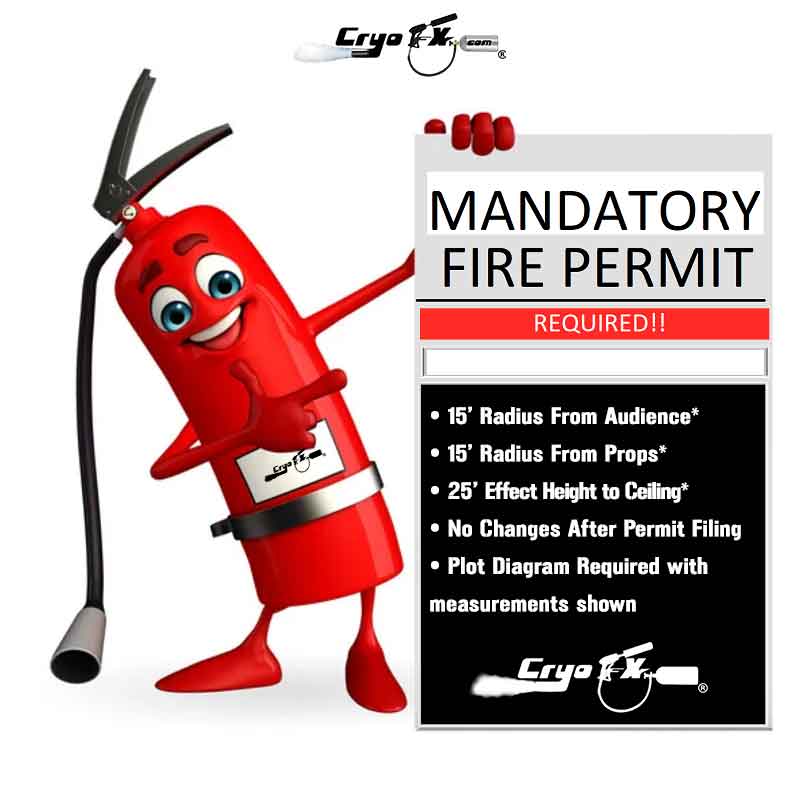
Fire Permit Information For Cold Spark Machines And Co2 Effects
Cold spark machines need a fire permit almost anywhere the public is present. NFPA 1126 and International Fire Code Section 5608 treat them as pyrotechnics before a proximate audience, and Section 5608.2.2 requires a permit plus NFPA 1126 compliance. What varies by location is which office issues the permit, what the package has to contain, and how long the review takes.
This page deals only with approval. If you want the equipment side first, the cold spark machine information guide explains what the machines are and how the effect is produced. CO2 effects sit on a different permitting path and get their own section further down, because the two frequently appear on the same show and the filing has to account for both.
How code classifies a cold spark machine
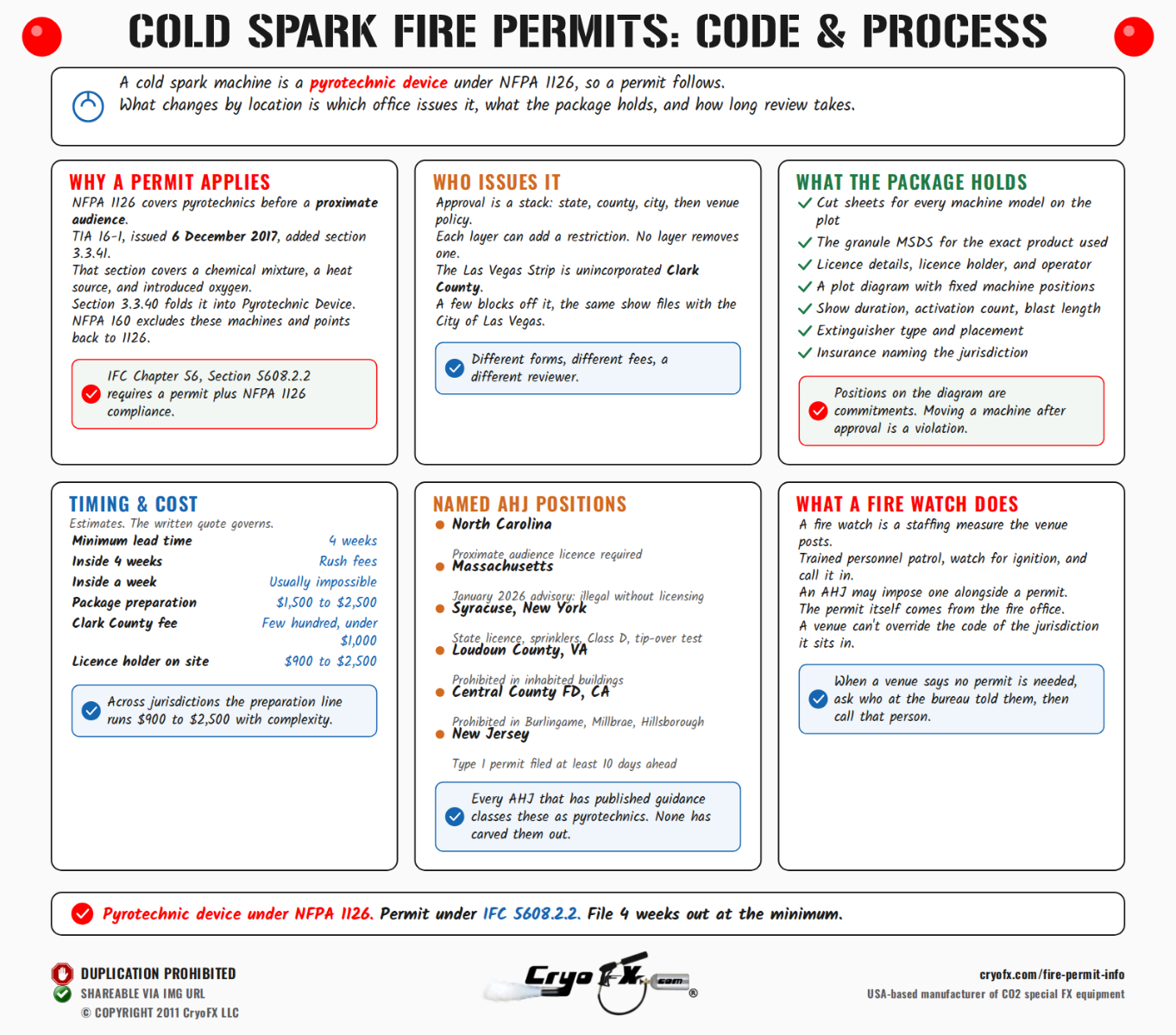
NFPA 1126 is the "Standard for the Use of Pyrotechnics Before a Proximate Audience." It's the document a fire marshal reaches for when an effect fires in the same room as people.
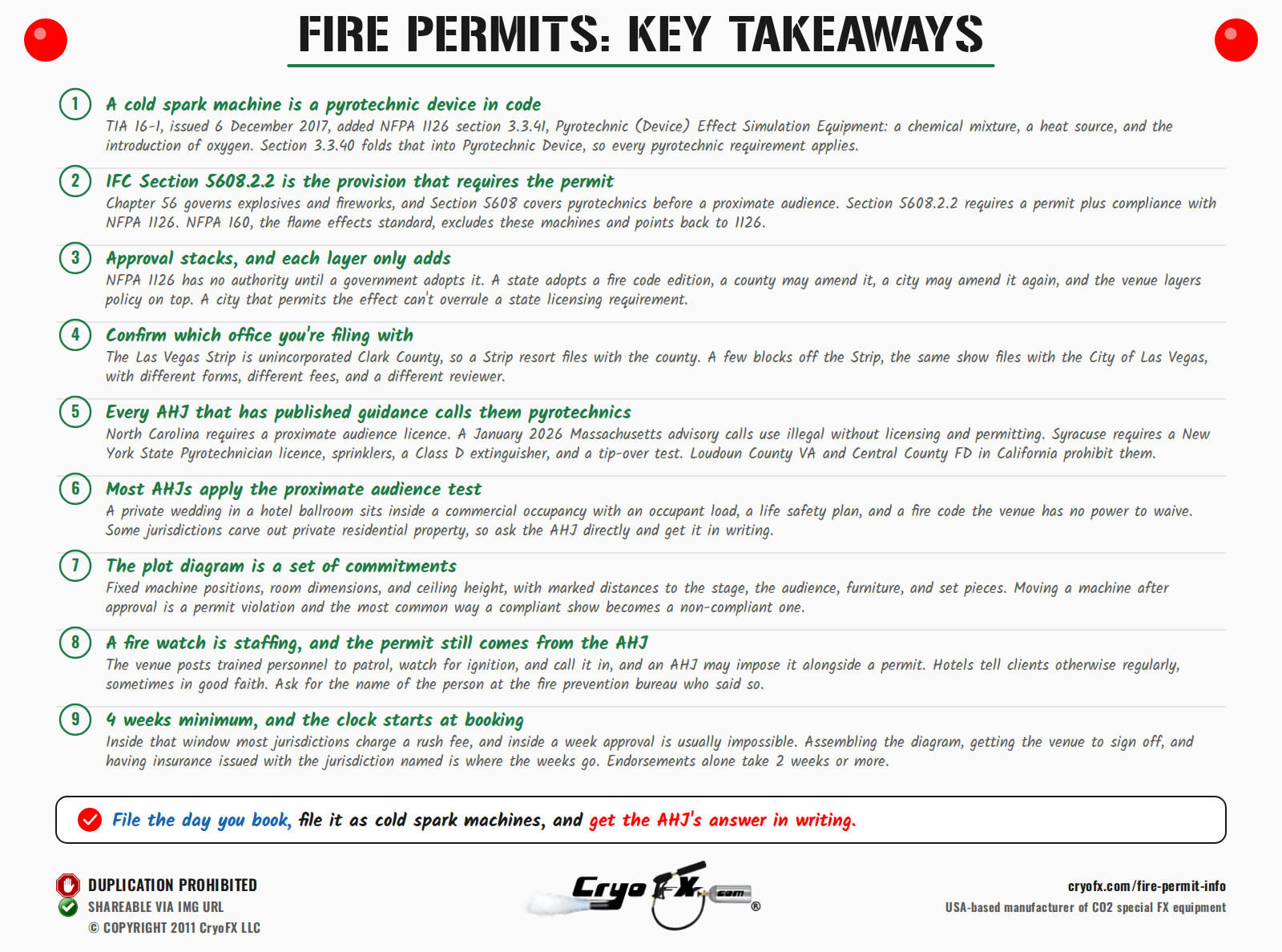
TIA 16-1, issued 6 December 2017, added section 3.3.41 to that standard: "Pyrotechnic (Device) Effect Simulation Equipment," defined as equipment that uses a chemical mixture, a heat source, and the introduction of oxygen to initiate or maintain combustion, to produce visible or audible effects.
Read that definition against the machine and it lands cleanly. The granules are a chemical mixture of zirconium and titanium. The heating chamber is a heat source. The blower introduces air, which is where the oxygen comes from. Combustion is maintained for the length of the arc.
Section 3.3.40 then folds pyrotechnic effect simulation equipment into the definition of "Pyrotechnic Device." That single move is why every requirement written for pyrotechnics applies to a cold spark machine, including licensing, clearances, extinguisher provision, and the permit itself.
NFPA 160, which covers flame effects, explicitly excludes these machines and points back to 1126. There's no gap between the two standards for a machine to sit in.
On the building code side, IFC Chapter 56 governs explosives and fireworks, and Section 5608 covers pyrotechnics before a proximate audience. Section 5608.2.2 is the operative subsection: a permit is required and the use has to comply with NFPA 1126.
The argument that fails at the permit counter is "it's cold, so it isn't pyro." The definition turns on a heat source plus the introduction of oxygen, both of which the machine does by design. Arguing the temperature question with a plan reviewer costs credibility that's needed later in the same conversation.
CryoFX files everything as "cold spark machines" and makes the distinction explicitly with the fire marshal on every application. The phrase "cold fireworks" belongs nowhere on a filing, because it invites a reviewer to apply fireworks rules that were never written for this equipment.
How jurisdiction stacks
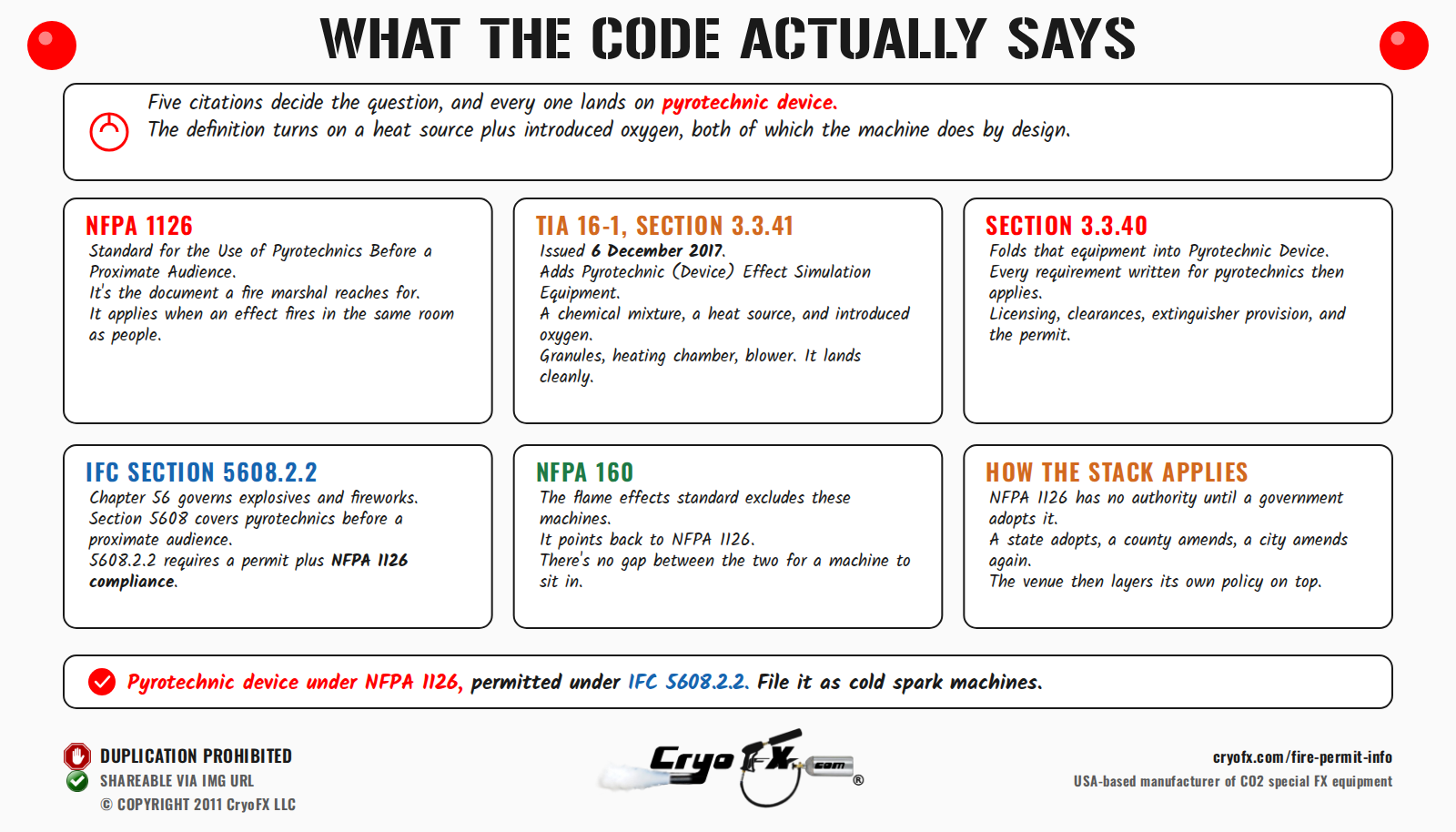
Approval is a stack. NFPA 1126 is a national consensus standard with no authority until a government adopts it. A state adopts a fire code edition, a county may amend it, a city may amend it again, and the venue then layers its own policy on top.
Each layer can add restriction. No layer can remove one. A city that permits the effect can't overrule a state licensing requirement, and a venue that allows it can't overrule the city.
The worked example that catches out-of-town producers: the Las Vegas Strip is unincorporated Clark County, so a show at a Strip resort files with the county. Move a few blocks off the Strip and the same show files with the City of Las Vegas, with different forms, different fees, and a different reviewer.
Fire prevention bureaus also impose conditions that sit outside the printed code. Requiring cold spark machines on their own DMX universe with their own controller and cables is a common one, encountered in California, other states, and Clark County depending on the packet reviewer and the on-site inspector. The reasoning is that a patch error on a shared universe can put voltage on a firing channel, and the cold spark machine DMX control page covers how that's wired.
Named AHJ positions on cold spark machines
Every authority having jurisdiction that has published cold spark guidance has classified the machines as pyrotechnics. None has carved them out.
- North Carolina Office of State Fire Marshal: a proximate audience licence is required.
- Massachusetts State Fire Marshal: a January 2026 advisory states that use is illegal without licensing and permitting.
- Syracuse, New York: illegal without a New York State Pyrotechnician licence, and conditions include a sprinklered building, a Class D extinguisher, a tip-over test, and 10 feet of clearance.
- Loudoun County, Virginia: prohibited in inhabited buildings.
- Central County Fire Department, California: prohibited outright in Burlingame, Millbrae, and Hillsborough, citing California Health and Safety Code 12505, which classes titanium and zirconium ignitable compounds as Dangerous Fireworks.
- New Jersey jurisdictions: a Class D extinguisher with a current inspection tag, 10 feet of clearance from combustibles, a Type 1 permit filed at least 10 days ahead, and a floor plan showing machine locations.
- Columbia, South Carolina has published guidance as well.
No Clark County or FDNY bulletin specific to cold spark machines exists. Where there's no dedicated bulletin, the general pyrotechnic rules apply, which is a heavier requirement rather than a lighter one.
Public versus private events
The test most AHJs apply is the proximate audience. Ticket sales don't enter into it, because the condition the code was written around is people sitting in the same room as the effect.
A private wedding in a hotel ballroom sits inside a commercial occupancy with an occupant load, a life safety plan, and a fire code the venue has no power to waive. The guest list being private changes nothing about the building.
Some jurisdictions carve out private residential property, and a handful treat a backyard differently from a banquet hall. Interpretations differ across county lines, so ask the AHJ directly and get the answer in writing. A verbal yes from a duty officer is worth very little when an inspector arrives on show day.
What goes in a permit package
Equipment and material documents
Cut sheets for every machine model on the plot, showing wattage, output height, weight, and dimensions. The granule MSDS, matched to the exact product being used rather than a generic sheet for the brand.
Licence and personnel
The pyrotechnic licence details, plus the identity of the licence holder and the identity of the operator. Nevada requires two people: a licence holder whose licence covers that machine type and use, and a separate operator running the machines. Most other states allow one person to hold both roles. A planner or DJ filing against someone else's licence is a pattern AHJs recognise quickly.
The plot diagram
Fixed machine positions, room dimensions, and ceiling height, with marked distances to the stage, the audience, furniture, and set pieces. Positions on the diagram are commitments. Moving a machine after approval is a permit violation and it's the single most common way a compliant show becomes a non-compliant one.
Show data
Show duration, activation count, and blast length per activation. Extinguisher type and placement, which gets verified on site rather than taken on trust. Some offices also request air exchange figures for the room.
Certification and listing questions
Almost no cold spark machine on the market carries UL, ETL, or CSA listing. Most carry CE, RoHS, and FCC marks. In the overwhelming majority of filings the absence of an NRTL listing raises no issue, because no standard package asks for one, and the American Pyrotechnics Association notes that where manufacturers have obtained such approvals they cover electrical integrity rather than effect safety.
It does come up occasionally. CryoFX has had permits rejected in specific jurisdictions on the grounds that the machines weren't UL, ETL, or CSA certified and stamped. The response that worked was a letter explaining what full listing involves and how long it takes, plus a request for an in-person demonstration with the casing off, so the agency could see the mechanism and confirm the enclosure is metal and an internal failure isn't exposed externally. Conditional use was granted. That's a case-by-case outcome, not a guarantee.
Insurance is its own document set, and the jurisdiction has to be named on the certificate before the office will process the package. The cold spark machine insurance page covers limits, endorsements, and what a permit-ready certificate has to say.
Clearances and on-site safety procedure are captured in the diagram and the show data, and the numbers behind them are on the cold spark machine safety guide.
[INSERT PERMIT PACKAGE CHECKLIST INFOGRAPHIC HERE]
Permitting CO2 effects on the same show
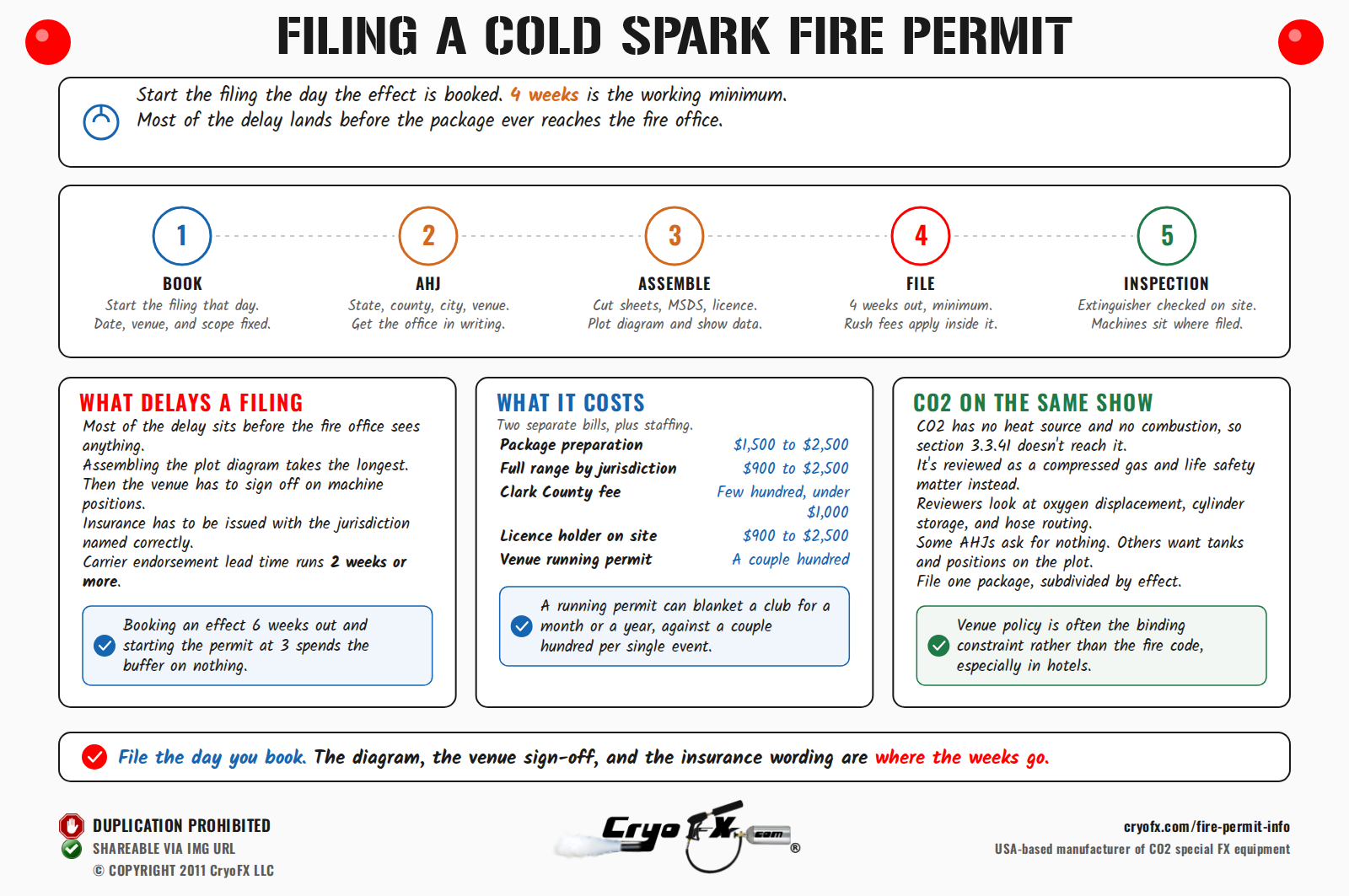
CO2 effects don't meet the section 3.3.41 definition. There's no heat source and no combustion, so a CO2 jet or cannon sits outside the pyrotechnic permit in most jurisdictions and is reviewed as a compressed gas and life safety matter instead.
What a reviewer looks at for CO2 is different in kind: oxygen displacement in enclosed or low-lying spaces, cylinder storage and securing, hose routing, and cryogenic contact risk. Some AHJs ask for nothing at all. Others want the cannon positions on the same plot diagram as everything else, with tank quantities and locations listed. Venue policy is often the binding constraint rather than the fire code, particularly in hotels with air handling concerns. The CO2 cannon information guide covers the equipment and the operating detail.
Where a single show carries both effect types, file one package subdivided by effect. Mixed cold spark and conventional pyrotechnic shows work the same way: one submission, sections per effect, potentially with more than one plan reviewer and more than one inspector attached to it.
Timing, rush fees, and what actually delays a filing
4 weeks minimum. Inside that window most jurisdictions charge a rush fee, and inside a week approval is usually impossible regardless of what anybody pays.
Most of the delay happens before the package ever reaches the fire office. Assembling the plot diagram, getting the venue to sign off on machine positions, and having insurance issued with the jurisdiction named correctly is where the weeks go. Endorsement lead time from a carrier runs 2 weeks or more on its own, sometimes faster at extra cost.
Start the filing the day the effect is booked. A production that books an effect 6 weeks out and starts the permit at 3 weeks has spent its buffer on nothing.
Costs run in two parts. CryoFX charges for preparing and submitting the package, realistically $1,500 to $2,500, with $900 to $2,500 as the full range depending on jurisdiction and complexity. The jurisdiction's own fee is separate: Clark County's runs from a few hundred dollars to under $1,000, on top of a business pyro permit and other prerequisites that have to be in place before anything can be filed. A licence holder on site is a further line item, $900 to $2,500 for a half or full day.
Venues running the effect regularly should ask about a running permit. Some fire marshals will blanket a club at a couple hundred dollars for a month or a year, against a couple hundred per single event. A room running 3 to 5 nights a week gets a blanket or reduced rate rather than per-night pricing.
The fire watch misconception
A fire watch is a staffing measure. The venue posts trained personnel to patrol, watch for ignition, and call it in. It's a condition an AHJ may impose alongside a permit.
It isn't a permit and it doesn't replace one. A venue cannot override the code of the jurisdiction it sits in, and no amount of internal policy grants an approval the fire office hasn't issued.
Hotels tell clients the opposite regularly, sometimes in good faith, because internal policy is what their staff deals with every day and the permit process sits with vendors they don't see. When a venue says no permit is needed, ask for the name of the person at the fire prevention bureau who told them, and call that person. The answer usually arrives inside 10 minutes.
Self-operated rentals and downstream liability
A rental company that hands machines to somebody circumventing fire code is liable downstream. That's the reason CryoFX underwrites self-operated rentals rather than treating them as counter sales.
Before machines are released, CryoFX needs the event date and time, the location, who's operating, whether the event is public or private, the activation count and timing, the blast duration, and a venue plot diagram. That's enough to determine whether a pyrotechnic licence is required in that jurisdiction and whether the job can go out at all.
CryoFX also runs training on machine use, fire code compliance, rental operations, and machine care, including a version aimed at DJs and wedding vendors. The certificate has been accepted by several fire departments as recognised professional training. Cost depends on the person, the level, the headcount, and whether a certificate is issued.
For operators building a business around the effect, buying beats renting past a handful of events, and the cold spark machines for sale range ships with the cut sheets and manuals a permit package needs, which removes the document-chasing step from every future filing.
Frequently asked questions
Do cold spark machines require a fire permit?
In practical terms, yes, anywhere the public is present. NFPA 1126 and IFC Section 5608 treat these as pyrotechnics before a proximate audience, and Section 5608.2.2 requires a permit plus NFPA 1126 compliance. Some jurisdictions handle private residential use differently, but state, county, city, and venue can each add a requirement on top. Confirm with the AHJ in writing.
Are cold spark machines classified as pyrotechnics?
Yes. TIA 16-1, issued 6 December 2017, added NFPA 1126 section 3.3.41, "Pyrotechnic (Device) Effect Simulation Equipment," covering equipment that uses a chemical mixture, a heat source, and the introduction of oxygen to initiate or maintain combustion for visible or audible effects. Section 3.3.40 folds that into "Pyrotechnic Device." NFPA 160 excludes these machines and points back to 1126.
What documents does a fire marshal require?
Equipment cut sheets, the granule MSDS, insurance naming the jurisdiction, pyrotechnic licence details with the licence holder's and operator's identities, and a plot diagram showing fixed machine positions, room dimensions, ceiling height, and marked distances to stage, audience, furniture, and set pieces. Add show duration, activation count, blast length, and extinguisher type and placement. Some offices also request air exchange figures.
How far in advance do I need to file a permit?
4 weeks minimum. Inside that window most jurisdictions charge a rush fee, and inside a week it's usually impossible. The lead time isn't only the fire office's review. It's assembling the plot diagram, getting the venue to sign off, and having insurance issued with the correct wording. Start the filing when the effect is booked.
Does a private event need a permit?
Often yes. What matters to most AHJs is the proximate audience rather than ticket sales. A private wedding in a hotel ballroom still sits inside a commercial occupancy with an occupant load and a fire code the venue can't waive. Some jurisdictions carve out private residential property. Ask the AHJ directly, because interpretations differ across county lines.
Our venue has a fire watch, do we still need a permit?
Yes. A fire watch is a staffing measure the venue puts in place. It doesn't grant a permit, and a venue can't override the code of the jurisdiction it sits in. Hotels tell clients otherwise regularly, sometimes in good faith, because internal policy is what they deal with daily. The permit comes from the AHJ.
Do permit requirements differ by state?
Substantially. North Carolina's Office of State Fire Marshal requires a proximate audience licence. Massachusetts issued a January 2026 advisory calling use illegal without licensing and permitting. Syracuse requires a New York State Pyrotechnician licence, a sprinklered building, a Class D extinguisher, and a tip-over test. Loudoun County VA prohibits them in inhabited buildings, and Central County Fire Department in California prohibits them outright.
Who is allowed to file the permit?
Whoever holds the pyrotechnic licence covering that machine type and use. Their name goes on the application alongside the operator's in most jurisdictions. Nevada requires two people: the licence holder, plus a separate operator running the machines. Other states let one person do both. A DJ or planner filing against someone else's licence is something AHJs catch.
What happens if we use a machine without a permit?
The usual outcome is the fire marshal shutting the effect down on arrival, so the show runs without it. Then come fines, risk to the venue's own permits, and a denied insurance claim, since the activity was unpermitted. If something ignites, unpermitted use becomes the centre of the liability question and it lands on whoever ran the machine.
*CryoFX reserves the right to update this page at any time without notice.
Updated - 08/13/2026.