Cold Spark Machine Insurance: What's Covered & What's Excluded
Cold Spark Machine Insurance: Coverage, Limits, COIs | CryoFX
Cold Spark Machine Insurance: What's Covered, What's Excluded, And What A Venue Will Actually Accept
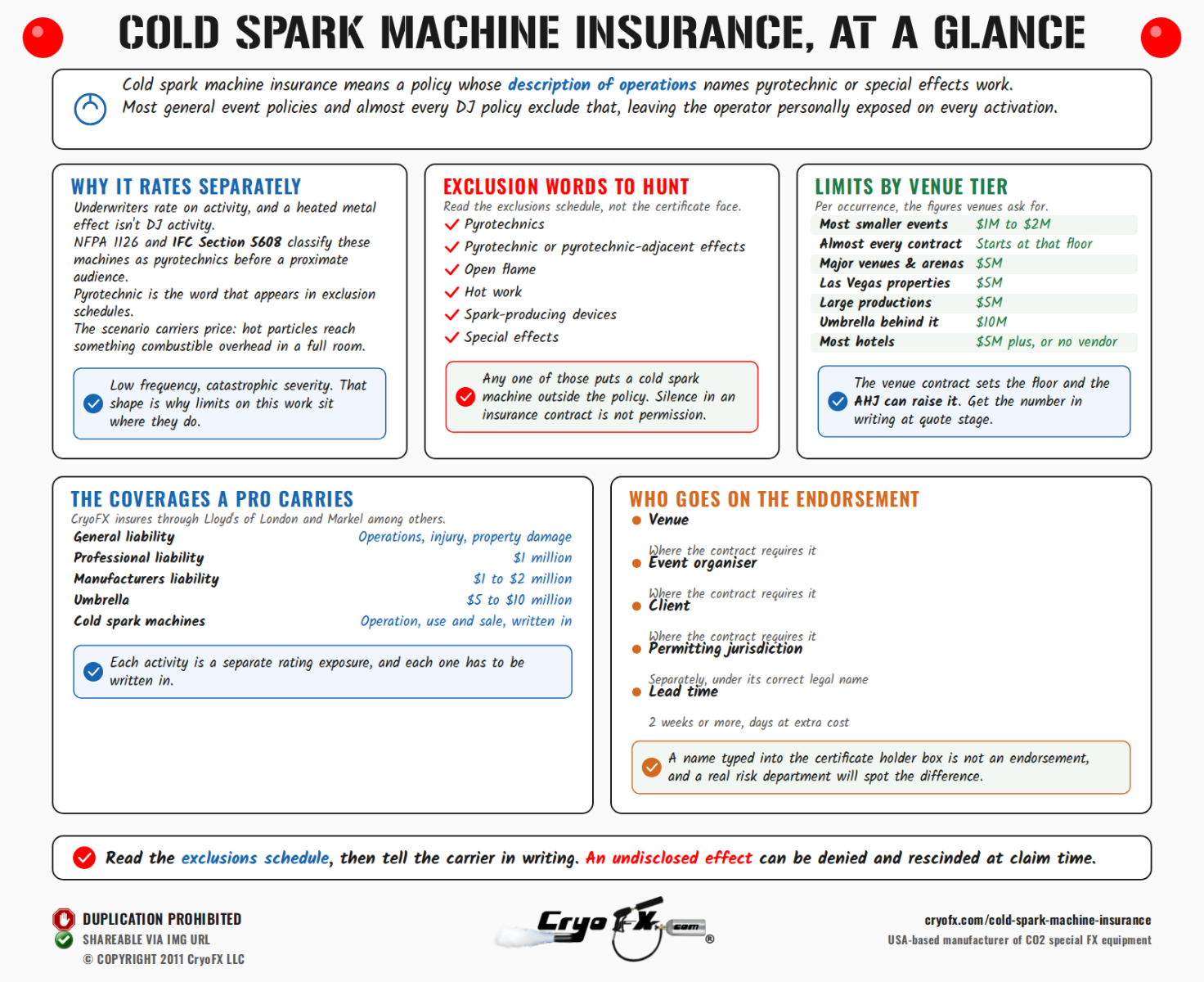
Cold spark machine insurance means a policy whose description of operations names pyrotechnic or special effects work. Most general event policies and almost every DJ policy exclude exactly that, which leaves the operator personally exposed on every activation. This page covers the exclusions to look for, the limits venues and hotels require, additional insured endorsements, and what a fire office needs to see on a certificate.
Why cold spark work sits in its own insurance category
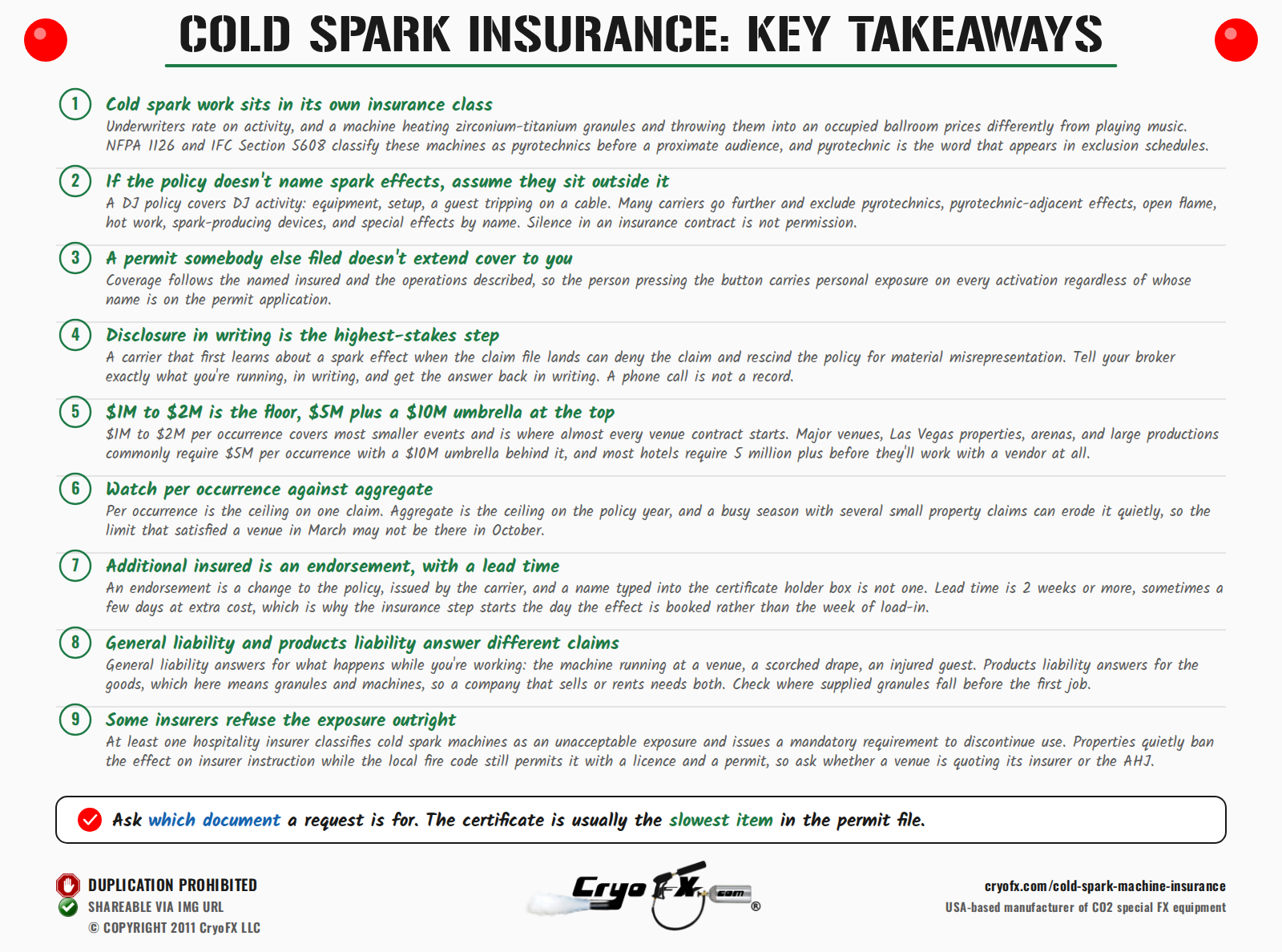
Underwriters rate on activity. A machine heating zirconium-titanium granules to 480 to 650°C and throwing them 16 feet into an occupied ballroom prices differently from playing music, and the cold spark machine information page explains what the equipment does well enough for a broker to read it.
Code decides the vocabulary. NFPA 1126 and IFC Section 5608 classify these machines as pyrotechnics before a proximate audience, and "pyrotechnic" is the word that appears in exclusion schedules. The fire permit information page covers the classification in detail.
The claim underwriters price for is a single scenario: hot particles reach something combustible overhead in a full room, and the loss becomes bodily injury for a crowd rather than property damage for a drape. Low frequency, catastrophic severity. That shape is why limits on this work sit where they do.
Where standard DJ and event policies fail
A DJ policy covers DJ activity. Equipment, setup, a guest tripping on a cable, an injured back. Nothing in that wording contemplates a heated metal effect.
Many carriers go further and exclude pyrotechnic-adjacent effects by name. The wording to hunt for in the exclusions schedule includes pyrotechnics, pyrotechnic or pyrotechnic-adjacent effects, open flame, hot work, spark-producing devices, and special effects. Any one of those puts a cold spark machine outside the policy.
If the policy doesn't name spark effects, assume they sit outside it. Silence in an insurance contract is not permission.
The second failure is a transfer assumption. A DJ or planner running machines under a permit somebody else filed is often certain that the permit holder's coverage extends to them. It doesn't. Coverage follows the named insured and the operations described, so the person pressing the button carries personal exposure on every activation regardless of whose name is on the permit application.
Carrier language to look for before you sign
Read the exclusions schedule line by line rather than the certificate face. A certificate is a summary produced for third parties. The policy form and its endorsements are the contract.
Four things to confirm in writing:
- The description of operations names special effects or pyrotechnic operations explicitly, in the words the carrier will read at claim time.
- No exclusion in the schedule captures spark-producing devices, hot work, or open flame in a way that reaches your equipment.
- The policy covers the operation and use of the machines, and the sale or supply of granules if you resell them.
- The carrier has been told, in writing, exactly what you're running.
That last one carries the largest downside. Disclosure is a duty, and a carrier that first learns about a spark effect when the claim file lands can deny the claim and rescind the policy for material misrepresentation. Tell your broker what you're running, in writing, and get the answer back in writing. A phone call is not a record.
The coverages a professional operator carries
CryoFX insures through Lloyd's of London and Markel among others. The policies are strict and expensive, because the business manufactures CO2 equipment, sells and distributes special effects equipment, repairs it, and operates it on live jobs. Each of those is a separate rating exposure and each one has to be written in.
The stack breaks down as:
- General liability for operations on site, third-party bodily injury, and third-party property damage.
- Professional liability for effects design and engineered documentation, carried at 1 million.
- Manufacturers liability at 1 to 2 million, covering the CO2 equipment CryoFX manufactures.
- Umbrella at 5 to 10 million depending on the situation, the time of year, and the project.
- Coverage written specifically for the operation, use, and sale of cold spark machines.
A client asking for "your COI" is usually asking for the wrong one. The venue wants general liability with the right limits and the right additional insureds. The fire office wants the jurisdiction named. A production company subcontracting effects design may want the professional liability certificate. Ask which document the request is for before issuing anything.
Limits by venue tier
$1M to $2M per occurrence covers most smaller events, and it's the floor almost every venue contract starts at.
Major venues, Las Vegas properties, arenas, and large productions commonly require $5M per occurrence with a $10M umbrella behind it. Most hotels require 5 million plus before they'll work with a vendor at all, which has nothing to do with the effect and everything to do with their own insurer's vendor schedule.
The venue contract sets the floor and the AHJ can raise it. Get the required number in writing at quote stage, because raising limits after a certificate has been issued means going back to the carrier and losing days.
Watch the difference between per occurrence and aggregate. Per occurrence is the ceiling on one claim. Aggregate is the ceiling on the policy year, and a busy season with several small property claims can erode it quietly, so the limit that satisfied a venue in March may not be there in October.
[INSERT LIMITS LADDER INFOGRAPHIC: VENUE TIER, PER OCCURRENCE, UMBRELLA, ADDITIONAL INSUREDS HERE]
Additional insured, and who belongs on the endorsement
An additional insured endorsement extends your policy's protection to another party for claims arising out of your work. On a cold spark job that normally means the venue, the event organiser, and the client where the contract requires it.
The permitting jurisdiction goes on separately, because the fire office won't process a package without being named on the certificate under its correct legal name. "City of X Fire Department" when the entity is "City of X" gets the certificate sent back.
An endorsement is a change to the policy, issued by the carrier. A name typed into the certificate holder box is not an endorsement, and a venue with a real risk department will spot the difference. Endorsement lead time is 2 weeks or more, sometimes a few days at extra cost, which is why the insurance step starts the day the effect is booked rather than the week of load-in.
CryoFX adds clients, venues, and jurisdictions as additional insured on rental jobs as standard practice.
Products liability versus general liability
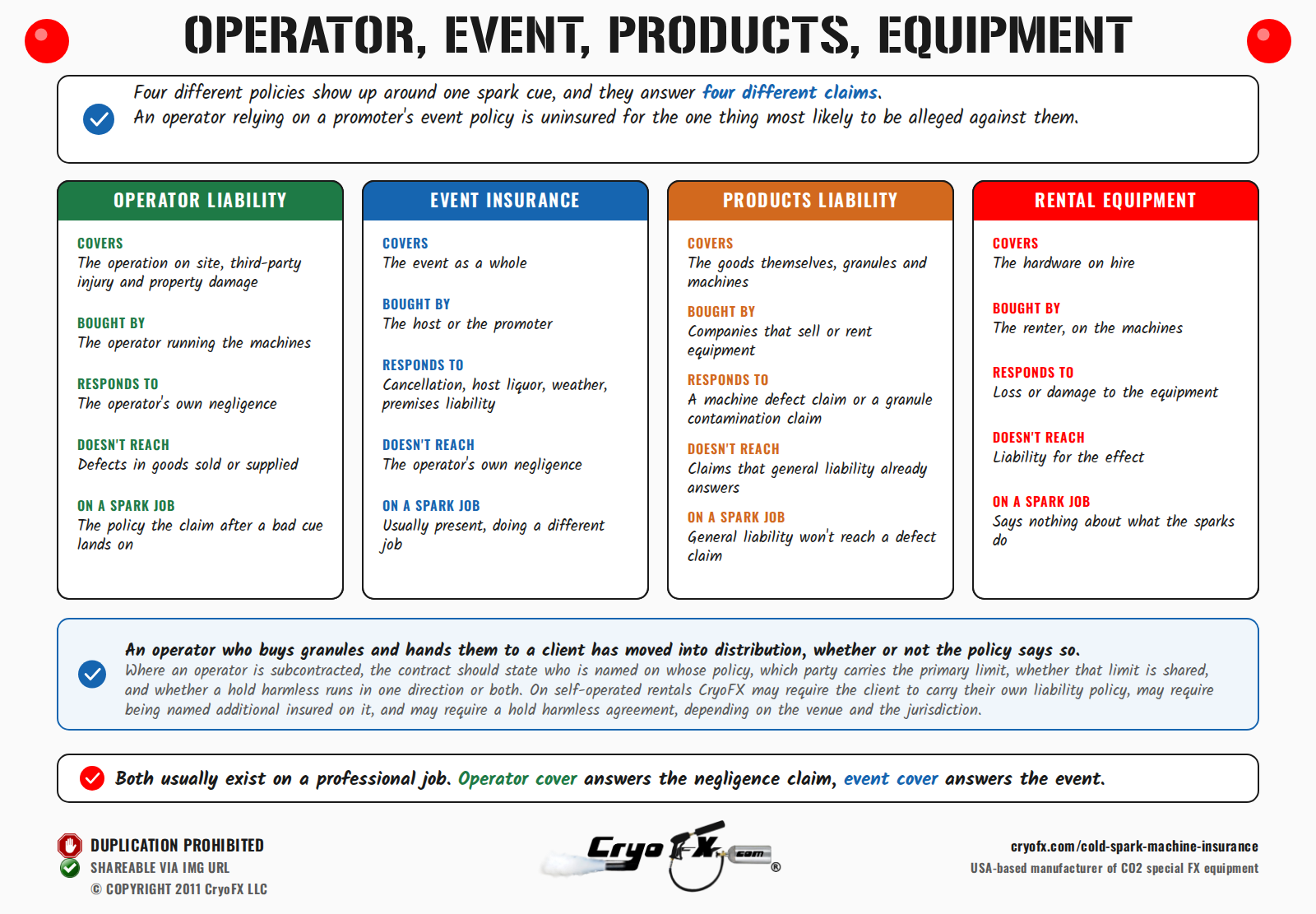
General liability answers for what happens while you're working: the machine running at a venue, a scorched drape, an injured guest, a damaged floor.
Products liability answers for the goods themselves. Here that means granules and machines, so a company that sells or rents equipment needs both. A defect claim on a machine or a contamination claim on a granule pack lands on products, and general liability won't reach it.
A solo operator running equipment they didn't sell leans on general liability. The question to answer before the first job is where supplied granules fall, because an operator who buys granules and hands them to a client has moved into distribution whether or not the policy says so.
Operator insurance versus event insurance
Event insurance covers the event. It's usually bought by the host or the promoter and it responds to the event as a whole: cancellation, host liquor, weather, and general premises liability.
Operator insurance covers the operation. It responds to the operator's own negligence, which is precisely the claim filed after a spark effect goes wrong. An operator relying on a promoter's event policy is uninsured for the one thing most likely to be alleged against them.
Both usually exist on a professional job, doing different work. Where an operator is subcontracted, the contract should state who is named on whose policy, which party carries the primary limit, whether that limit is shared, and whether a hold harmless runs in one direction or both.
When an insurer refuses the exposure
Some carriers won't write it at any price. At least one hospitality insurer classifies cold spark machines as an unacceptable exposure and issues a mandatory requirement to discontinue use.
A mandatory recommendation letter is not a suggestion. A hotel or club that receives one either stops the activity or risks its own coverage at renewal, which is a far larger number than any effect fee. The practical result is properties quietly banning cold spark effects on insurer instruction while the local fire code still permits them with a licence and a permit.
This is worth asking about early. A venue that says the effect is "not allowed" may be quoting its insurer rather than the AHJ, and that distinction changes whether the conversation is winnable and who you need to be talking to.
Self-operated rentals and the client's own policy
Renters carry their own rental equipment insurance on the machines. That covers the hardware. It says nothing about liability for the effect.
On self-operated rentals CryoFX may require the client to carry their own liability policy, may require being named additional insured on it, and may require a hold harmless agreement, depending on the venue and the jurisdiction. A rental company that releases machines to somebody with no applicable coverage is exposed downstream, so the underwriting happens before the machines leave.
CryoFX doesn't run a broker program. It will help point operators toward carriers who write this class on request, which is a shorter list than most people expect.
Building a permit-ready certificate
A certificate that satisfies a fire office carries 5 things:
- The jurisdiction named as additional insured under its correct legal name.
- Per-occurrence and aggregate limits at or above what the AHJ requires.
- A policy period that covers the event date, including load-in and strike days.
- A description of operations that names pyrotechnic or special effects work.
- The venue and event organiser as additional insured where the contract requires them.
The rejections repeat: a generic certificate with no mention of effects, the fire department named instead of the municipal entity, limits below the stated requirement, a policy period that stops before strike, and a name in the certificate holder box standing in for an endorsement.
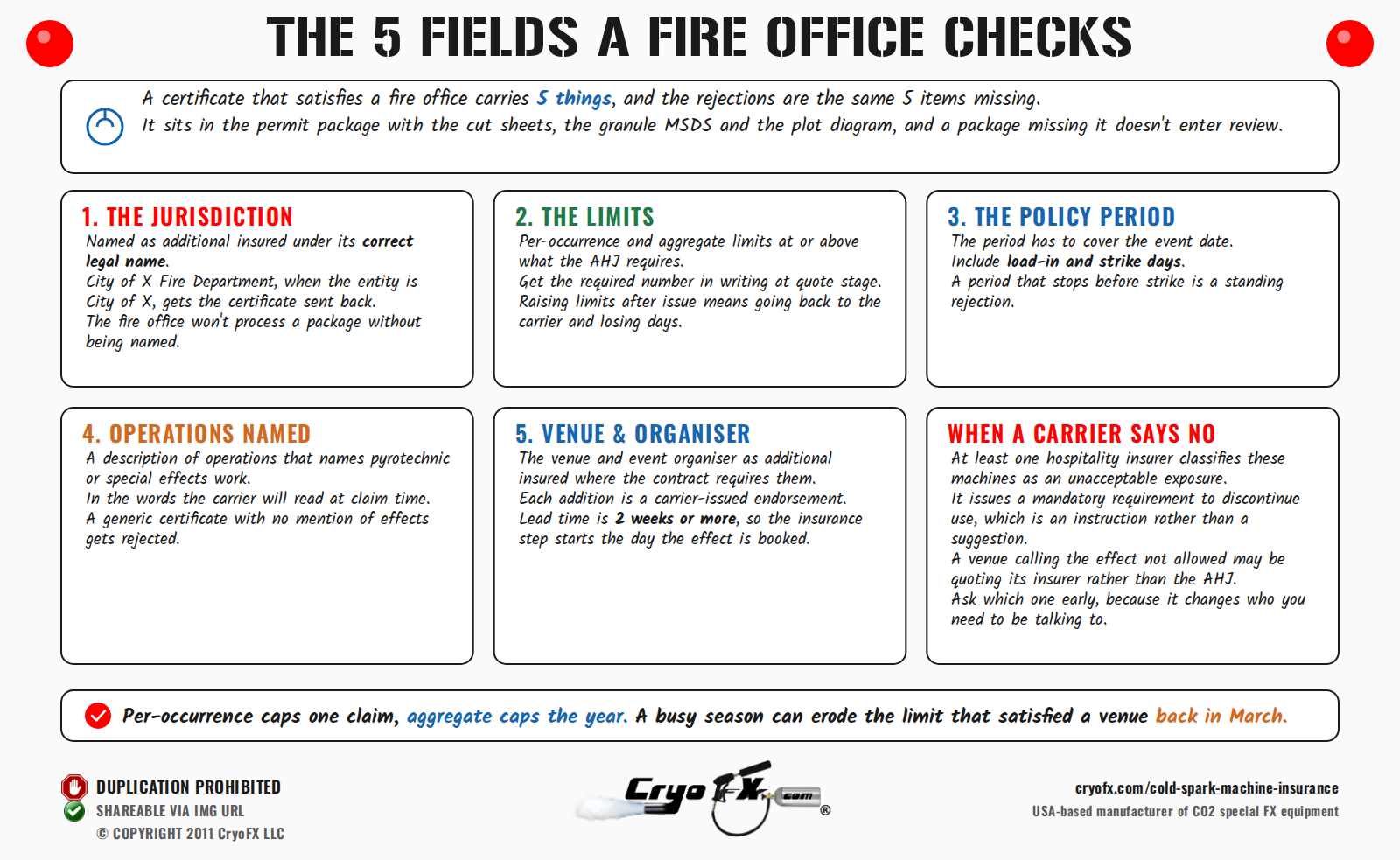
The certificate sits in the permit package alongside the equipment cut sheets, the granule MSDS, and the plot diagram, and a package missing it doesn't enter review. What the page on cold spark machine fire permits says about timing applies here too, because the insurance document is usually the slowest item in the file.
For operators buying rather than renting, products liability is the question to put to the seller. Buying cold spark machines for sale from a company that carries products liability on the machines and the granules it supplies means a defect claim has somewhere to land other than your general liability policy.
Frequently asked questions
Do I need insurance to use cold spark machines?
Yes, in two places. A certificate of insurance is essentially universal in professional use, and the permit filing itself requires insurance naming the jurisdiction. Venues ask for a COI before load-in, so without one you don't get a permit and without a permit you don't run the effect. CryoFX carries operating and professional liability coverage, manufacturer's liability on the CO2 equipment it builds, and coverage written specifically for cold spark machines.
Does my DJ insurance cover cold spark machines?
Almost certainly not. DJ policies are written around DJ activity, and many carriers explicitly exclude pyrotechnic-adjacent effects. If the policy doesn't name spark effects, assume they sit outside it. That leaves personal exposure on every event, including ones where a third party filed the permit, because the permit holder's coverage doesn't extend to you. Read the exclusions page.
What liability limits do venues require?
$1M to $2M per occurrence covers most smaller events. Major venues, Las Vegas properties, and large productions commonly require $5M per occurrence with a $10M umbrella behind it. The venue contract sets the floor and the AHJ can raise it. Get the number in writing at quote stage, since raising limits after a certificate has been issued costs time.
What is an additional insured endorsement and who needs to be on it?
It extends your policy's protection to another party for claims arising out of your work. On a cold spark job that's normally the venue, the event organiser, and sometimes the client. The permitting jurisdiction goes on separately, because the fire office won't process a package without being named. Each addition is a policy endorsement, not a line typed onto the certificate.
Does the operator need separate insurance from the event?
Yes. Event insurance covers the event. The operator carries their own policy covering the operation, use, and in CryoFX's case the sale, of the machines. The two do different jobs. An operator leaning on a promoter's event policy is uninsured for their own negligence, which is precisely the claim filed after a spark effect goes wrong.
What is the difference between products and general liability here?
General liability covers operations and third-party property damage: the machine running at a venue, a scorched drape, an injured guest. Products liability covers the goods, which here means granule issues and machine defects. A company that sells or rents needs both. An operator running equipment they didn't sell leans on general liability, but check where supplied granules fall.
Will my insurer cancel my policy over cold spark machines?
It happens. At least one hospitality insurer classifies cold spark machines as an unacceptable exposure and issues a mandatory requirement to discontinue use. Non-disclosure carries the bigger risk, because a carrier that learns about the effect at claim time can deny and rescind. Tell your broker what you're running, in writing, and get the answer back in writing.
What does a permit-ready COI need to include?
The jurisdiction named as additional insured under its correct legal name, the per-occurrence and aggregate limits the AHJ requires, a policy period covering the event date, and a description of operations that actually names pyrotechnic or special effects work. Add the venue and organiser where the contract requires them. A generic certificate with no mention of effects gets rejected.
___
CryoFX® is the leading manufacturer, designer, and global supplier of CO2 special effects equipment and custom special effects systems
for Theme Parks, Sporting Arenas, Mega Nightclubs & Day Clubs , TV/FILM & large scale events & installs in any industry requiring Co2 Systems.
CryoFX LLC Global Headquarters • 3859 S Valley View Blvd, Suite 2, Las Vegas, NV 89103 • 1.855.527.9639
Updated - 08/13/2026.