Sparkular China | CryoFX®
Sparkular China (where it all started) -> CryoFX®. CALL NOW to Order!
Sparkular China for Sale (New or Used) • Showven Sparkular Rental • Sparktacular China
Sparkular China Price..for Rent or Purchase Call CryoFX®.
Contact us NOW for info...Call:1.855.527.9639

CryoFX LLC • 3859 S Valley View Blvd, Suite 2, Las Vegas, NV 89103 • 1.855.527.9639
24/7 Rental Inquiry Submission: https://cryofx.com/rentals
Sparkular and China: What Manufacturing Origin Tells You, and What It Doesn't
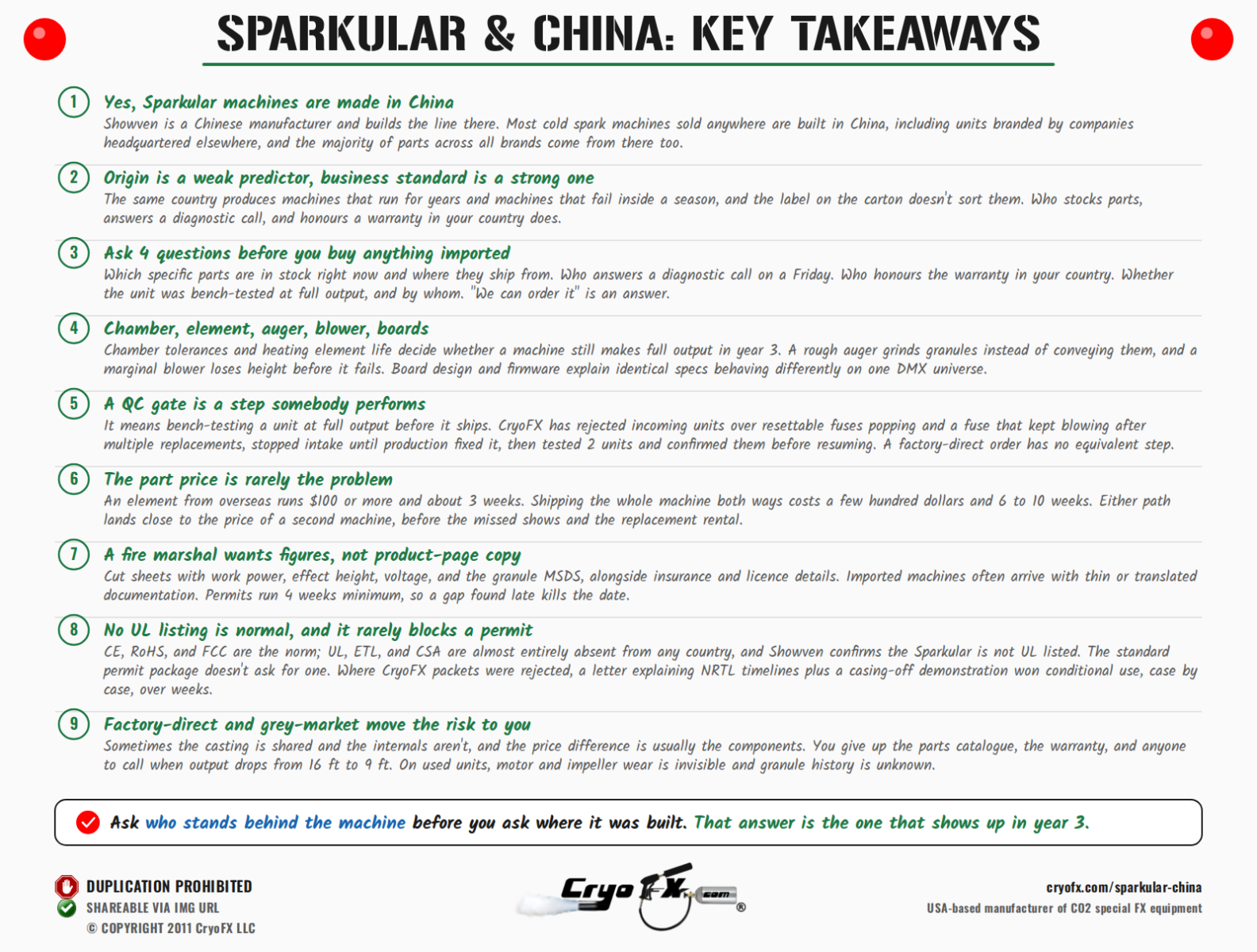
Sparkular machines are made in China. Showven Technologies is a Chinese manufacturer and builds the line there, and most cold spark machines sold anywhere are built in China, including units branded by companies headquartered elsewhere. The question underneath "where is it made" is usually a different one: what predicts whether a given machine survives 3 seasons of touring.
The answer is the business standard behind the unit, and this page is about how to read it.
Where these machines are actually built
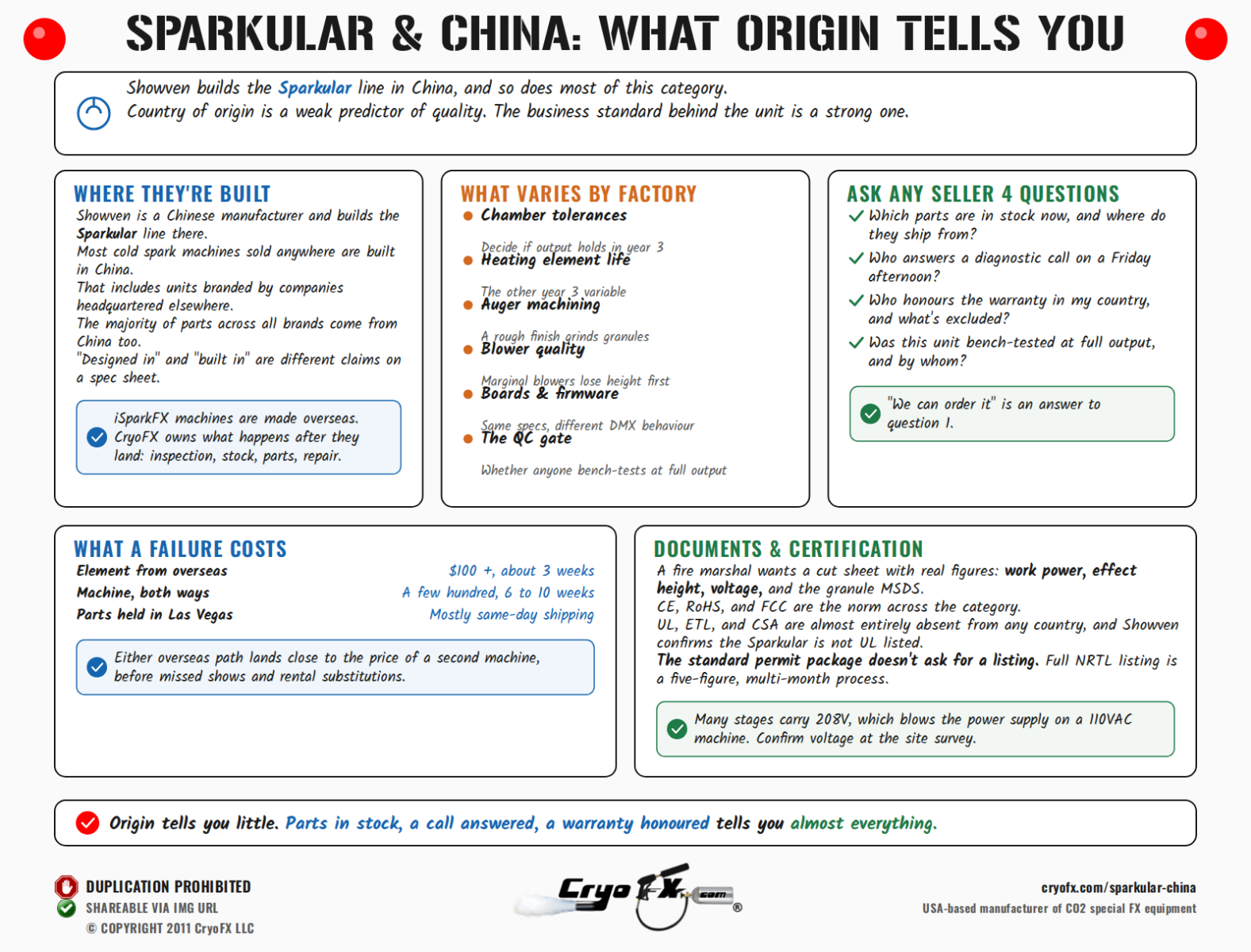
Showven manufactures the Sparkular line in China. So does most of this category, and the pattern goes deeper than final assembly: the majority of parts across all brands, Showven included, come from China. A machine assembled somewhere else is often a machine full of Chinese components, which is worth knowing before anyone sells you a country of origin as a quality argument. Category-wide context is in our complete guide to cold spark machines.
"Designed in" and "built in" are different claims on a spec sheet, and only 1 of them tells you anything about the tolerances in the chamber.
iSparkFX is its own company with its own brand, and its machines are manufactured overseas. CryoFX buys them and sells them. The part CryoFX owns is what happens after the machine lands: inspection, stock, parts, and repair.
What varies between factories
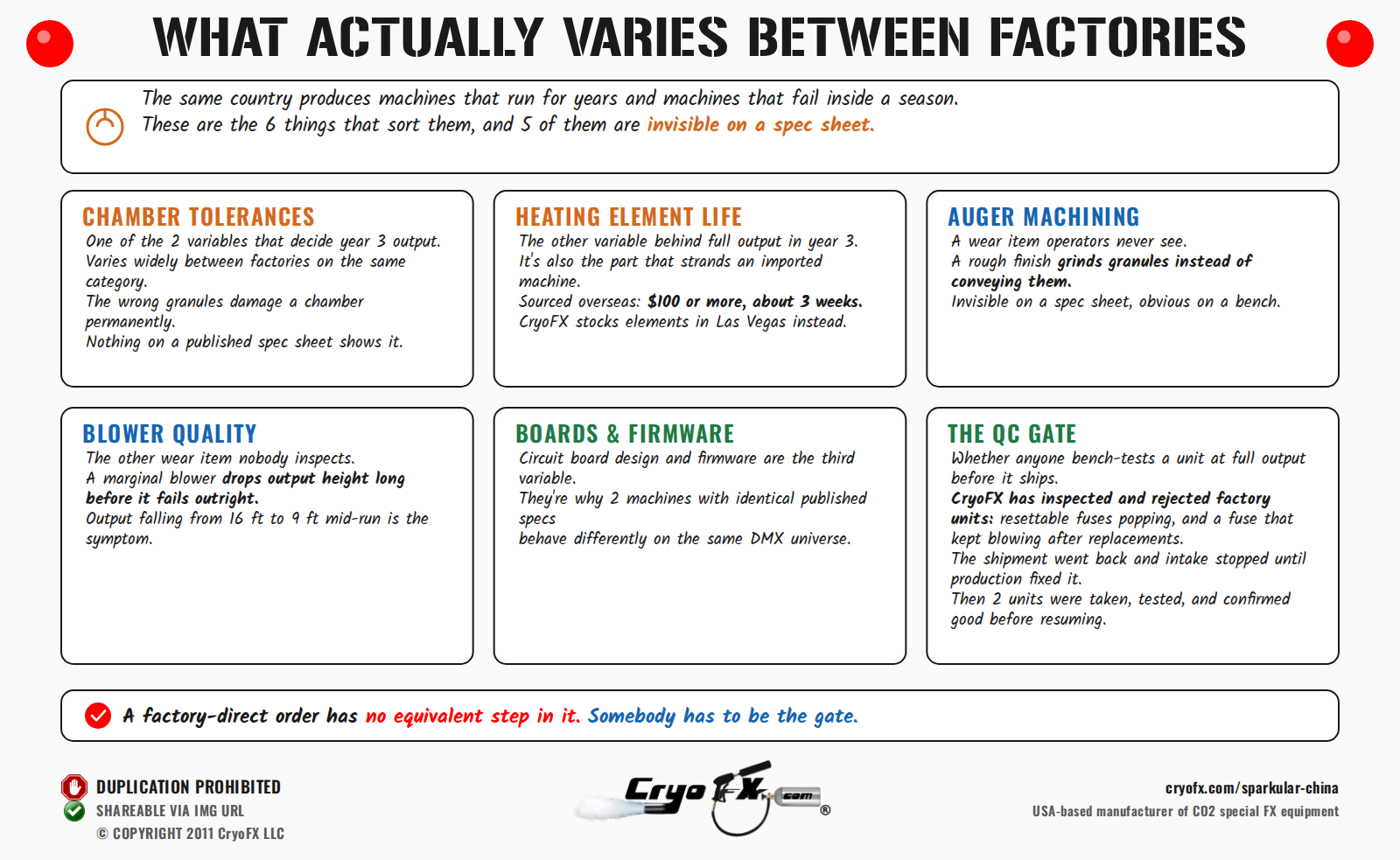
Chamber tolerances and heating element life vary widely, and they're the 2 things that decide whether a machine is still producing full output in year 3.
Auger machining and blower quality are the wear items operators never see. An auger with a rough finish grinds granules instead of conveying them, and a marginal blower drops output height long before it fails outright. Both are invisible on a spec sheet and obvious on a bench.
Circuit board design and firmware are the third variable, and they're the reason 2 machines with identical published specs can behave differently on the same DMX universe.
Then there's the QC gate, meaning whether anyone bench-tests a unit at full output before it ships. CryoFX has inspected and rejected factory units. One real example: units arrived with resettable fuses popping, and a separate set where a fuse kept blowing after multiple replacements. CryoFX rejected the incoming shipment back to the factory and stopped accepting units until production fixed the problem, then took delivery of 2 units, tested them rigorously, and confirmed them good before resuming.
That's what a QC gate looks like from the distributor side. A factory-direct order has no equivalent step in it.
Why country of origin is a weak predictor
The same country produces machines that run for years and machines that fail inside a season, and the label on the carton doesn't sort them.
The stronger signal is who stands behind the unit. Ask any seller 4 questions before you buy anything imported:
- Which specific parts do you hold in stock right now, and where do they ship from?
- Who answers a diagnostic call on a Friday afternoon, and are they looking at the same machine you sold me?
- Who honours the warranty in my country, and what does it exclude?
- Was this unit bench-tested at full output before it shipped, and by whom?
An answer of "we can order it" to question 1 is an answer. The decision framework for matching a machine to a use case is on the cold spark machine buyer guide.
The real cost of a cheap import when it breaks
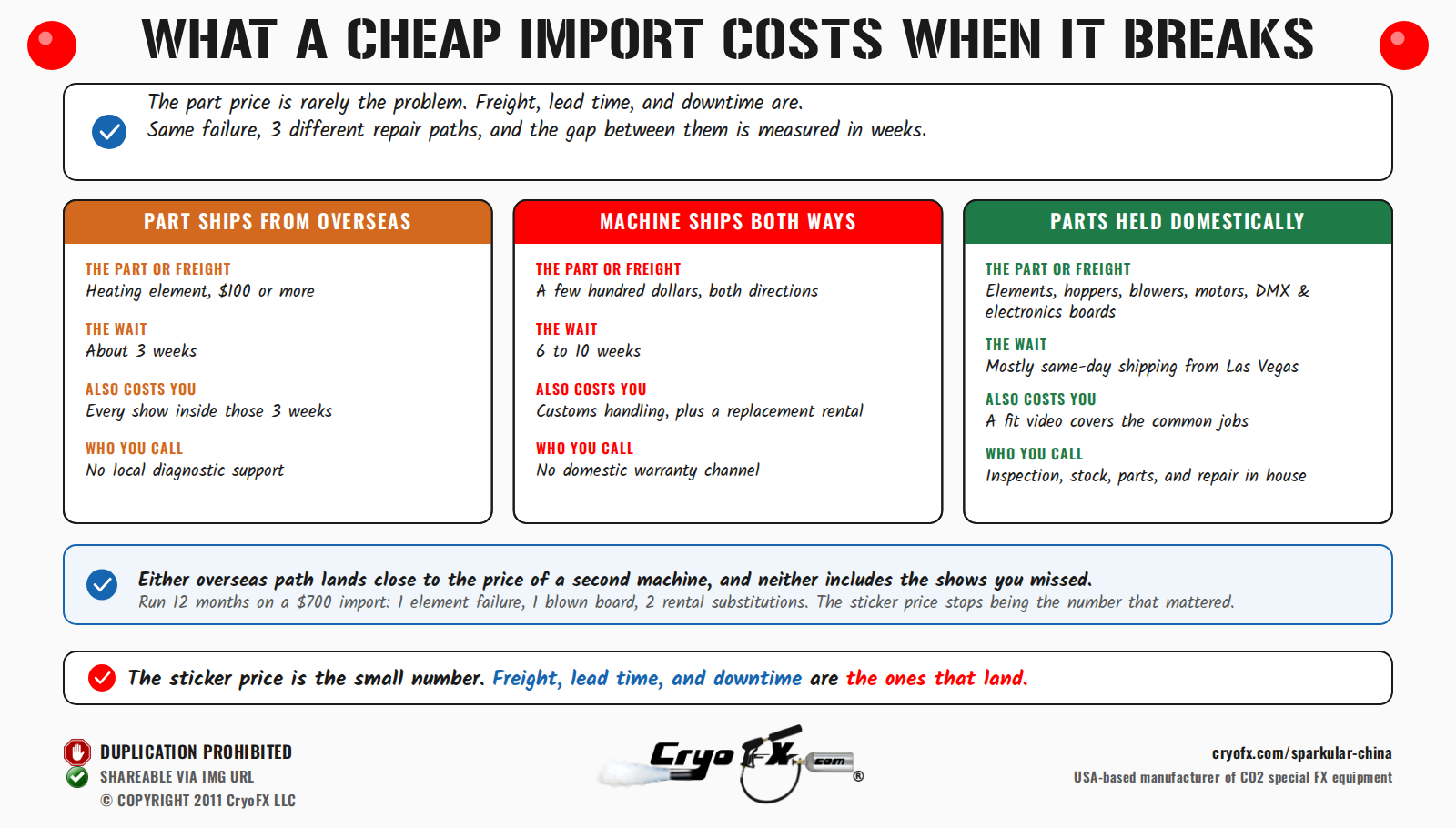
The part price is rarely the problem. Freight, lead time, and downtime are.
A heating element sourced from overseas typically runs $100 or more and about 3 weeks. Shipping the whole machine both ways costs a few hundred dollars and 6 to 10 weeks. Either path lands close to the price of a second machine, and neither includes the shows you missed or the replacement rental you paid for in the meantime.
Run it over 12 months on a $700 import: 1 element failure, 1 blown board, and 2 rental substitutions, and the sticker price stops being the number that mattered.
Domestic stock changes the shape of that. CryoFX holds heating elements, hoppers, blowers, blower motors, DMX boards, and electronics boards in Las Vegas, mostly shipping same day, with a fit video for the common jobs, and the current cold spark machines for sale are the units those parts are stocked against.
Documentation, certification and your permit
Imported machines often arrive with thin documentation, and translated manuals that read as marketing rather than specification. A fire marshal reviewing a package wants a cut sheet with real figures on it: work power, effect height, voltage, and the granule MSDS. "Is safe, no fire" on a product page is not a spec.
CE, RoHS, and FCC are the norm across the category. UL, ETL, and CSA are almost entirely absent from cold spark machines from any country, and Showven has confirmed the Sparkular is not UL listed. Full NRTL listing is a five-figure, multi-month process. Comparable atmospheric effect machines used in the same production market do carry NRTL certification, so the gap reflects a commercial choice rather than an impossibility.
The standard permit package doesn't ask for a listing, and the APA has noted that where manufacturers have obtained UL, CE, or CSA approvals, those cover electrical integrity rather than effect safety.
Individual reviewers have still pushed back. CryoFX has had permit packets rejected in specific jurisdictions because the machines weren't UL, ETL, or CSA certified and stamped. The response was a letter to the agency explaining what NRTL certification involves and how long it takes, plus a request for an in-person demonstration with the casing off, so inspectors could see how the machine works and confirm that the enclosure is metal and an internal failure isn't exposed externally. Conditional use was granted. That's case by case and it isn't guaranteed, and it's an argument that takes weeks, which is time you don't have inside the 4-week minimum for fire permit information for cold spark machines.
One import detail that destroys hardware rather than delaying a show: many stages carry 208V, which will run some 220V machines and will blow the power supply on a 110VAC unit. Confirm machine voltage against venue supply during the site survey, and read cold spark machine power requirements before you order a machine for a 110V room.
Factory-direct versus branded
Sometimes the casting is shared and the internals aren't. A brand specifies heating elements, augers, boards, and firmware, and it sets the gate a unit has to pass before it ships. A factory-direct unit off the same line can carry different components at a lower price, and the price difference is usually the components.
What you give up going direct is the brand's parts catalogue, its warranty, and anyone to call when output drops from 16 ft to 9 ft in the middle of a run.
Used and grey-market imports carry the same problem with an extra unknown attached. Motor and impeller wear is invisible, granule history is unknown, and the wrong granules damage a chamber permanently. CryoFX B-stock and C-stock is stripped, chamber cleared, hoppers emptied, blown through, augers verified, and confirmed at full output before resale, which is a different product from a private-party sale. If you're weighing used against new, the cold spark machine buyer guide walks the tiers.
Frequently asked questions
Q: Are Sparkular machines made in China? A: Yes. Showven is a Chinese manufacturer and builds the Sparkular line there. Most cold spark machines sold anywhere are built in China, including units branded by companies headquartered elsewhere, and the majority of parts across all brands come from there too. Origin on its own tells you very little about how a specific machine will perform. What the seller does after the sale tells you a great deal more.
Q: Are Chinese cold spark machines any good? A: Some are excellent and some fail inside a season, and the country label doesn't sort them. Factories vary in chamber tolerances, auger machining, blower quality, heating element life, and board design. The predictor worth using is the business standard behind the machine: whether someone stocks parts, answers a diagnostic call, and honours a warranty in your country.
Q: What is the risk of importing a cold spark machine directly? A: You own every problem after delivery. A failure means parts ship from overseas at $100 or more and 3 weeks, or the whole machine goes both ways at a few hundred dollars and 6 to 10 weeks. Either path lands close to the price of a second machine. Add customs handling, no local diagnostic support, and no domestic warranty channel.
Q: What documentation do imported machines need for a US fire permit? A: Equipment cut sheets and the granule MSDS at minimum, alongside insurance naming the jurisdiction and your pyro licence details. Imported machines often arrive with thin or poorly translated documentation that a fire marshal won't accept as submitted. Permits run 4 weeks minimum lead time, so a documentation gap found late in the process kills the date outright.
Q: Why do imported machines cost so much more to repair? A: The part price is rarely the problem. Freight, lead time, and downtime are. A heating element that takes 3 weeks to arrive costs you every show in between, plus whatever you spend renting a replacement. CryoFX stocks elements, hoppers, blowers, DMX boards, and electronics boards domestically and ships most of them the same day with a fit video.
Q: What certifications do Chinese-made cold spark machines carry? A: Usually CE, RoHS, and FCC. Almost no cold spark machine from any country carries UL, ETL, or CSA, and Showven has confirmed the Sparkular is not UL listed. Full NRTL listing is a five-figure, multi-month process. Comparable atmospheric effect machines used in the same production market do carry NRTL certification, so the gap reflects a choice rather than an impossibility.
Q: Is a factory-direct machine the same as a branded one? A: Sometimes the casting is shared and the internals aren't. Brands specify heating elements, augers, boards, and firmware, and they set the QC gate before a unit ships. A factory-direct unit off the same line can carry different components at a lower price. You also lose the brand's parts catalogue, its warranty, and anyone to call when output drops.
Updated - 08/06/2026.