Cold Spark Machines vs. Pyrotechnics: What Actually Separates Them?
Cold Spark Machines vs Pyrotechnics: Real Differences | CryoFX
Cold Spark Machines vs. Pyrotechnics: What Actually Separates Them?
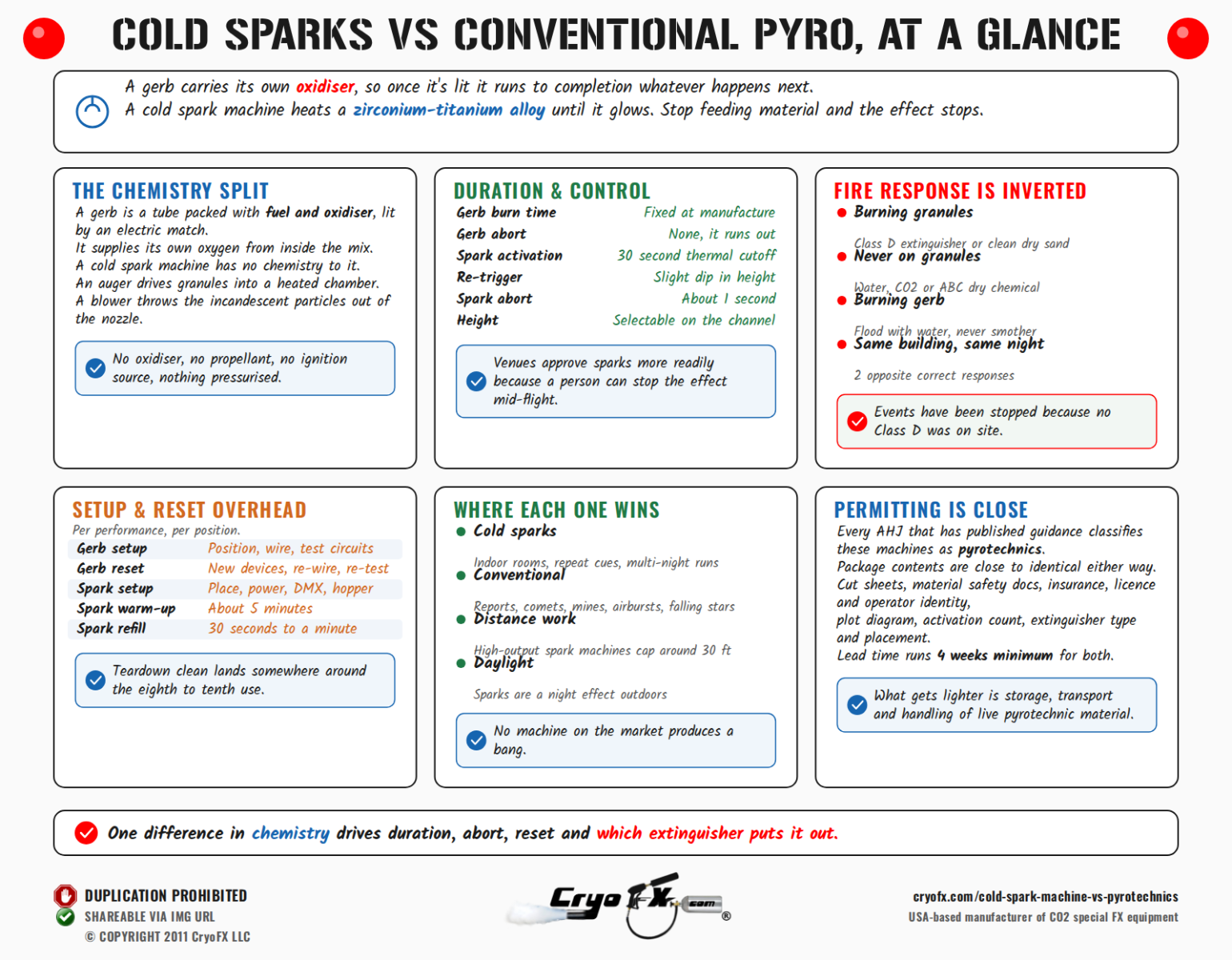
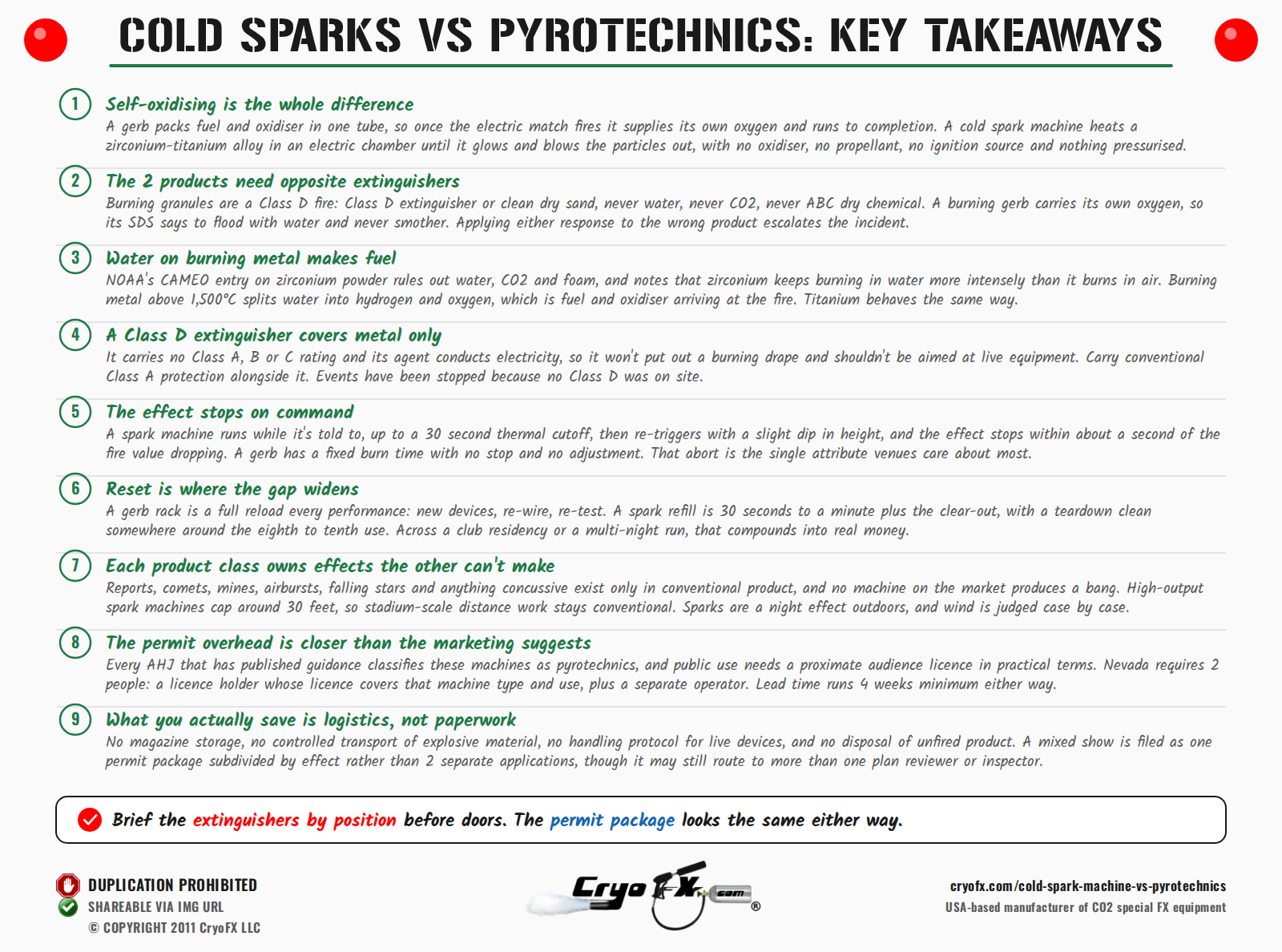
A conventional gerb carries its own oxidiser, so once it's lit it sustains its own combustion and runs to completion whatever happens next. A cold spark machine heats a zirconium-titanium alloy in an electric chamber until it glows and blows the particles out, with no oxidiser, no propellant, no ignition source and nothing pressurised. Stop feeding material and the effect stops.
That single difference in chemistry drives everything else: how long each effect runs, whether you can abort it, how you reset between shows, and, most importantly on a live job, which fire extinguisher puts it out.
The extinguisher answer is inverted between the 2 products. Water is the correct response to a burning gerb and the wrong response to burning cold spark granules. Crews who've worked pyro for years will reach for the wrong one by habit, which is the section of this page worth reading twice.
Oxidiser versus no oxidiser
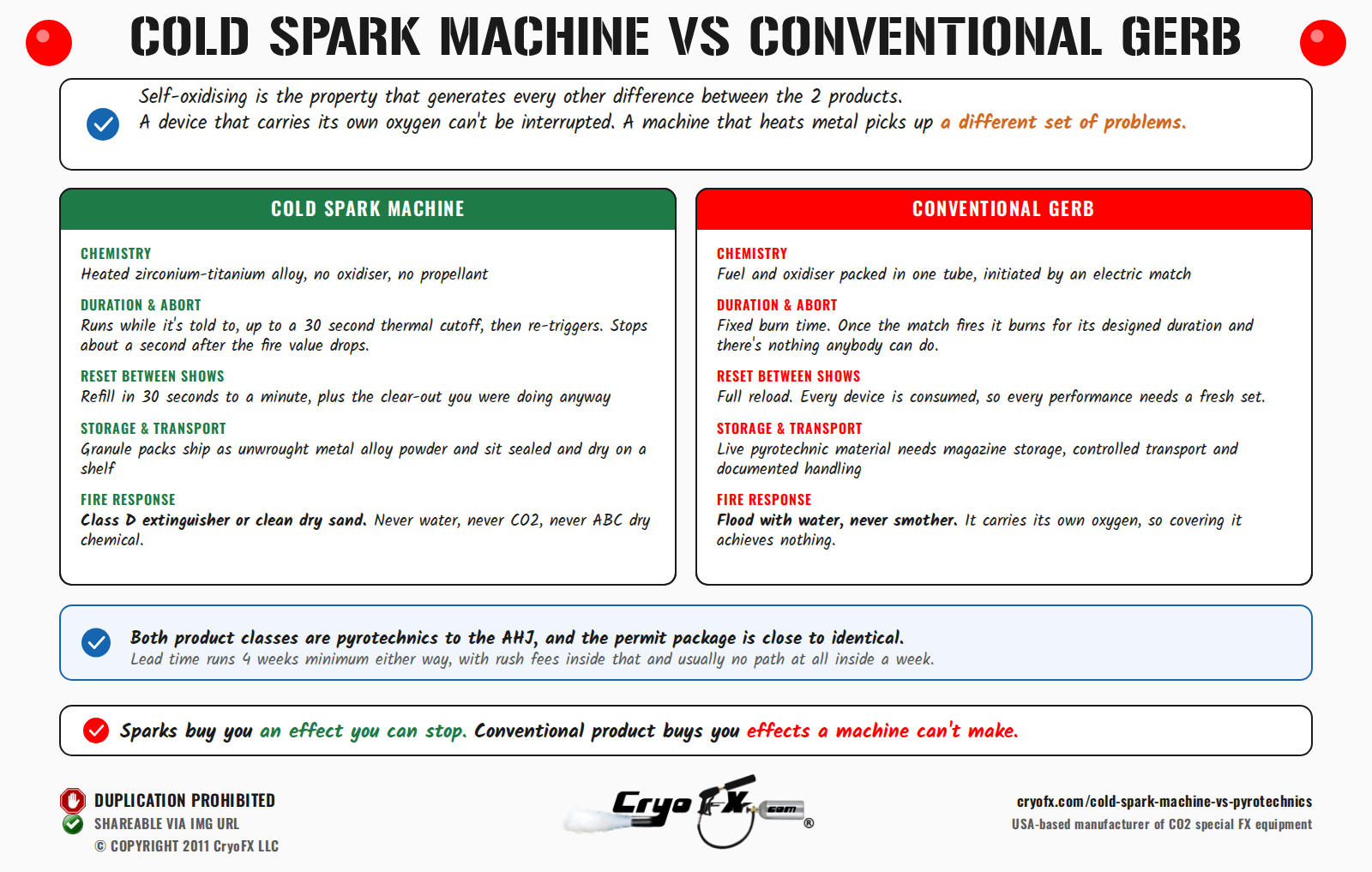
A gerb is a tube packed with a pyrotechnic composition that includes both a fuel and an oxidiser, initiated by an electric match. Once the composition is burning it supplies its own oxygen from inside the mix, so it doesn't need air, doesn't stop when you cover it, and can't be turned off. It burns for its designed duration and then it's spent.
A cold spark machine has no chemistry to it. An auger drives metal granules into a chamber wrapped in a heating element, the granules reach incandescence, and a blower throws them out of the nozzle. The complete guide to cold spark machines covers the internals in detail.
Self-oxidising is the property that generates every other difference on this page. A device that carries its own oxygen can't be interrupted, has to be treated as live from the moment it's loaded, and has to be stored and transported as explosive material. A machine that heats metal has none of those attributes and picks up a different set of problems instead.
What each leaves behind also differs. A gerb leaves a spent tube, residue and a rack to strip. A spark machine leaves cooled metal particles on the floor and residue in its own chamber, which is why the clear-out function after every use matters, covered on the maintenance page.
Duration and control
A gerb has a fixed burn time. One device, one effect, no stop, no adjustment once the match fires. If the cue lands 4 seconds early, it lands 4 seconds early and there's nothing anybody can do.
A cold spark machine runs while it's told to, up to a thermal cutoff at 30 seconds per activation, then re-triggers with a slight dip in height on reactivation. Height is selectable on the control channel, and the effect stops within about a second of the fire value dropping.
The operational value of that shows up when a show goes sideways. A host overruns, a bride stops halfway down the aisle, a guest walks inside the clearance. With sparks you abort and re-cue. With a gerb you watch it happen.
That difference is also why venues approve sparks more readily. An effect that a person can stop mid-flight changes the risk conversation with a building manager who has heard of the alternative.
Setup and reset overhead
Loading a gerb rack means positioning devices, wiring each to a firing module, testing continuity on every circuit, and keeping the rack disarmed until the room is clear. Every device is consumed, so every performance needs a fresh set.
Setting up a spark machine means placing it, running power on a dedicated circuit, running DMX, filling a hopper, and warming up for about 5 minutes.
Reset is where the gap widens. A gerb rack is a full reload: new devices, re-wire, re-test. A spark refill is 30 seconds to a minute if you're quick, plus the clear-out you were doing anyway.
Across a multi-night run or a club residency, that compounds into real money. 4 nights of gerbs is 4 sets of consumed devices and 4 reloads. 4 nights of sparks is 4 refills out of granule packs and a teardown clean somewhere around the eighth to tenth use.
Storage and transport are the other half of it. Live pyrotechnic material needs magazine storage, controlled transport and documented handling. Granules ship as unwrought metal alloy powder and sit sealed and dry on a shelf.
The extinguisher inversion
This is the part that gets people hurt, and it's the part almost nobody briefs properly.
What burning cold spark granules need
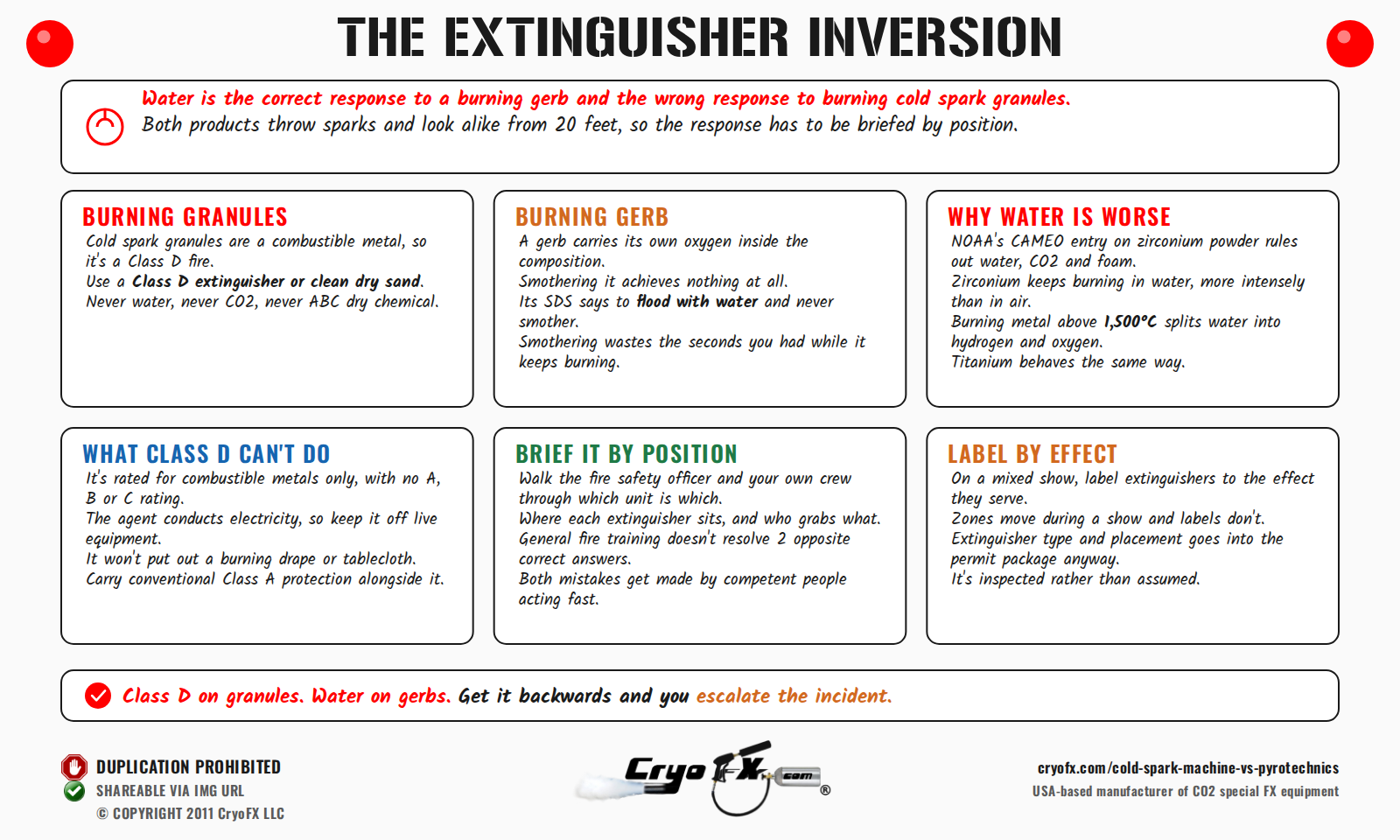
Cold spark granules are a combustible metal, so a burning-granule fire is a Class D fire. Use a Class D extinguisher or clean dry sand. Never water, never CO2, never ABC dry chemical.
The water prohibition isn't a general caution about electrical equipment. NOAA's CAMEO entry on zirconium powder states plainly: do not use water, CO2 or foam on the material itself, and notes that zirconium continues burning despite immersion in water, with greater intensity than it burns in air. Burning metal above 1,500°C splits water into hydrogen and oxygen, which is fuel and oxidiser arriving at a fire you're trying to put out.
Titanium behaves the same way. The 2 metals in the granules are the 2 metals the Class D requirement exists for.
A Class D extinguisher is rated for combustible metals only. It carries no Class A, B or C rating, and its agent conducts electricity, so it won't put out a burning drape or tablecloth and shouldn't be aimed at live equipment. Carry conventional Class A protection alongside it. Extinguisher counts and placement under NFPA 1126 are covered on the cold spark machine safety guide.
What a burning gerb needs
The opposite response. A gerb carries its own oxygen inside the composition, so smothering achieves nothing at all. Its SDS says to flood with water and never smother.
That instruction is correct for that product and dangerous for the other one.
Why the wrong response makes it worse
Water on burning granules intensifies the fire and can produce hydrogen. Smothering a gerb wastes the seconds you had while it keeps burning on its internal oxygen.
Both mistakes are made by competent people acting fast under pressure, because both products throw sparks and look alike from 20 feet. 2 products can sit in the same building on the same night with opposite correct fire responses, and no amount of general fire training resolves that. It has to be briefed by position.
What to brief the venue's fire team
Extinguisher type and placement goes into the permit package, so this conversation is happening on paper anyway. Do it in person as well.
Walk the fire safety officer and your own crew through which unit is which, where each extinguisher sits, and who grabs what. Where a mixed show is running both product classes, label the extinguishers to the effect they serve rather than to the zone, because zones move during a show and labels don't.
Events have been stopped because no Class D was on site. It's inspected rather than assumed.
Where cold spark machines win
Indoor rooms with a defined ceiling and an audience close in. The effect can be sized down, aborted, and re-cued, which is what makes it workable in a ballroom.
Repeat cues across a long show. 6 activations across a 90-minute keynote costs granules and nothing else, where the same 6 moments in conventional product is 6 devices per position.
No live pyrotechnic material in the building. For a hotel or convention centre, that removes an entire category of question from their approval process.
The effect stops on command, which is the single attribute venues care about most.
Residency and multi-night economics, where reset time and consumable cost both favour machines. A club running 4 nights a week is the clearest case for buying rather than booking, and the cold spark machines for sale range covers the mini, standard and high-output tiers that suit a fixed install.
Where conventional pyrotechnics win
Effects that have no spark-machine equivalent. Reports, comets, mines, airbursts, falling stars, and anything with a concussive element exist only in conventional product. No machine on the market produces a bang.
Large-format outdoor work at distance. High-output spark machines cap around 30 feet, jet units throw a ball 25 to 30 feet, and a stadium effect designed to read from 300 feet away needs conventional product.
Daylight. Spark machines are a night effect outdoors, because incandescent particles disappear against a bright sky.
Wind tolerance. Sparks are judged case by case on speed and gusts, on whether the material would leave the intended pattern or blow into people, set pieces or equipment, and the call is often to cut the effect.
[INSERT EFFECT-BY-EFFECT COMPARISON TABLE INFOGRAPHIC, WHICH EFFECTS EXIST IN EACH PRODUCT CLASS HERE]
The compliance overhead is closer than the marketing suggests
Sellers imply cold spark machines slip past the paperwork. They don't, and building a show plan on that assumption is how effects get cut at walkthrough.
Every AHJ that has published guidance on these machines classifies them as pyrotechnics, and for public use a proximate audience licence is required in practical terms. Nevada requires 2 people: a licence holder whose licence covers that machine type and use, plus a separate operator running the machines. Other states let one person hold both roles.
The permit package contents are close to identical between the 2 product classes: equipment cut sheets, material safety documentation, insurance naming the jurisdiction, licence holder and operator identity, a plot diagram with fixed positions and marked distances, show duration with activation count and blast length, and extinguisher type and placement. Lead time runs 4 weeks minimum either way, with rush fees inside that and usually no path at all inside a week.
What does get lighter is real. No magazine storage, no controlled transport of explosive material, no handling protocol for live devices, and no disposal of unfired product. That's a meaningful reduction in liability and logistics without being a reduction in permitting.
The code classification itself, NFPA 1126 and the IFC sections that pull these machines in, is covered on the fire permit information page along with what a filing actually contains.
Running both on the same show
Plenty of productions run both, and the usual split is sparks handling sustained indoor looks and repeat cues while conventional product handles the moments that need a bang or a break.
CryoFX doesn't shoot conventional pyrotechnics. We partner with pyrotechnic companies on the pyro side, and we've worked hand in hand with those partners on mixed shows for years. Because we're bringing equipment involvement and industry rates the client doesn't have access to directly, coming through us on a pyro show generally costs the client less than going direct, and the comparison on this page isn't a pitch for one product over the other.
On the paperwork side, a mixed show is filed as one permit package subdivided by effect rather than 2 separate applications. That single package may still route to multiple plan reviewers or draw more than one on-site inspector, depending on the jurisdiction, since spark effects and conventional product are sometimes assessed by different people.
One company coordinating both sides removes the argument nobody wants to have at 4pm on show day. Effects share a DMX universe only with other effects run by the same company, and 2 vendors each holding half the effects package with separate controllers, separate cable runs and separate operators is exactly the situation a plan reviewer pushes back on.
Frequently asked questions
What is the difference between cold spark machines and conventional pyrotechnics?
Chemistry, and everything follows from it. A gerb carries its own oxidiser, so once lit it sustains its own combustion and runs to completion. A cold spark machine heats a zirconium-titanium alloy in an electric chamber until it glows and blows it out, with no oxidiser, no propellant, no ignition source, and nothing pressurised. Stop feeding material and the effect stops.
Are cold spark machines safer than pyrotechnics?
In the hardware, yes. There's nothing to detonate, the effect stops on command, and no pyrotechnic material sits in storage on site. The outcome still turns on the operator, because hot metal reaching a combustible ceiling starts a fire regardless of what class the device belongs to. Every AHJ that has published guidance on these machines classifies them as pyrotechnics.
Can cold spark machines replace indoor pyrotechnics?
For most indoor work, yes, and that's the majority of what gets booked now. They give a sustained fountain you can run for 30 seconds, stop, and run again on the next cue with no reload. Where the design calls for a report, a comet, a mine, or an airburst, no spark machine produces that effect and you're back to conventional product.
Do cold spark machines need a licensed pyrotechnician like pyro does?
For public use, in practical terms, yes. Jurisdictions that have published guidance treat them as pyrotechnics and require a proximate audience licence. Nevada requires 2 people: a licence holder whose licence covers that machine type and use, plus a separate operator running the machines. Other states let one person hold both roles. The fire permit page covers the filing side.
Why do cold sparks and gerbs need opposite fire extinguishers?
The fuels behave in opposite ways. Cold spark granules are a combustible metal, so they take a Class D extinguisher or clean dry sand, and water on a metal fire can make it worse. A gerb carries its own oxygen, so smothering it achieves nothing and its SDS says to flood with water. Applying either response to the wrong product escalates the incident.
Is the permit process easier for cold spark machines?
Closer than the marketing suggests. The package looks similar: equipment cut sheets, granule MSDS, insurance naming the jurisdiction, licence details, a plot diagram with fixed positions and marked distances, activation count and blast length, extinguisher type and placement. Lead time runs 4 weeks minimum either way. What you save is storage, transport, and magazine handling of live pyrotechnic material.
When should I use real pyrotechnics instead?
When the effect only exists in conventional product: reports, comets, mines, airbursts, falling stars, anything with a concussive element. Large-format outdoor work at distance is also conventional territory, since high-output spark machines cap around 30 feet and wind carries fallout outside the calculated zone. Plenty of shows run both, with sparks handling the sustained indoor looks.
Do cold spark machines contain gunpowder?
No. There's no gunpowder, no black powder, no oxidiser, and no propellant anywhere in the machine or in the granules. The granules are a metal alloy that emits light because it's been heated to incandescence, the same reason a filament glows. That's also why the effect stops the moment the machine stops feeding material into the chamber.
___
CryoFX® is the leading manufacturer, designer, and global supplier of CO2 special effects equipment and custom special effects systems
for Theme Parks, Sporting Arenas, Mega Nightclubs & Day Clubs , TV/FILM & large scale events & installs in any industry requiring Co2 Systems.
CryoFX LLC Global Headquarters • 3859 S Valley View Blvd, Suite 2, Las Vegas, NV 89103 • 1.855.527.9639
Updated - 06/15/2026.