
Cold Fireworks Price In India: What Each Tier Costs
Cold Fireworks Price In India: What Each Tier Costs, And Why Two Quotes For The Same Machine Differ So Much
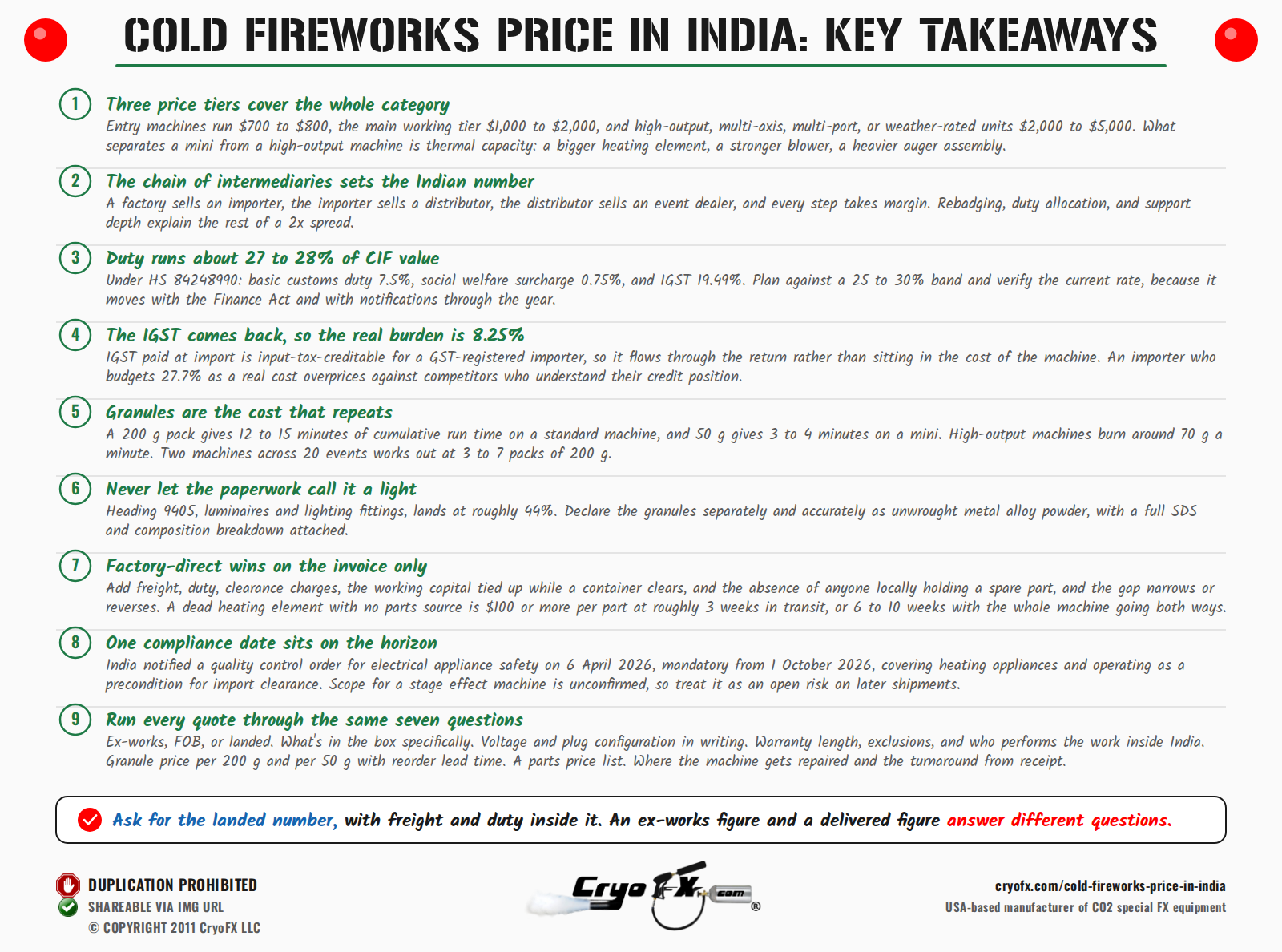
Cold fireworks machines cost roughly $700 to $800 at the entry tier, $1,000 to $2,000 for the main working tier, and $2,000 to $5,000 for high-output, multi-axis, multi-port, or weather-rated units. In rupees that's about ₹62,000 to ₹70,000, ₹88,000 to ₹1.76 lakh, and ₹1.76 lakh to ₹4.4 lakh. The number on an Indian quote is set by how many intermediaries touched the machine and how duty and freight were allocated, rather than by the hardware.
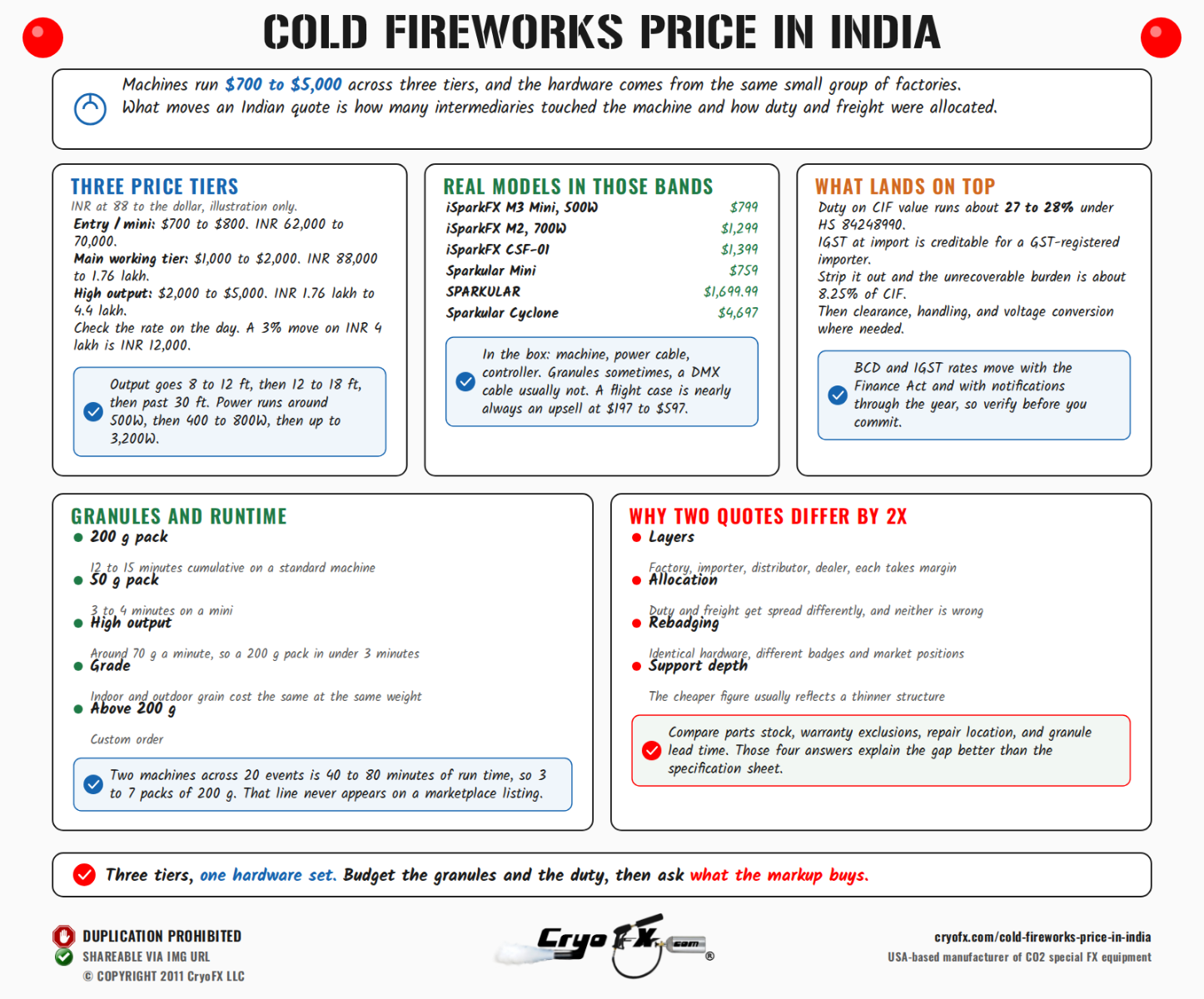
Currency note: USD figures are the reference prices. INR conversions on this page use ₹88 to the dollar for illustration only. Check the rate on the day, because a 3% move on a ₹4 lakh machine is ₹12,000.
The three price tiers, and what each one buys
| Tier | USD | INR (at ₹88) | Output | Power |
|---|---|---|---|---|
| Entry / mini | $700 to $800 | ₹62,000 to ₹70,000 | 8 to 12 ft | around 500W |
| Main working tier | $1,000 to $2,000 | ₹88,000 to ₹1.76 lakh | 12 to 18 ft | 400 to 800W |
| High output, multi-axis, multi-port, weather-rated | $2,000 to $5,000 | ₹1.76 lakh to ₹4.4 lakh | past 30 ft | up to 3,200W |
Real model prices inside those bands, so the tiers aren't abstract. The iSparkFX M3 Mini is $799, about ₹70,000, at 500W and 16 lb, reaching 3 to 12 ft on indoor granules and 13 ft on outdoor. The M2 is $1,299, about ₹1.14 lakh, at 700W and 3 to 16 ft. The CSF-01 is $1,399 and the M1 NO RFID is $1,499, roughly ₹1.23 lakh and ₹1.32 lakh.
On the Showven side, a Sparkular Mini is $759, about ₹67,000. The base SPARKULAR is $1,699.99, about ₹1.50 lakh. The Jet is $2,697 and the Cyclone $4,697, roughly ₹2.37 lakh and ₹4.13 lakh. Dealer B-stock starts around $559, about ₹49,000, on a 30-day warranty.
What separates a mini from a high-output machine is thermal capacity rather than badge: a bigger heating element, a stronger blower, and a heavier auger assembly, which is what pushes particles higher and holds output through repeat activations. The cold spark machine information guide covers the internals behind that.
In the box: machine, power cable, controller. Granules sometimes. A DMX cable usually not. A flight case nearly always an upsell at $197 to $597, roughly ₹17,000 to ₹53,000.
Volume pricing applies on 2, 4, or 6 machines bought together, which is how buyers order anyway. Layouts are symmetrical, so it's 2 for an entrance or a gateway, 4 for a dance floor surround or a stage flank, 6 to 8 for a large stage.
[INSERT PRICE LADDER INFOGRAPHIC HERE: THREE TIERS WITH OUTPUT HEIGHT, WATTAGE AND TYPICAL USE CASE PER TIER, USD AND INR]
Granule cost and the runtime maths
Granules are the cost that repeats, and most Indian budgets treat them as an accessory.
A 50g pack runs $35 to $45, roughly ₹3,100 to ₹4,000. A 200g pack runs $53 to $69, roughly ₹4,700 to ₹6,100. Both figures are before freight and duty.
Runtime: a 200g pack gives 12 to 15 minutes of cumulative run time on a standard machine, and 50g gives 3 to 4 minutes on a mini. High-output machines burn around 70g a minute, which empties a 200g pack in under 3 minutes.
Indoor and outdoor grain cost the same at the same weight, so buying the wrong grade is pure waste. Smaller grain indoors keeps the plume tight, larger grain outdoors climbs higher and needs more standoff. Anything above 200g is a custom order. Composition and storage are covered on the cold spark granules page; the short version is that moisture ruins a pack and a damp pack is a repair bill waiting to happen.
Worked example across a wedding season. Two machines, 20 events, 2 to 4 activations each at 10 to 30 seconds. That's roughly 40 to 80 minutes of total run time, which is 3 to 7 packs of 200g. Call it $160 to $480, about ₹14,000 to ₹42,000, before freight and duty. Against a ₹1.14 lakh pair of machines that's a manageable line, and it's a line that never appears on a marketplace listing.
Import duty, freight, and clearance
A factory price and a landed price are different numbers and they can't be compared side by side.
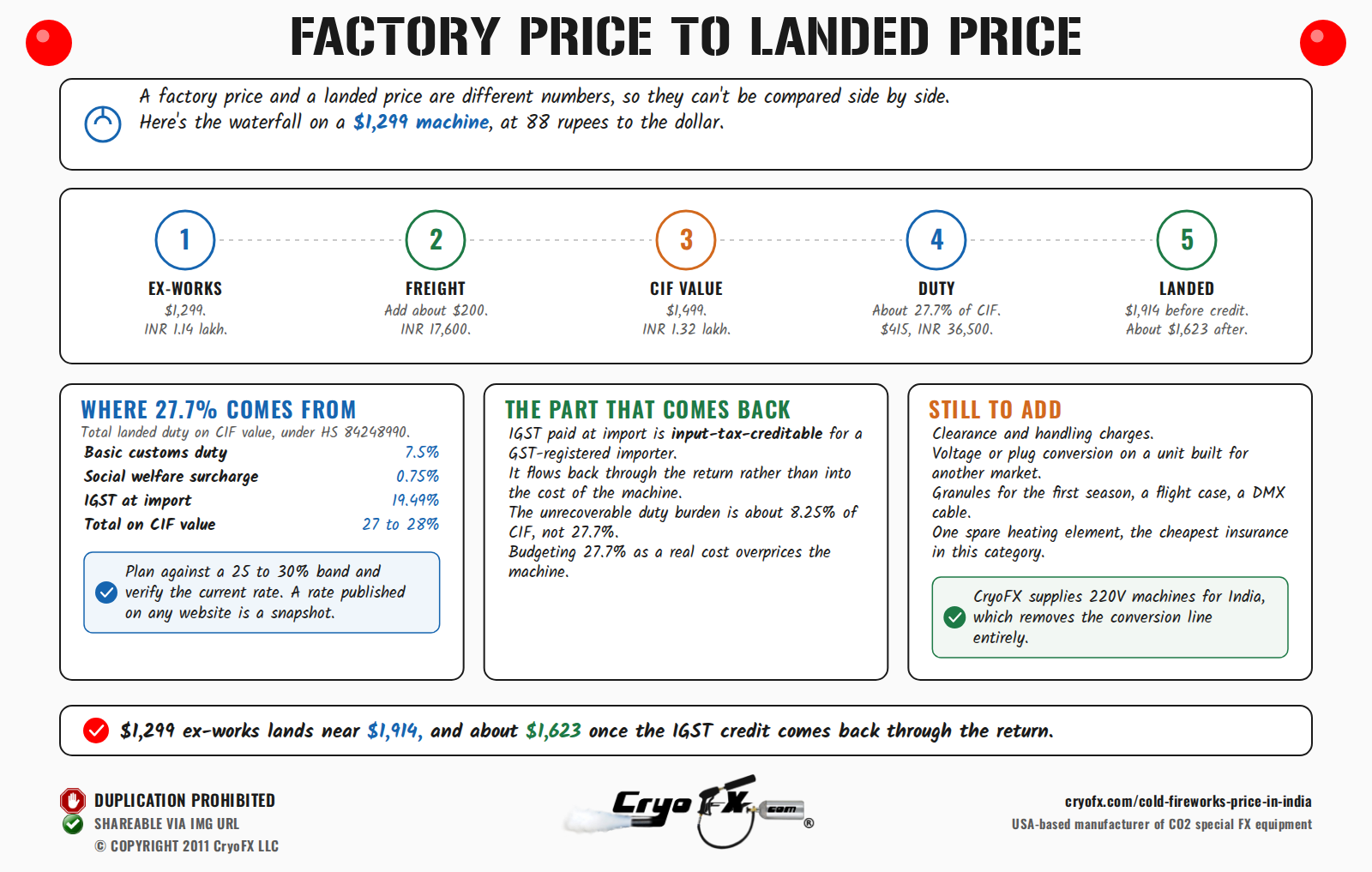
The most likely HS classification for a cold spark machine is 84248990. Under that heading the total landed duty on CIF value comes out around 27 to 28%, built from basic customs duty at 7.5%, a social welfare surcharge at 0.75%, and IGST at 19.49%. Plan against a 25 to 30% band and verify the current rate before you commit, because BCD and IGST rates change with the Finance Act and with notifications through the year, and a rate published on any website is a snapshot.
The number that matters is smaller than the headline. IGST paid at import is input-tax-creditable for a GST-registered importer, so it flows back through the return rather than sitting in the cost of the machine. Strip it out and the unrecoverable duty burden is about 8.25% of CIF, not 27.7%. An importer who budgets 27.7% as a real cost is overpricing the machine against competitors who understand their own credit position.
Here's the waterfall on a $1,299 machine, at ₹88:
| Line | USD | INR |
|---|---|---|
| Ex-works machine | $1,299 | ₹1.14 lakh |
| Freight and insurance | ~$200 | ~₹17,600 |
| CIF value | $1,499 | ₹1.32 lakh |
| Total duty at ~27.7% | $415 | ₹36,500 |
| Landed cost before credit | $1,914 | ₹1.68 lakh |
| Effective cost after IGST credit | ~$1,623 | ~₹1.43 lakh |
Add clearance and handling charges, and add voltage or plug conversion where a unit was built for another market. CryoFX supplies 220V machines for India, which removes that line entirely.
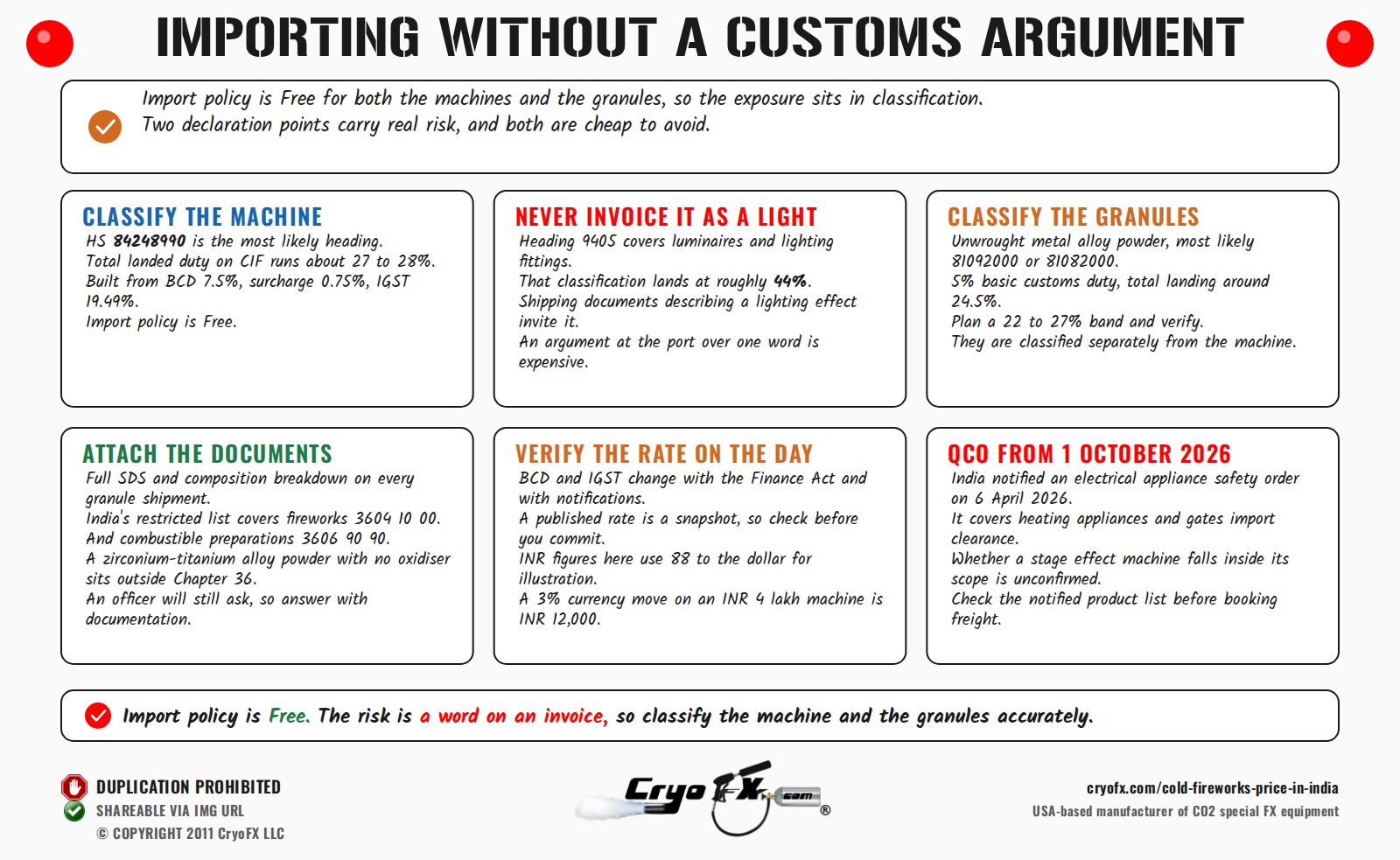
Granules are classified separately as unwrought metal alloy powder, most likely 81092000 or 81082000, at 5% BCD and a total landing around 24.5%. Plan a 22 to 27% band and verify. Import policy is Free for both the machines and the granules.
Two declaration points carry real risk, and both are cheap to avoid.
Never invoice or market the unit as a light or a luminaire. The worst-case classification is heading 9405, luminaires and lighting fittings, which lands at roughly 44%. Shipping documents describing the machine as a lighting effect invite exactly that reclassification, and an argument at the port over a word on an invoice is an expensive argument.
Declare granules accurately as unwrought metal alloy powder, with a full SDS and composition breakdown attached. India's restricted list includes Fireworks under 3604 10 00 and combustible preparations under 3606 90 90. A zirconium-titanium alloy powder with no oxidiser is technically outside Chapter 36, and a customs officer looking at a metal powder used for a spark effect will still ask. Answer with documentation rather than argument.
One compliance item sits on the horizon. India notified a Quality Control Order for electrical appliance safety on 6 April 2026, mandatory from 1 October 2026, covering heating appliances and operating as a precondition for import clearance. Whether a stage effect machine falls inside its scope is unconfirmed. Treat it as an open risk on any shipment planned to land after that date and check the notified product list before booking freight.
Spark Machine Cold Fireworks Price In India Factory To Landed" href="#">
Factory-direct versus distributor, and what the gap buys
On the invoice, factory-direct is usually cheaper. That's the whole of the case for it.
Add freight, duty, clearance charges, the working capital tied up while a container clears, and the absence of anyone locally holding a spare part, and the gap narrows or reverses. A distributor's markup pays for stock on a shelf, a warranty someone will honour without a shipping quote attached, and documentation a venue's fire officer will accept.
The failure case is specific. A direct unit with a dead heating element and no parts source means $100 or more per part at roughly 3 weeks in transit, or 6 to 10 weeks with the whole machine going both ways at a few hundred dollars in freight. Either route approaches the cost of a second machine, and neither covers the booking you already took.
Evaluate the seller rather than the sticker. What to ask, and what each answer tells you, is set out on the cold fireworks supplier page.
Why two quotes for the same machine differ by 2x
Four reasons, and none of them is a better machine.
Layers. A factory sells an importer, the importer sells a distributor, the distributor sells an event dealer, and every step takes margin. A quote three layers down carries three margins.
Allocation. Duty, freight, and clearance get spread differently. A seller who recovers duty through input tax credit can price below one who has loaded 27.7% into the cost of goods, and neither number is wrong.
Rebadging. Identical hardware sells under different badges at different market positions, with the same copied specification text under both.
Support depth. The cheaper figure usually reflects a thinner support structure behind the machine, which is invisible at purchase and decisive at month 9.
Compare parts stock, warranty exclusions, repair location, and granule lead time. Those four answers explain the price gap better than the specification sheet does.
[INSERT FACTORY PRICE TO LANDED PRICE WATERFALL INFOGRAPHIC HERE: FACTORY FIGURE, FREIGHT, DUTY, CLEARANCE, IGST, IGST CREDIT RECOVERY, DISTRIBUTOR MARGIN, FINAL NUMBER]
Reading a quote properly
Run every quote through the same seven questions.
- Is it ex-works, FOB, or landed? An ex-works figure and a delivered figure are not comparable.
- What's in the box, specifically: controller, wireless remote, DMX cable, granules, case?
- Voltage and plug configuration as supplied, in writing.
- Warranty length and its exclusions, and who performs the work inside India.
- Granule price per 200g and per 50g, and lead time on a reorder.
- A parts price list, with a heating element and a control board quoted by name.
- Where the machine gets repaired, and what the turnaround is from receipt.
The total to plan against is the machine, granules for the first season, a flight case, a DMX cable, and one spare heating element. That last item is the cheapest insurance available in this category, and it's the one nobody orders until they need it.
When you're ready to compare an Indian quote against a manufacturer-direct landed figure, ask for cold spark machine pricing and availability with freight and duty inside the number.
Frequently asked questions
How much do cold fireworks cost in India?
Machine pricing follows the same tiers as everywhere else, because most units come from the same small group of factories. Entry machines land around $700 to $800 (about ₹62,000 to ₹70,000), the main working tier is $1,000 to $2,000 (₹88,000 to ₹1.76 lakh), and high-output, multi-axis, multi-port, or weather-rated units run $2,000 to $5,000 (₹1.76 lakh to ₹4.4 lakh). Indian landed cost sits above the factory figure once freight, duty, and distributor margin are added.
Why is there such a price difference between sellers in India?
Because the same machine passes through a different number of hands. A factory sells an importer, the importer sells a distributor, the distributor sells an event dealer, and each layer takes margin. Duty and freight get allocated differently too, and an importer who recovers IGST through input tax credit can price below one who hasn't. The spread rarely reflects a better machine, so compare parts stock, warranty terms, and support behind each quote.
How much do cold spark granules cost in India?
The reference figures are $35 to $45 for a 50g pack (about ₹3,100 to ₹4,000) and $53 to $69 for 200g (about ₹4,700 to ₹6,100), before freight and duty. A 200g pack gives 12 to 15 minutes of cumulative runtime on a standard machine, and 50g gives 3 to 4 minutes on a mini. High-output machines burn around 70g per minute. Budget granules as a recurring cost rather than a one-time accessory.
Is it cheaper to buy factory-direct in India?
On the invoice, usually. Add freight, customs duty, clearance charges, and the absence of anyone locally holding spare parts, and the gap narrows or reverses. What a distributor's markup buys is stock on a shelf, a warranty someone will honour, and documentation for a venue or fire office. A direct unit with a dead heating element and no parts source costs more than it saved.
What are the hidden costs of importing a cold fireworks machine?
Freight, customs duty and clearance charges, IGST at import, and voltage or plug conversion where the unit was built for another market. Duty under HS 84248990 runs around 27 to 28% of CIF, though IGST is input-tax-creditable for a GST-registered importer, which brings the unrecoverable burden to roughly 8.25%. Verify current rates before committing. Then the ongoing ones: granule shipments, replacement parts at $100 or more with roughly 3 weeks transit, and 6 to 10 weeks round trip if the machine itself has to go back.
How does Indian pricing compare to US pricing?
The machine tiers match, since the hardware originates in the same places. What differs is what sits on top. Import duty and freight raise the Indian landed cost, while US buyers pay a premium for domestic parts inventory, in-house repair, and permit documentation. The cheaper figure usually reflects a thinner support structure behind the machine.
Cold Fireworks Price in India | CryoFX®
Updated - 08/12/2026.