
Why Is My CO2 Cannon Not Working?
Why Is My CO2 Cannon Not Working? | CryoFX®
Issues...Why is my CO2 cannon not working?
Why is my CO2 cannon not spraying?
CryoFX® explains the most common occurences.
Contact us NOW for info...Call:1.855.527.9639

CryoFX LLC • 3859 S Valley View Blvd, Suite 2, Las Vegas, NV 89103 • 1.855.527.9639
Why Is My CO2 Cannon Not Working? Problems Outlined
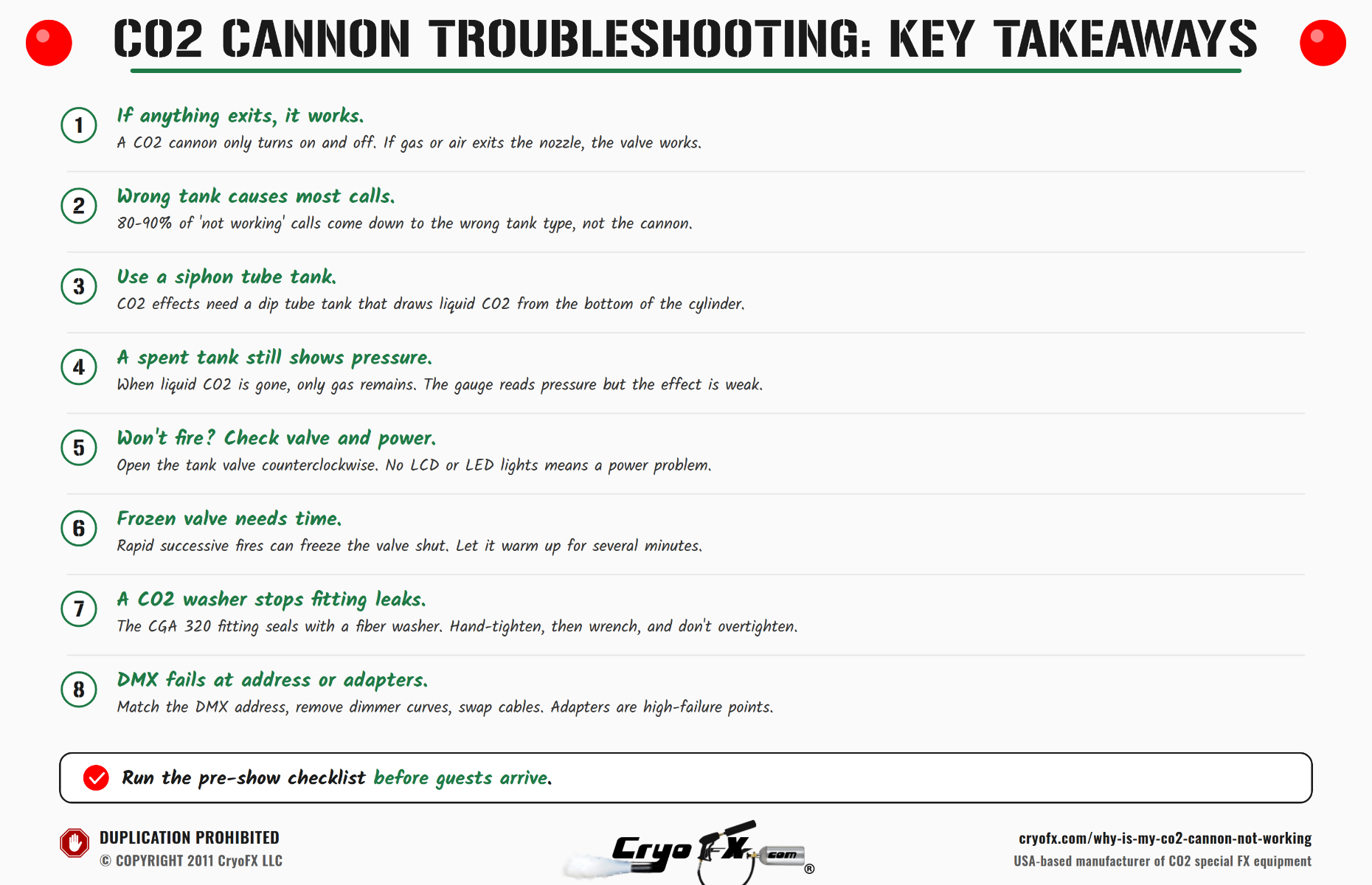
Before you call support, open a ticket, or start swapping parts, answer one question: is anything coming out of the nozzle when you activate the cannon? If the answer is yes, the cannon is working.
That's not sarcasm. A CO2 cannon has exactly one function: turning on and turning off. If CO2 or even air pressure is exiting the nozzle when activated, the valve is doing its job. The problem is almost certainly upstream, and in 80-90% of all "not working" calls CryoFX receives, the upstream problem is the same: wrong tank type.
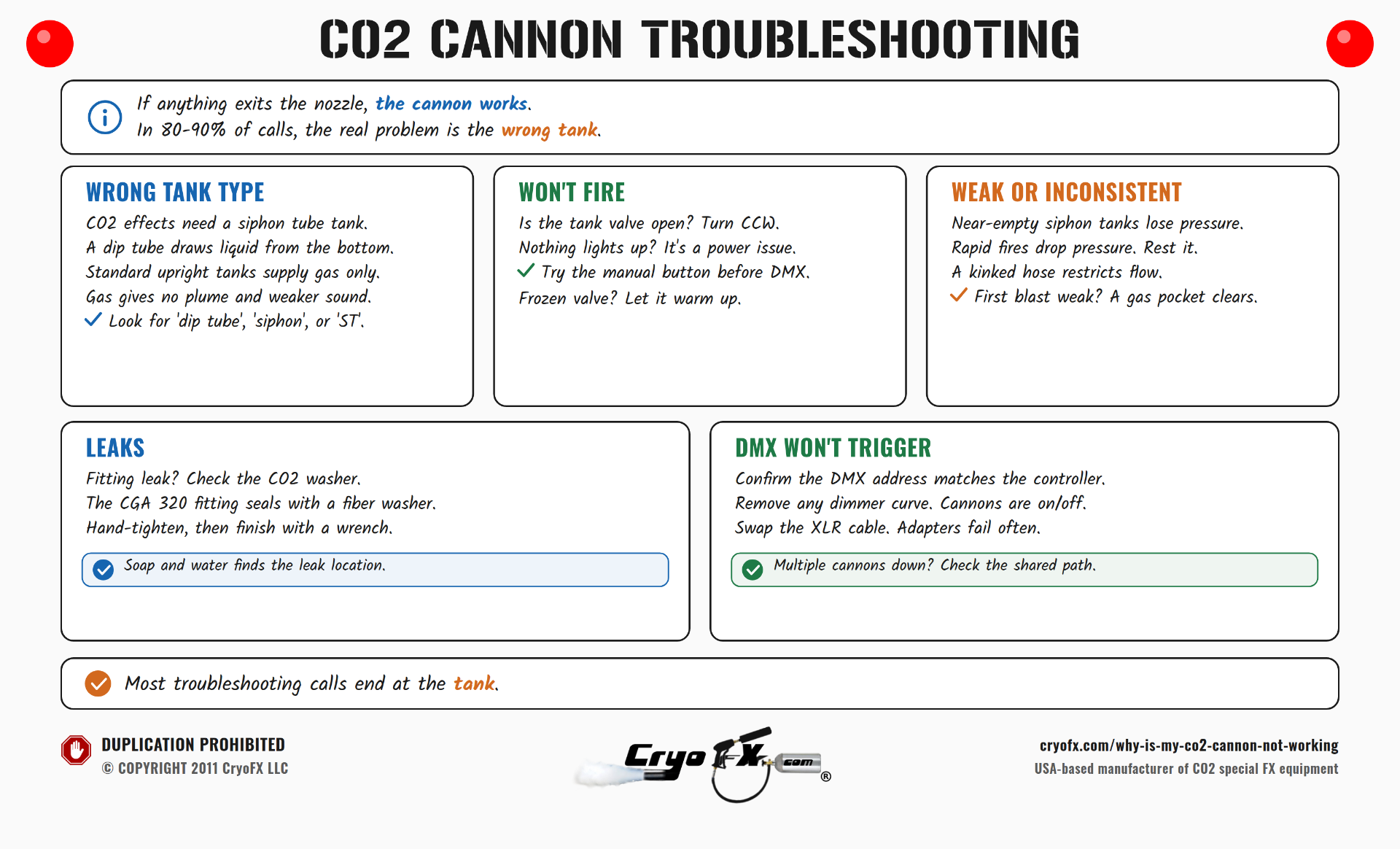
Most troubleshooting calls end at the tank. Not the cannon, not the hose, not the solenoid. The tank.
Start here: the wrong tank is the most common cause
CO2 special effects require a siphon tube (liquid) CO2 tank. These tanks have a dip tube inside that draws liquid CO2 from the bottom of the cylinder rather than gaseous CO2 from the top. Standard upright CO2 tanks supply gas only. Gas produces no visible plume, dramatically different sound, and roughly one-third to one-half the output effect.
When you put a standard upright CO2 tank on a CO2 cannon, the cannon fires, air moves, and nothing happens visually. Every time this happens, the person using the equipment assumes the cannon is broken.
Siphon tanks should have markings: "dip tube," "siphon tube," "ST," or similar notation. If those markings aren't there, or if the tank came from an unverified source, there's a very real chance it's the wrong type.
A secondary tank issue is a spent siphon tank. When liquid CO2 is fully depleted, only gaseous CO2 remains. The tank still has pressure, the cannon still activates, but the effect is weak or non-existent. The gauge shows pressure, so the operator assumes the tank is fine. It's not. The liquid is gone.
Symptom-by-symptom troubleshooting
No visible plume, but the cannon appears to fire
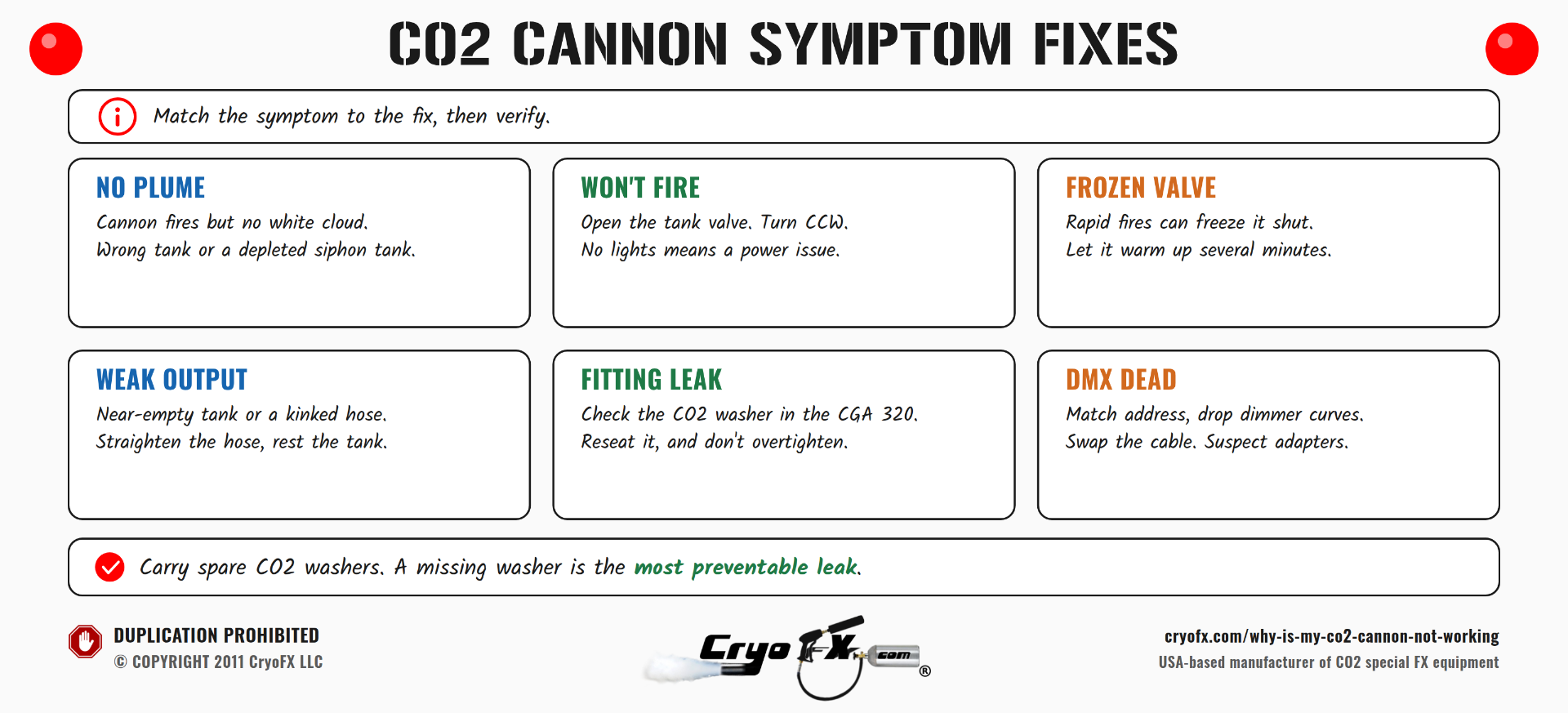
Start with the tank. Is it a siphon tube tank? If you're not certain, assume it isn't and verify. If it is a siphon tank, check whether liquid remains. A tank that's light for its stated weight and still has gauge pressure is likely depleted.
In low-humidity environments like Las Vegas, the plume will be less visible even with a correctly set up system. High heat and low humidity cause the CO2 to evaporate faster. If you've used this setup before and the plume was visible, and now it's not, the tank is the first variable to check.
Won't fire at all
Work through this sequence:
Is the CO2 tank valve open? Turn counterclockwise to open. This is the most basic check, and it gets skipped.
Is power reaching the solenoid? Does anything light up on the cannon: LCD panel, LED indicators, DMX lights? If nothing lights up, you have a power issue. Swap the power cord or check the outlet.
If the cannon powers on but won't fire via DMX, the next check is the DMX signal chain. Try the manual on/off button directly on the unit before assuming DMX is the issue. If the manual button works and DMX doesn't, the problem is in the control system, the cable, or the configuration.
Is the valve frozen shut? If the cannon was activated repeatedly in rapid succession, the valve can freeze closed. The solution is time, not force. Let it warm up for several minutes before attempting to fire again.
Fires but output is very weak
Check how long the tank has been in use and how many activations it's been through. A siphon tank that's nearly empty will have declining pressure and a noticeably weaker output in the final minutes of its tank life.
Rapid successive activations drop the internal tank pressure temporarily. This is normal. Pressure recovers with a brief rest period.
Also check the hose. A kinked CO2 hose restricts flow and weakens output significantly. Run the hose without tight bends, especially near fittings.
Output is inconsistent (strong first blast, weaker subsequent blasts, then improves)
This is a gas pocket issue. When the hose sits idle for several minutes, liquid CO2 near the end of the hose warms slightly and begins converting to gas. The first activation discharges that gas pocket rather than liquid. The output looks different: less dense, less visual effect, sometimes louder than usual.
Once the gas is cleared, subsequent activations pull liquid CO2 from the tank and the output normalizes. This is more common with longer hose runs and in warmer environments. It's not a defect.
Leaking at the tank connection
The most common cause of a fitting leak is a missing or worn CO2 washer. The CGA 320 fitting (left-hand thread, specific to CO2 service) uses a small fiber washer to seal at the tank connection point. Without a washer, or with a damaged one, the fitting will leak regardless of how tightly it's torqued.
Remove the fitting, confirm a CO2 washer is present and undamaged, reinstall, and hand-tighten before finishing with a wrench. Do not overtighten. If it's still leaking after that, the fitting seat may be damaged or debris may be preventing a clean seal.
A reliable way to locate leaks is soap and water applied around the fitting while the system is pressurized. Bubbles confirm the leak location.
Leaking at the nozzle or valve body
If the cannon is leaking at the valve body or nozzle when not activated, the valve may not be seating fully. The most common cause is debris on the valve seat preventing a complete close.
Perform a valve purge: with the tank valve closed and hose depressurized, fire the cannon several times to clear any debris from the seat. Then reconnect the tank, pressurize slowly, and test. If the leak persists, there may be an O-ring failure or seat damage requiring service.
CryoFX valves use piston construction with Viton and PTFE sealing materials, which are rated for cryogenic CO2 service and are more durable under repeated use than diaphragm-style valves. When a CryoFX valve does need service, the piston design is rebuildable.
DMX not triggering the cannon
DMX problems follow a consistent pattern. Work through this sequence:
Confirm the DMX address on the cannon matches the channel assigned on the controller. An address mismatch is the single most common DMX issue and takes 10 seconds to check.
Check whether a dimmer curve is applied to the channel controlling the cannon. CO2 cannons are on/off devices. They don't respond to intensity values. If a dimmer channel is assigned, the cannon won't fire at less than full value, or may not fire at all depending on the controller.
Swap the DMX cable. XLR cables fail. A cable that works for audio may still have a pin issue that prevents DMX signal from passing correctly.
If you're running adapters in the signal chain, those are high-failure points.
The adapter chain story
CryoFX once diagnosed a situation where multiple CO2 cannons were failing to respond to DMX simultaneously. Multiple cannons failing at once ruled out the cannons themselves. The system was running a Grand MA controller with a 3-pin to 5-pin XLR adapter, then a 5-pin to RJ45 adapter, then Ethernet cable into the first cannon.
Somewhere in that chain, the signal was dropping. The process of isolating which adapter was the fault involved removing adapters one by one and testing at each step with a small standalone DMX controller connected directly to one cannon. When the system worked with the small controller and failed with the full adapter chain, the problem localized to the adapters.
One of them was not converting the signal correctly. Replacing that single adapter resolved the issue across all cannons on the system.
When a DMX problem affects multiple cannons simultaneously, look at the common signal path first: the controller output, the first cable leaving the controller, and any adapters in the chain.
Hose smell: a separate problem that matters
If the CO2 hose produces a smell when the system fires, the hose is wrong. This is not a minor inconvenience. CO2 permeates through hoses that aren't rated for CO2 service, and as the gas works through the hose wall, the reaction with the hose material produces the smell.
The same non-rated hose can develop pressurized bubbles in the wall. Popping one of those bubbles by squeezing or puncturing is approximately as loud as a 12-gauge shotgun firing next to your ear. This is not exaggeration. It will damage hearing at close range.
CryoFX hoses carry a manufacturer seal: silver or red tape applied at the factory. Do not remove that tape. It marks factory-sealed connections. Any hose without this marking from a CryoFX source should be verified for CO2 rating before use.
Pre-show checklist that prevents most of these calls
Run this before guests arrive, not during the event:
- Cannons positioned and powered on. Listen for the click that confirms the solenoid is receiving power.
- DMX address confirmed and signal tested with a manual trigger before connecting to the full controller.
- Hoses connected to cannons, then to tanks. CO2 washers confirmed in all CGA 320 fittings.
- Tank valve opened slightly. Check for leaks at all connections. Soap and water if needed.
- Tank opened fully. Test fire.
- One test fire from DMX at show settings.
Carry spare CO2 washers on every job. They're small, they're cheap, and a missing washer is the most preventable version of a show-stopping leak. Also carry spare hose caps to protect fittings during transport and a backup DMX cable.
For full technical guidance on setup, specifications, and operation, the CO2 cannon troubleshooting and maintenance guide on CryoFX's website covers equipment in detail.
For CO2 cannon replacement and repair options, CryoFX carries replacement valves, hoses, fittings, and complete units.
FAQs
My CO2 cannon fires but there's no white cloud. What's wrong? Almost certainly the tank. Either you have a standard upright CO2 tank (gaseous only, no visible effect) or a siphon tank that's depleted its liquid CO2 and is now discharging gas only. Verify you have a siphon tube tank with liquid remaining. In very low-humidity, high-heat environments, plume visibility also reduces even with a correct setup.
The cannon clicks when I press the trigger but nothing comes out at all. Start with the tank valve. Is it open? Turn counterclockwise to open. If the valve is open and nothing is coming out, is the hose connected to the tank and is there a CO2 washer in the CGA 320 fitting? A missing washer means no seal and no flow.
DMX works on one cannon but not the others in the same chain. Check the DMX cable between the working cannon and the next one in the chain. The working cannon should be passing DMX signal through to the next unit. If it's not, there may be a cable fault at that segment, or the cannon in between needs its DMX through-put confirmed.
Can I use CO2 without DMX? Yes. CryoFX CO2 cannons have a manual on/off function. DMX allows remote and automated triggering but isn't required for basic operation. The manual function is also the fastest way to isolate whether a problem is in the cannon or in the DMX control chain.
How often should CO2 washers be replaced? Replace them whenever you see any deformation, cracking, or compression set on the washer material. In active use, inspect them at every setup. They're inexpensive and a failed washer causes leaks that waste CO2 and can be mistaken for equipment failure. Order extras whenever you buy equipment. Running out of washers mid-event is entirely avoidable.
What causes a CO2 cannon to produce inconsistent output, with strong first blasts followed by weaker ones? This is usually a sign of a tank running low on liquid CO2. As the liquid level drops, the siphon tube begins drawing a mix of liquid and gas rather than pure liquid. The result is a visible but weaker plume that fluctuates. When the tank runs completely dry, only gas passes through and no plume forms at all. Replace the tank.
What does CO2 hose smell indicate and how serious is it? A CO2 hose that smells like solvent or dry cleaning indicates CO2 is permeating through the hose wall. This happens when the hose material isn't rated for CO2 service. Beyond the odor, CO2 permeating through non-rated hose creates pressurized gas bubbles in the hose wall. When those bubbles fail, the pressure release is equivalent to a 12-gauge shotgun at close range. Take the hose out of service immediately and replace it with CO2-rated hose.
What is the most common reason a CO2 cannon doesn't fire at all when the trigger is pressed? The most common cause is a closed tank valve. The tank valve must be turned counterclockwise to open before the system will flow. After confirming the valve is open, check that the hose is connected to the tank, that a CO2 washer is seated in the CGA 320 fitting, and that the trigger or DMX command is actually reaching the solenoid valve.
What should a pre-show CO2 cannon checklist cover? Confirm the tank is a siphon tube tank with liquid CO2 remaining. Open the tank valve. Inspect the CGA 320 fitting for a CO2 washer and hand-tighten before tool-tightening. Check the hose for visible damage or smell. Fire the cannon manually at least once before the show to confirm output. For DMX setups, confirm the console address matches the cannon's assigned DMX address. Confirm CO2 monitor placement and function.
Updated - 07/25/2026.