
How to Make a CO2 Cannon - Parts, Details, Assembly
How to Make a CO2 Cannon - Parts, Details, Assembly | CryoFX®
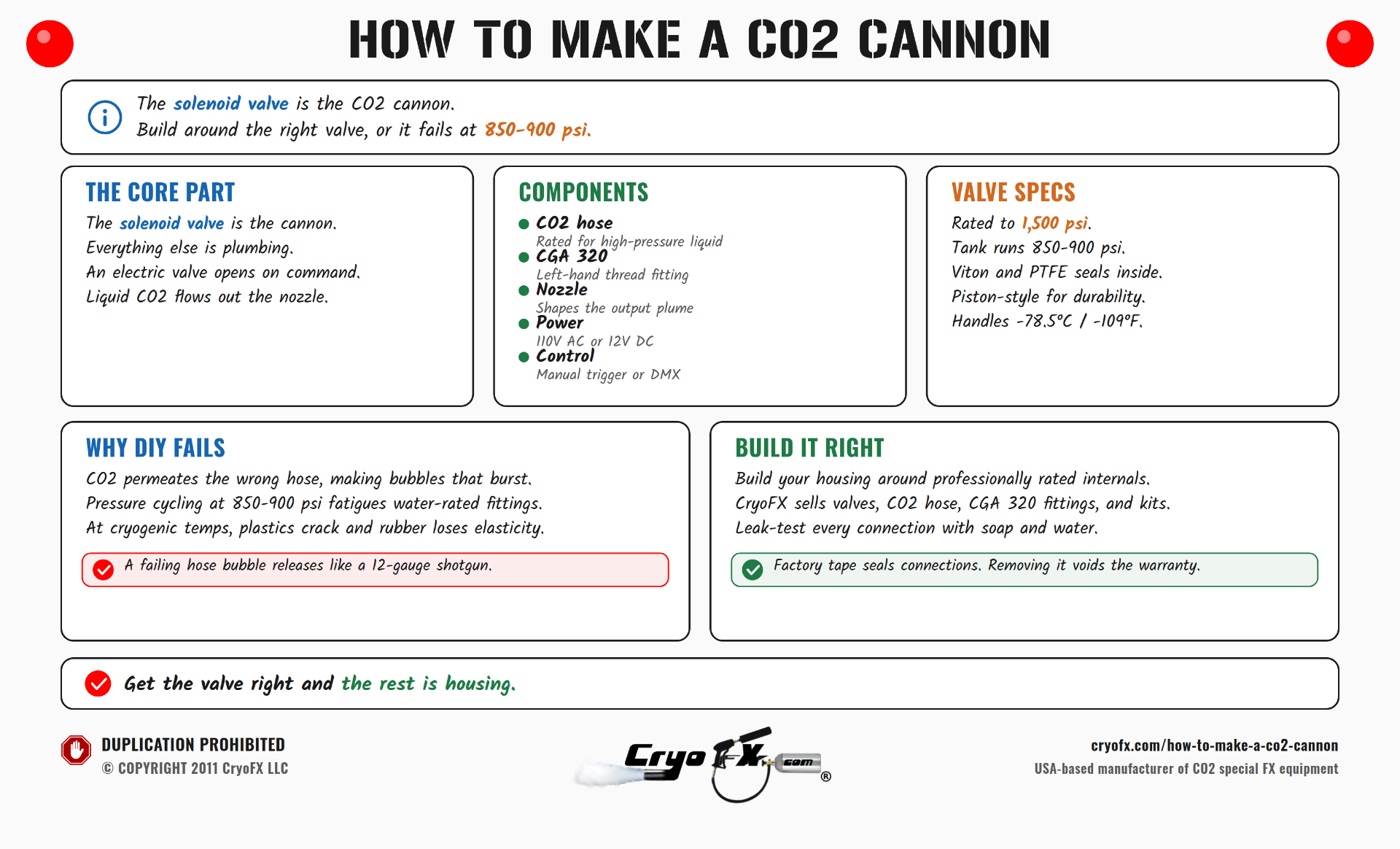
The question "how do I make a CO2 cannon?" has a shorter answer than most people expect: the solenoid valve is the CO2 cannon. Everything else is plumbing, housing, and control wiring. If you build around the right valve with the right hose, you have a functional CO2 special effects device. If you build around the wrong materials, you have a pressurized assembly rated for something that isn't liquid CO2 at 850-900 psi.
That distinction is where most DIY builds go wrong.
What a CO2 cannon actually is
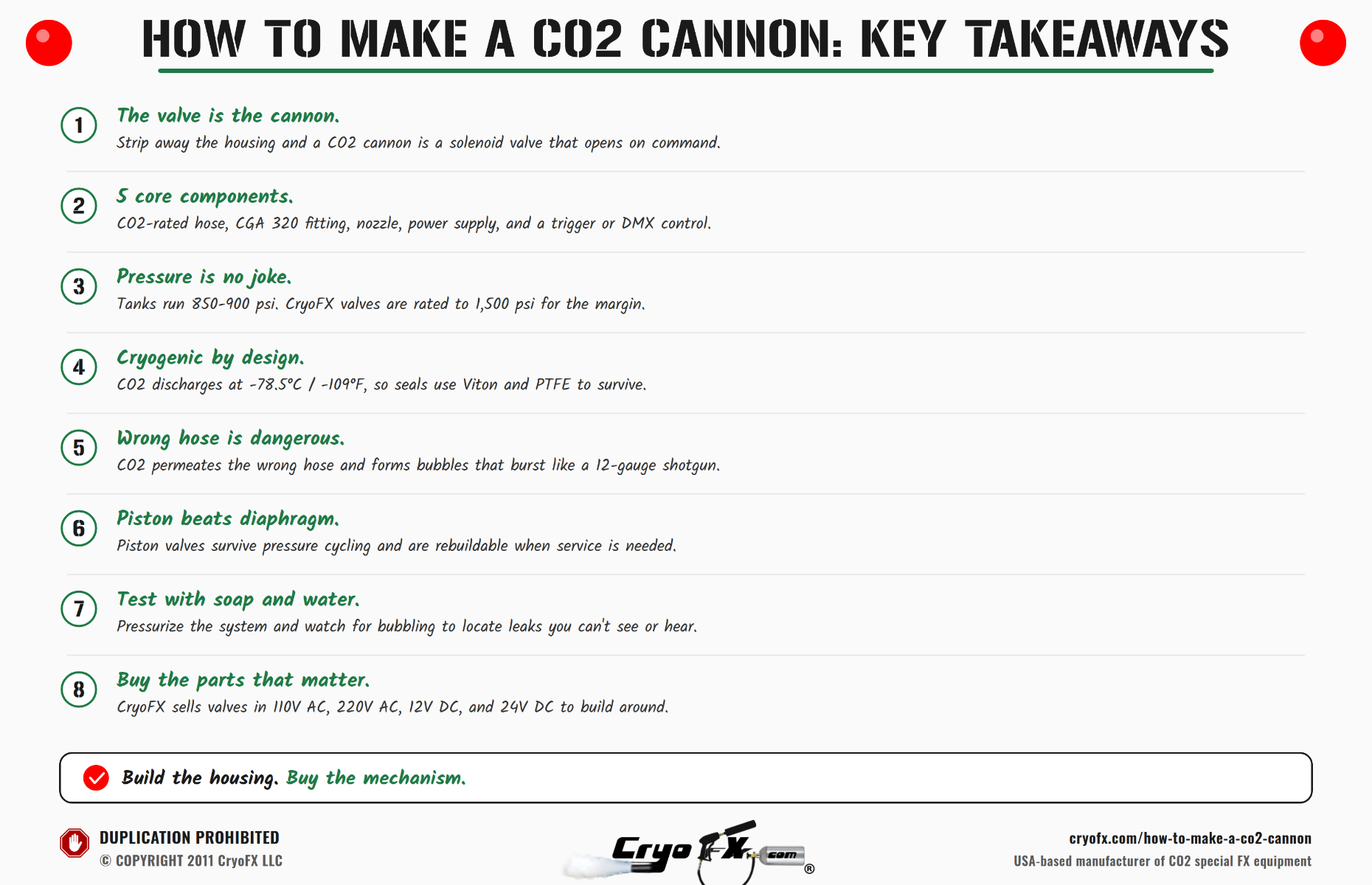
Strip away any enclosure or housing and what's left is a solenoid valve: an electrically controlled valve that opens and closes on command. When open, liquid CO2 flows from a siphon tube tank through the valve and out the nozzle, expanding rapidly into the white fog-like plume the effect is known for.
The other components are real but secondary:
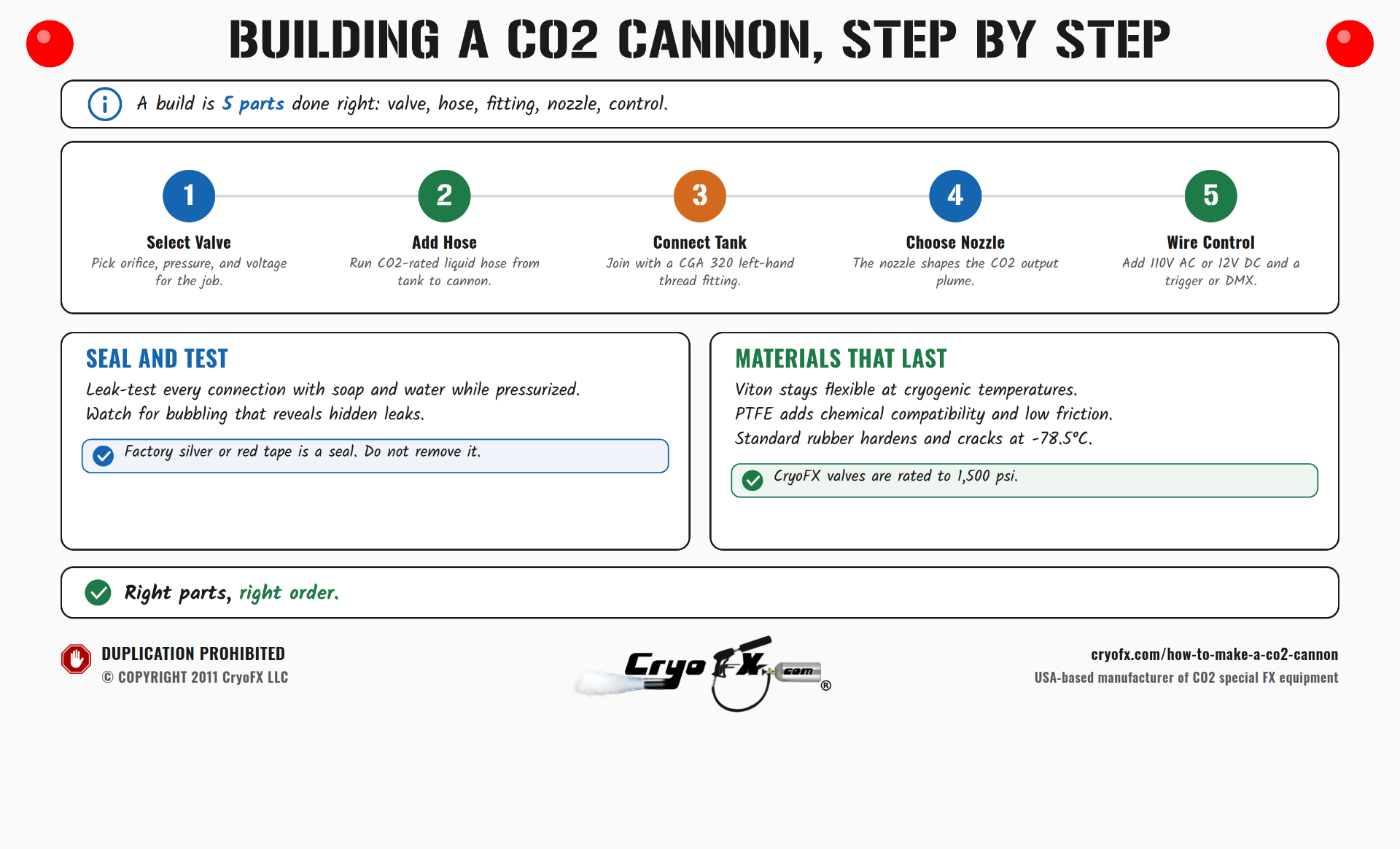
CO2-rated liquid hose. The hose carries high-pressure liquid CO2 from the tank to the cannon. Not all hose is rated for this.
CGA 320 fitting. The fitting standard for CO2 connections in North America. Left-hand thread. This matters. Anyone trying to use a different fitting is working around a standard that exists for a specific reason.
Nozzle. Determines the shape and spread of the output. The nozzle design affects the visual effect significantly.
Power supply. Solenoid valves run on AC or DC power depending on the valve specification. 110V AC and 12V DC are both common in CryoFX products.
Trigger or DMX control. Manual trigger, DMX receiver, or both. CO2 cannons are on/off devices.
The valve specifications matter because CO2 service is demanding. Tank pressure runs 850-900 psi under normal operating conditions. CryoFX valves are rated to 1,500 psi. The materials inside the valve must withstand cryogenic temperatures (CO2 discharges at -78.5°C / -109°F) and repeated pressure cycling without degrading.
CryoFX valves use Viton and PTFE sealing materials. Viton is a fluoroelastomer that stays flexible at cryogenic temperatures. PTFE (polytetrafluoroethylene) provides chemical compatibility with CO2 and low friction for the valve seat. Valves built with standard rubber O-rings or diaphragm materials rated for air or water service will fail under CO2 conditions, either from the cold, the pressure, or both.
CryoFX uses piston-style valves rather than diaphragm-style. The piston design is more durable under pressure cycling, less susceptible to debris damage, and rebuildable when service is eventually needed. A diaphragm valve has a thin membrane that takes the full load of every actuation and degrades faster.
The engineering requirements that make DIY challenging
Building a CO2 cannon isn't complex in concept. Executing it safely with non-rated components is where people run into problems.
CO2 permeation through wrong hose materials. CO2 under pressure permeates through hose materials that aren't designed for it. The gas works through the hose wall, producing an odor and creating pressurized bubbles in the hose material. Those bubbles, when they fail, release pressure equivalent to approximately a 12-gauge shotgun firing at close range. This is not metaphorical. It will damage hearing and can cause injury.
Pressure cycling at 850-900 psi. Every activation cycles the system from full pressure to zero and back. Standard plumbing fittings and hose rated for water pressure or low-pressure air will fatigue over time and fail under these cycles. When a fitting fails under CO2 service pressure, it doesn't leak slowly. It ejects.
Cryogenic temperature effects. At -78.5°C, materials that behave normally at room temperature become brittle. Plastics crack. Rubber loses elasticity. Anything not rated for cryogenic service will eventually fail in ways that aren't predictable.
Electrical safety. Solenoid valves on a CO2 cannon are controlling 110V or 220V AC in an environment where condensation builds up on cold surfaces during operation. The electrical components need to be properly housed and protected.
Code compliance for permits. If you intend to use the cannon at any venue that requires a permit, the equipment must come with manufacturer cut sheets and documented specifications. A homebuilt cannon with unknown component ratings won't pass permit review.
The most common DIY mistake: wrong hose
CryoFX hears this consistently. Someone builds a CO2 cannon using a valve they sourced online, routes it through hose they also found online, connects it to a CO2 tank, and activates the system. One of a few things happens:
The hose smells when CO2 passes through it. This means CO2 is permeating the hose wall. The hose is wrong and needs to come off the system immediately.
The hose develops bubbles visible on the outer surface. These are pressurized pockets of CO2 working through the hose material. Do not touch or puncture them. The pressure release when one of these fails is severe.
The hose disintegrates or splits under pressure.
The standard test for fittings and connections on a CO2 system is soap and water. Apply it around connections while the system is pressurized and look for bubbling. This locates leaks that aren't otherwise visible or audible.
CryoFX hose arrives with silver or red tape applied at the factory over connections. This is a manufacturer seal. Removing it voids the warranty and should not be done in the field. The tape indicates that those connections were sealed during manufacturing and should not be disturbed.
What CryoFX supplies for builders
CryoFX sells the component pieces for builders who want to build their own CO2 cannon housing around professionally rated internals. This includes solenoid valves in multiple configurations, CO2-rated liquid hose, CGA 320 fittings, and complete component kits.
The range of valves CryoFX offers covers different orifice sizes, operating pressures, voltage requirements (110V AC, 220V AC, 12V DC, 24V DC), and temperature ratings. Selecting the right valve for the application is the first real engineering decision in any CO2 cannon build.
CryoFX has supplied component systems for installations that never look like typical CO2 cannons from the outside. Permanent installations in private residences have had CO2 hoses routed through electrical conduits with junction boxes, matched exactly to the conduit layout already in the space. The system blends into the building's existing infrastructure completely. Nothing about the installation would indicate a CO2 system is present. The only visible evidence is the nozzle at the output point.
Cigar lounges, private entertainment spaces, themed rooms in residential properties, and custom architectural builds are all applications where CryoFX has supplied components and instructions so that the client's own staff or contractors could complete the installation under CryoFX oversight.
When DIY makes sense vs. buying a complete unit
The line is the objective. Building a CO2 cannon means building an enclosure or housing around CryoFX components. The mechanism itself, the valve, the hose, the fittings, comes from a source rated for the application. The builder's contribution is the creative housing, the form factor, the integration into whatever larger prop or installation is being built. This is legitimate and CryoFX supports it.
Building a CO2 mechanism from hardware store components rated for water, air, or general industrial service is a different thing. The materials aren't rated for CO2. The fittings aren't rated for the pressures involved. The hose certainly isn't. The resulting assembly may work initially, and it will fail eventually under conditions that aren't predictable.
The professional CO2 cannon from CryoFX comes with a pre-engineered enclosure purpose-built for the valve and its thermal and pressure characteristics. The case handles condensation, mechanical stress from repeated blasts, and the operational realities of gigging or permanent installation. A DIY build also incurs cost: enclosure materials, assembly time, and the absence of a warranty. Component parts from CryoFX are sold as-is without the same warranty coverage that applies to a complete CryoFX unit.
For builders whose objective is creative integration of CO2 effects into a larger prop or installation, CryoFX is a resource for the parts that have to be right. For users whose objective is a working CO2 cannon without the build, a professional CO2 cannon guide covers the full CryoFX product line in detail.
Professional CO2 cannons for sale from CryoFX include complete units tested and assembled to the same specifications used in stadium, theme park, and touring applications.
FAQs
Can I use PVC fittings on a CO2 cannon build? No. PVC becomes brittle at cryogenic temperatures and isn't rated for CO2 service pressure. Standard PVC pipe and fittings are rated for water pressure, which is far below the 850-900 psi operating pressure of a liquid CO2 system. PVC on a CO2 system is a failure waiting to happen.
What voltage do CryoFX solenoid valves run on? CryoFX offers valves in 110V AC, 220V AC, 12V DC, and 24V DC configurations. The right choice depends on what power is available at the installation and how the trigger circuit is being wired. Most event use runs 110V AC. Permanent installations sometimes use 220V to reduce amp draw across the circuit.
Does the orifice size of the solenoid valve matter? Yes. Orifice size determines flow rate, which determines the volume of CO2 output per second. A larger orifice produces a more powerful effect and depletes the tank faster. A smaller orifice is more controlled. CryoFX can advise on the right orifice for the intended application.
Can I put a CO2 cannon on a sewer or water hose to test the build? Testing with water or air at much lower pressure is possible for checking connections before CO2 service, but it won't validate CO2 service performance. CO2 at operating pressure and temperature behaves differently than air or water at low pressure. Soap-and-water leak testing is done with the system pressurized with CO2 at operating conditions.
What's the difference between Viton and PTFE, and why do both matter? Viton is used for O-rings and seals where flexibility under cryogenic temperatures is needed. PTFE (Teflon) is used at valve seats and sliding surfaces for chemical compatibility and low friction. Together, they handle the combination of extreme cold, CO2 chemical exposure, and the mechanical cycling of repeated actuation. Standard rubber or neoprene will harden and crack at CO2 discharge temperatures.
Why is CO2-rated hose required for a CO2 cannon build, and what happens with standard hose? CO2 at 850-900 psi permeates through hose materials not designed for it. This produces odor and creates pressurized gas bubbles inside the hose wall. When those bubbles fail under pressure, the release produces a sound and force comparable to a 12-gauge shotgun at close range. Non-rated hose will eventually fail in this manner under normal CO2 service conditions.
What are the core components required to build a CO2 cannon? A CO2 cannon requires a solenoid valve rated for CO2 service at 850-900 psi minimum (piston construction preferred), CO2-rated liquid hose, CGA 320 fittings with left-hand thread, a nozzle, a power supply matched to the solenoid's voltage specification, and a trigger or DMX control mechanism. The solenoid valve is the functional core. Every other component must be compatible with it.
What is a CGA 320 fitting and why does the left-hand thread matter? CGA 320 is the standard fitting for CO2 service connections in North America. It has a left-hand thread, meaning it tightens counterclockwise. CO2 fittings use left-hand thread to prevent cross-connection with other gas types that use right-hand thread standards. Using a right-hand threaded fitting or an adapter designed for a different gas creates a non-code connection that can fail under CO2 service pressure.
What makes DIY CO2 cannon building difficult compared to buying complete equipment? The core challenge is sourcing components rated for the specific operating conditions: pressure ratings of 850-900 psi minimum, cryogenic temperature compatibility down to -78.5 degrees Celsius, and materials such as Viton and PTFE that maintain seal integrity under repeated cold cycling. Standard plumbing fittings, hardware store hose, and consumer electrical components aren't rated for these conditions. A homebuilt cannon also won't carry manufacturer documentation needed for venue permits.
Updated - 07/25/2026.