
Co2 Cannon Safety Guide - What Is Special Effects Safety
CO2 Cannon Safety Guide - What Is Special Effects Safety | CryoFX
CO2 cannon safety guide: what is special effects safety
CO2 special effects are used at live concerts, stage shows, corporate events, nightclubs, and private parties every night of the week. Most of the time, nothing goes wrong. The times something does go wrong are almost always the result of skipping steps that exist for specific, documented reasons.
This guide covers what those hazards actually are, what the real injury and fatality risk looks like from documented incidents, and what safe practice looks like from pre-show setup through shutdown and transport.
Understanding CO2 hazards before you operate
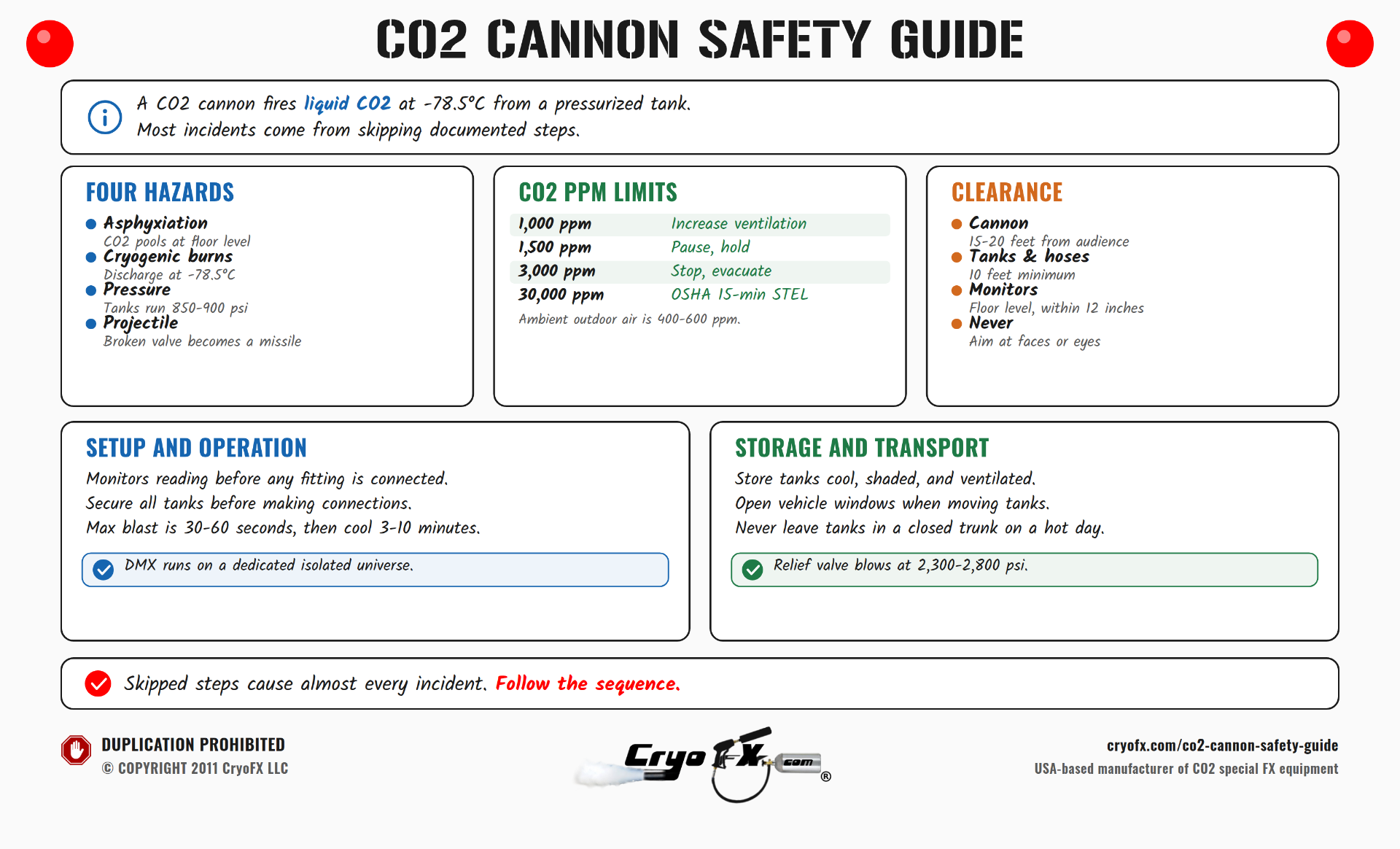
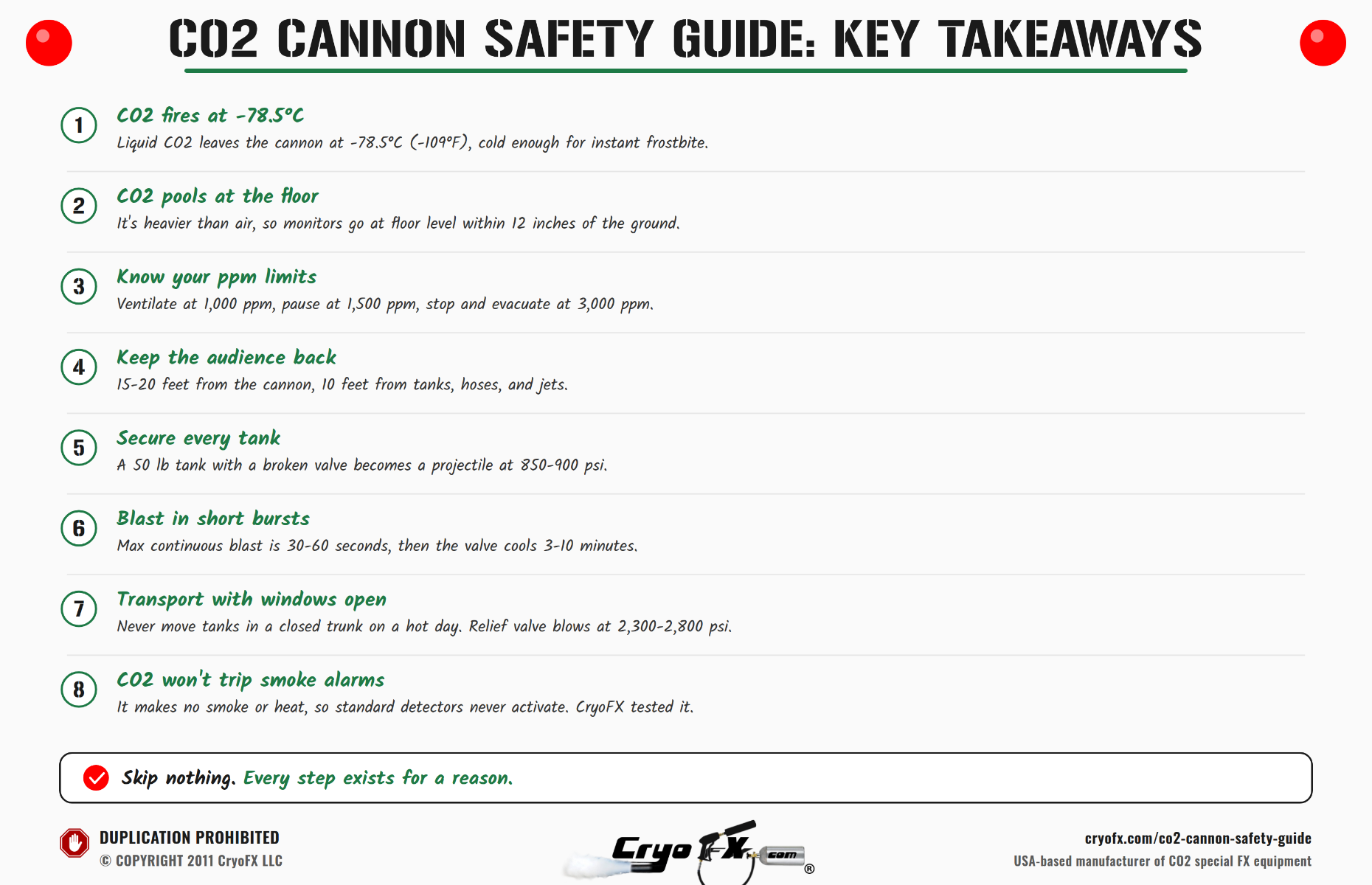
CO2 cannons deploy a cannon gun that fires liquid carbon dioxide from a siphon CO2 tank. The liquid expands instantly on exit, producing fog-like plumes at -78.5°C (-109°F). That's cold enough for immediate frostbite on contact. The delivery system operates at 850-900 psi. A 50 lb steel tank with the valve broken off becomes a projectile capable of punching through a house wall.
Getting the hazards in order:
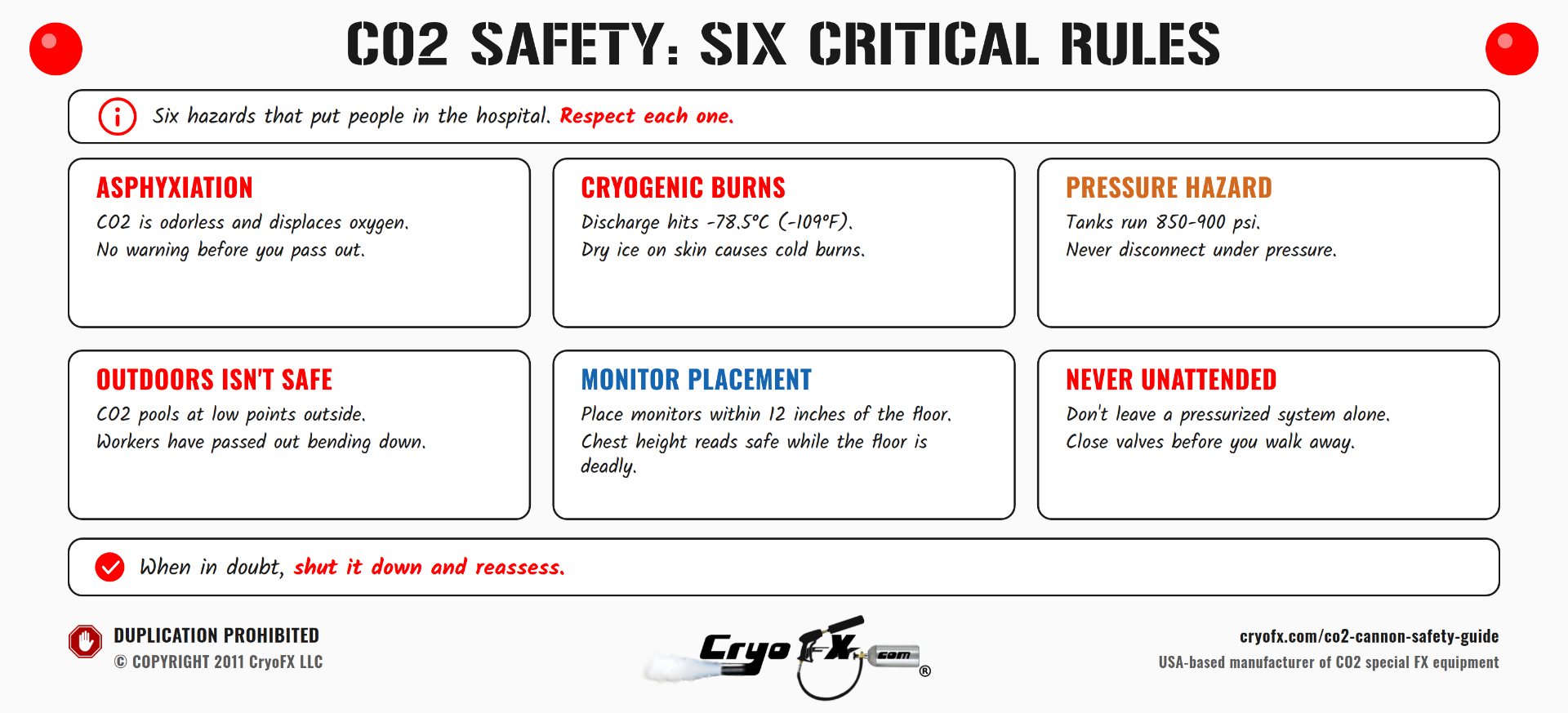
Asphyxiation from CO2 accumulation. CO2 is heavier than air. It accumulates at floor level, where it reaches higher concentrations than anywhere else in a space. OSHA's short-term exposure limit (STEL) is 30,000 ppm (3%) over 15 minutes. Practically, those thresholds are reached faster in enclosed spaces than most operators expect.
Normal ambient CO2 in outdoor air runs 400-600 ppm. Symptoms of overexposure develop well before OSHA's STEL. At 1,000 ppm, the recommendation is to increase ventilation. At 1,500 ppm, operations should stand by until levels drop. At 3,000 ppm, stop all CO2 effects and evacuate the space.
CO2 monitors must be placed at floor level, within 12 inches of the ground, because that's where the gas concentrates. A monitor at chest height in a room with active CO2 cannon use may read safe while the floor layer is already at dangerous concentration.
Cryogenic burn hazard. CO2 discharges at -78.5°C (-109°F). Direct contact with skin causes frostbite and third-degree burns rapidly. Dry ice chunks ejected from a CO2 cannon during discharge can travel at velocity and land on skin. This is the most commonly reported injury in CO2 cannon operation: dry ice contact with exposed skin. Women with spray tans have reported what they initially believe is a burn, though in most cases the CO2 is discoloring the spray tan rather than damaging the skin itself. Real cold burns do occur.
Pressurized vessel hazard. CO2 tanks operate at 850-900 psi. CryoFX valves and hoses are rated to 1,500 psi with appropriate safety margins. The risk comes from unsecured tanks and improper fitting disconnection under pressure. A fitting disconnected while the system is pressurized ejects at force. A tank with a broken neck valve becomes a missile.
Fire detector note. CO2 does not trigger standard smoke detectors. CryoFX has tested this directly. CO2 produces no combustion byproduct, no smoke, no heat. Standard ionization or photoelectric smoke alarms will not activate from a CO2 cannon discharge. CO2 detection systems used in permanent life safety installations are separate devices for a separate purpose.
A near-fatal CO2 accumulation incident
CryoFX founder Kris tells this story when explaining CO2 accumulation risk to operators who haven't thought seriously about it.
He had a tub of dry ice in the back of his station wagon. It sat overnight in the car. He got in the next morning, forgot about it completely, shut the door, and turned the key. By the time the car started, he'd already taken two breaths. On the third breath, he was starting to go weak. His vision was narrowing. He had maybe one or two breaths left before he would have lost consciousness with the door closed. He got the door open. Barely.
The entire car had filled with CO2 overnight from the dry ice sublimating in an enclosed space. There was no smell. There was no choking. His lungs were filling with gas, getting no oxygen, and his body was shutting down without any of the usual warning signals humans associate with suffocation.
This is the nature of CO2 as an asphyxiant: it's colorless, odorless, and displaces oxygen silently. It is not what you put in your lungs that warns you. It's what you don't get that eventually shuts your body down, and by then it's often too late to respond.
The CO2 cannon analog to that car is any small room, storage space, enclosed venue area, or equipment vault where CO2 tanks are stored or CO2 is being discharged without monitoring.
Outdoor CO2 accumulation is not safe by default
A common assumption: being outdoors means CO2 disperses immediately into the atmosphere and there's no risk. This is wrong.
CO2 is heavier than air. Outdoors, it pools at low points. Tanks stored behind a chest-height brick wall create a pocket of elevated CO2 concentration at ground level. Wind doesn't fully clear it. The CO2 settles.
Workers servicing tanks in that environment have bent down to pick up a dropped tool or phone and passed out. The concentration at ground level was high enough to cause rapid unconsciousness. Some of those incidents were fatal.
"Outdoors" and "ventilated" are not the same thing. Any low-lying area, enclosed by walls on multiple sides, or below grade is a potential accumulation zone regardless of whether there's a roof overhead.
Pre-show safety setup
The sequence matters. Don't rush this.
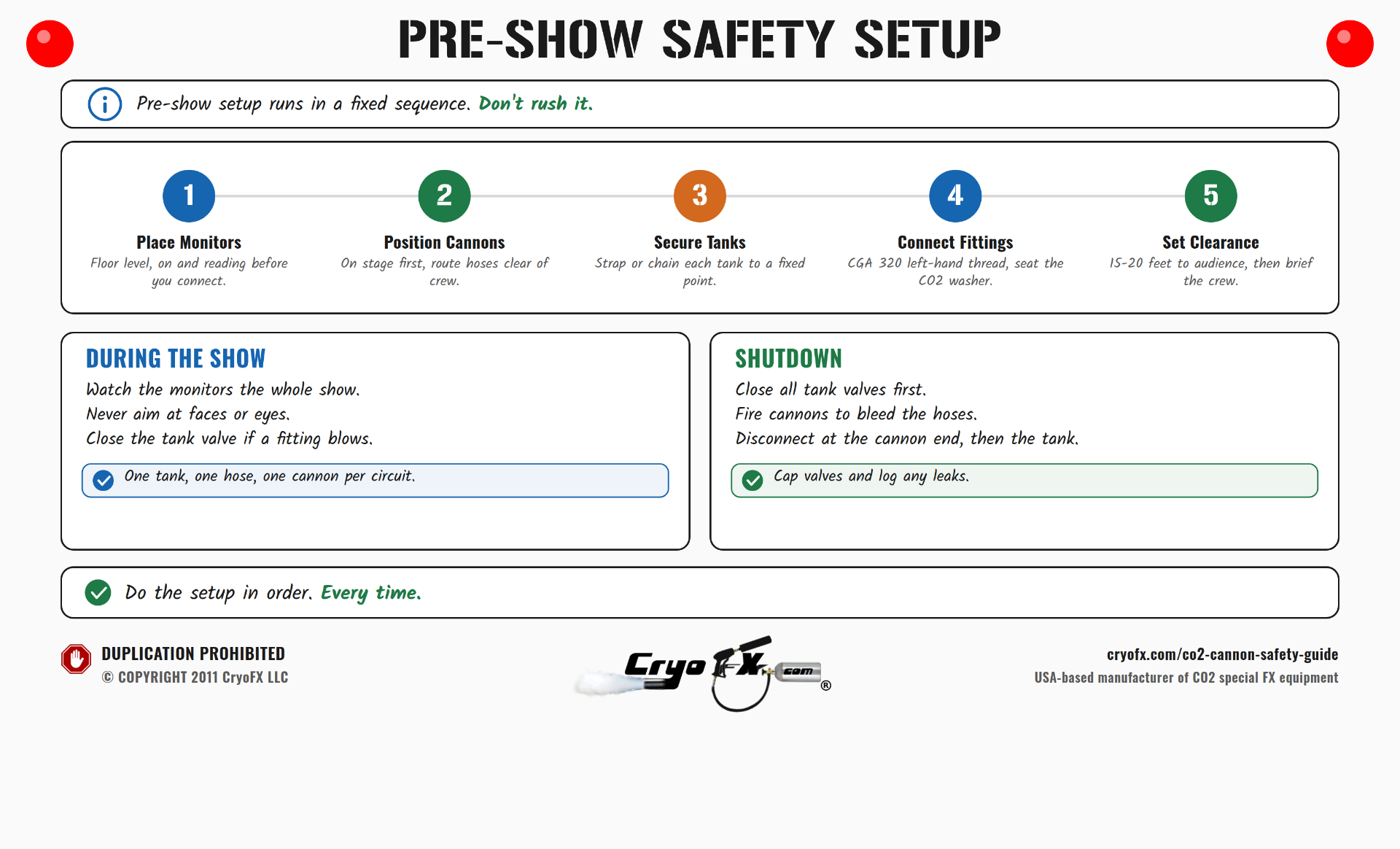
Before any CO2 equipment is connected to tanks, place CO2 monitors at floor level in any area where CO2 will be discharged or where tanks are stored. The monitors should be on and actively reading before a single fitting is connected. If a tank has a slow leak, you want to know that before the system is fully assembled.
Position CO2 cannons on stage first. Run hose routing to confirm paths that keep hoses away from audience areas and won't create trip hazards or contact points for crew. Hoses under pressure that separate do not stay still.
Position tanks with hose connections pointed away from the audience, toward the stage or the sides. If a fitting fails or a hose separates, the discharge should go toward the stage, not the crowd.
Secure all tanks before making any CO2 connections. Tanks must be strapped, chained, or mounted to a fixed point. An unsecured tank that falls and loses its valve becomes a missile under the stored pressure.
Inspect every CGA 320 fitting before connecting. Confirm a CO2 washer is seated in the fitting. The CGA 320 uses left-hand thread. Connect hoses to the cannons first, then to the tanks. Pressurize slowly. Check for leaks at all connection points before opening tanks fully.
The audience clearance minimum from any CO2 cannon is 15-20 feet. Tanks, hoses, and jets should all have a minimum of 10 feet clearance from audience positions. This covers both the output temperature risk and the projectile risk from any equipment failure.
Brief all crew and venue staff on what the CO2 monitors mean, where the alarm strobes and audible alerts are, what to do if a fitting blows, and that no one touches, adjusts, or approaches the CO2 equipment during operation without authorization.
During-show operating rules
CO2 cannons are not continuous-run devices. The valve requires a cooldown period between extended activations. Maximum continuous blast is typically 30-60 seconds. After that, the valve needs 3-10 minutes before extended use again. Pushing through this and running rapid repeat activations freezes the valve open, which wastes the entire tank.
Never aim directly at faces or eyes. CO2 blasts at -78.5°C. Eye exposure at close range causes injury. Even at the designed firing angle, keep spectators at the minimum clearance distances.
Monitor CO2 levels throughout the show. The operating thresholds:
- 1,000 ppm: increase ventilation.
- 1,500 ppm: pause CO2 activations. Hold until levels drop.
- 3,000 ppm: stop all CO2 effects immediately. Evacuate the space.
Never leave a pressurized CO2 system unattended. If you need to leave the area, close the tank valves first. A pressurized system with no one watching it is a liability if anyone interacts with the equipment.
If a fitting blows during the show, close the nearest CO2 tank valve immediately. CryoFX designs systems with one tank, one hose, one cannon per circuit wherever possible. This contains any failure to a single element rather than taking the entire system down. If you can't immediately identify which tank feeds the affected cannon, close all tanks and assess from there.
DMX control should be on a dedicated isolated universe for all CO2 and special effects equipment. Nothing else runs on the same DMX universe. This prevents any premature triggering from other DMX devices on the system.
Post-show and storage safety
When the show is done:
Close all CO2 tank valves. Then fire the CO2 cannons to bleed remaining CO2 from the hoses. If that's not practical, you can bleed the hoses manually at the tank connection by slightly loosening the fitting at the tank end and allowing controlled release.
Once hoses are depressurized, disconnect them from the CO2 cannons first, then from the tanks. Coil hoses loosely and store them without tight kinks at the fittings. Disconnect power from all cannons. Cap the tank connections.
Transport. Open vehicle windows when transporting CO2 tanks. A small, undetected tank leak during transport builds concentration in a confined vehicle interior. Keeping windows open maintains fresh air flow and prevents accumulation. Never transport CO2 tanks in a closed trunk on a hot day. An aluminum CO2 tank in a vehicle that reaches extreme temperatures on a hot day can reach pressures that exceed the tank's safety relief valve. When the safety blows, it blows fast. In an enclosed trunk, the result can be catastrophic.
Storage. Store CO2 tanks in cool, shaded, ventilated areas. Keep them out of direct sun. In Las Vegas, where ambient temperatures reach 115-120°F, tanks stored in garages and outdoor equipment areas are generally fine. The key factor is that the temperature of CO2 inside the tank under those ambient conditions doesn't reach the tank's safety relief valve threshold, which is 2,300-2,800 psi.
Las Vegas summer temperatures, while extreme, don't raise internal CO2 pressure to that level under normal storage conditions. Vehicles are different because they reach extreme temperatures very quickly in direct sun, accelerating the pressure rise faster than shade storage.
Most common injuries from CO2 cannon misuse
The most frequently reported injury in CO2 cannon operation is dry ice contact with skin. The discharge produces dry ice chunks at temperature, and if they land on exposed skin (or clothing over skin), they cause cold burns. The person experiencing it often doesn't realize what happened until after the fact.
Spray tan discoloration from CO2 contact is also reported frequently. The CO2 contacting a fresh spray tan discolors the tan immediately. This is visually dramatic but isn't a burn injury in most cases. It gets reported as one.
Cold burns from holding the valve body or nozzle during extended discharge are documented. A performer or operator who grips the cannon at the valve area during a sustained blast and doesn't release will sustain a cold burn to the hand. CryoFX has seen this result in a third-degree burn from a single sustained hold.
Shutdown procedure
At the end of every event:
- Close all CO2 tank valves.
- Fire the CO2 cannons to discharge remaining pressure from hoses.
- Disconnect hoses at the cannon end first, then the tank end.
- Coil and secure all hoses.
- Disconnect power from all CO2 cannons.
- Cap tank valves with valve caps.
- Log any issues, leaks, or equipment observations for follow-up before the next event.
For a complete operational reference including equipment selection, specifications, and DMX control guidance, the CO2 cannon safety and operations guide covers everything from handheld cannons to permanent nightclub installations.
CO2 cannons for sale from CryoFX include all equipment with manufacturer documentation for venues that require cut sheets and safety specifications.
FAQs
How far should audiences be from CO2 cannons during a live performance? 15-20 feet from the cannon itself is the standard CryoFX recommendation. Tanks, hoses, and all connected equipment should be at least 10 feet from any audience position. These distances account for the temperature of the discharge, the possibility of dry ice chunks in the output, and equipment failure scenarios.
Do CO2 cannons trigger smoke detectors or fire sprinklers? No. CO2 produces no smoke, heat, or combustion byproduct. Standard smoke detectors (both ionization and photoelectric types) will not activate from CO2 cannon output. CryoFX has tested this. CO2 detection systems installed as part of a life safety system are separate devices designed specifically to detect CO2 concentration, not standard fire detection.
What should I do if CO2 monitor levels rise during a show? At 1,000 ppm, increase ventilation in the venue. At 1,500 ppm, pause all CO2 cannon activations and hold until the level drops. At 3,000 ppm, stop the show and evacuate the space. Do not wait to see if the readings come back down before evacuating at 3,000 ppm. Evacuate first.
Can CO2 tanks be stored in a hot garage or vehicle overnight? In a ventilated garage, storage at high ambient temperatures is generally safe because internal tank pressure stays below the safety relief valve threshold (2,300-2,800 psi) even in hot climates. Vehicles in direct sun are a different situation: vehicle interiors reach extreme temperatures rapidly, which can raise tank pressure faster than shade storage. Never leave tanks in a closed vehicle in direct sun, and never transport tanks in a closed trunk on a hot day.
What are the signs that a CO2 hose or fitting needs to be replaced before use? Visible abrasion, cracking, or softening on the hose exterior. Fittings with visible deformation, corrosion, or damaged threads. Any CO2 washer that shows compression set, cracking, or deformation. A fitting that was ever over-torqued or stripped. If there's any doubt, replace it before the show. The cost of a hose or fitting is negligible compared to the cost of a show failure or an injury.
What are the most commonly reported injuries from CO2 cannon operation? Dry ice contact with exposed skin is the most common. During discharge, rapid CO2 expansion can produce small dry ice particles that exit the nozzle at velocity and contact skin, causing cold burns with sustained contact. The second most common issue is hearing impact from an unexpected discharge at close range; the initial crack of a CO2 cannon at operating pressure is startling and can be damaging in close proximity without hearing protection.
Why is CO2 accumulation more dangerous in underground venues than street-level spaces? CO2 is heavier than air. It settles at floor level and fills low points in a space before higher areas. Underground venues, basement clubs, and spaces with sunken floors accumulate CO2 faster at breathing height than open-floor street-level venues. HVAC in underground spaces is typically designed for people-generated CO2, not the additional load from special effects equipment firing at volume. These environments require CO2 monitors placed at floor level and lower thresholds for halting activations.
What is the correct shutdown procedure for CO2 cannon equipment after a show? Close the CO2 tank valve first. Then activate the cannon to bleed any remaining pressure from the hose. Disconnect the hose from the tank only after the pressure has been relieved. Confirm the valve is closed and the hose is depressurized before transport. Coil the hose without kinking. Store tanks upright and secured. Never transport a pressurized system in an enclosed vehicle.
How should CO2 tanks be transported safely between events? Keep vehicle windows open when transporting CO2 tanks. A small undetected tank leak during transport builds CO2 concentration inside the vehicle. Open windows maintain fresh air flow and prevent accumulation. Never transport tanks in a closed trunk on a hot day: extreme vehicle interior temperatures can raise tank pressure toward the safety relief valve threshold faster than shade storage. Tanks should also be secured against tipping during transport.
___
CryoFX® is the leading manufacturer, designer, and global supplier of CO2 special effects equipment and custom special effects systems
for Theme Parks, Sporting Arenas, Mega Nightclubs & Day Clubs , TV/FILM & large scale events & installs in any industry requiring Co2 Systems.
CryoFX LLC Global Headquarters • 3859 S Valley View Blvd, Suite 2, Las Vegas, NV 89103 • 1.855.527.9639
Updated - 07/25/2026.