
CO2 Cannon Rental vs CO2 Cannon for Sale, Which Makes Sense?
CO2 Cannon Rental vs CO2 Cannon for Sale, Which Makes Sense?
Torn between a Co2 Cannon purchase and a Co2 Cannon rental?
CryoFX® can help you decide, here's more info!
CryoFX® explains in details questions to consider on both.
Contact us NOW for info...Call:1.855.527.9639

CryoFX LLC • 3859 S Valley View Blvd, Suite 2, Las Vegas, NV 89103 • 1.855.527.9639
CO2 cannon rental vs CO2 cannon for sale: which makes sense?
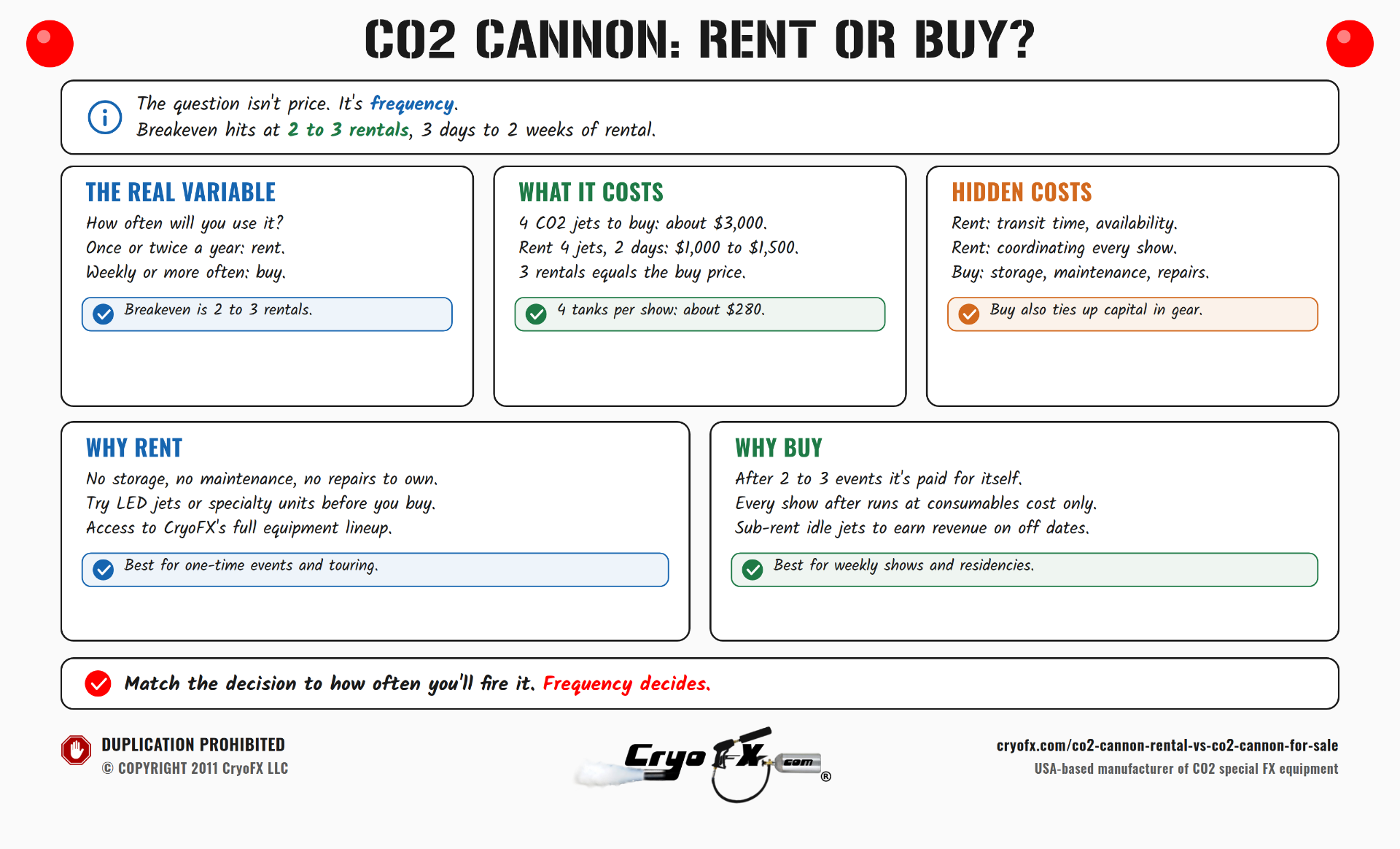
Most people frame this question the wrong way. They look at the price tag on a CO2 cannon, compare it to a rental quote, and try to work backwards. The real question isn't about price, it's about frequency. How often are you going to use this? That one variable settles the decision for most buyers before any other math gets done.
The primary variable: how often will you actually use it?
If you're running CO2 effects once or twice a year, renting almost always makes more financial sense. If you're using CO2 effects weekly, or multiple times a week, buying starts paying for itself quickly.
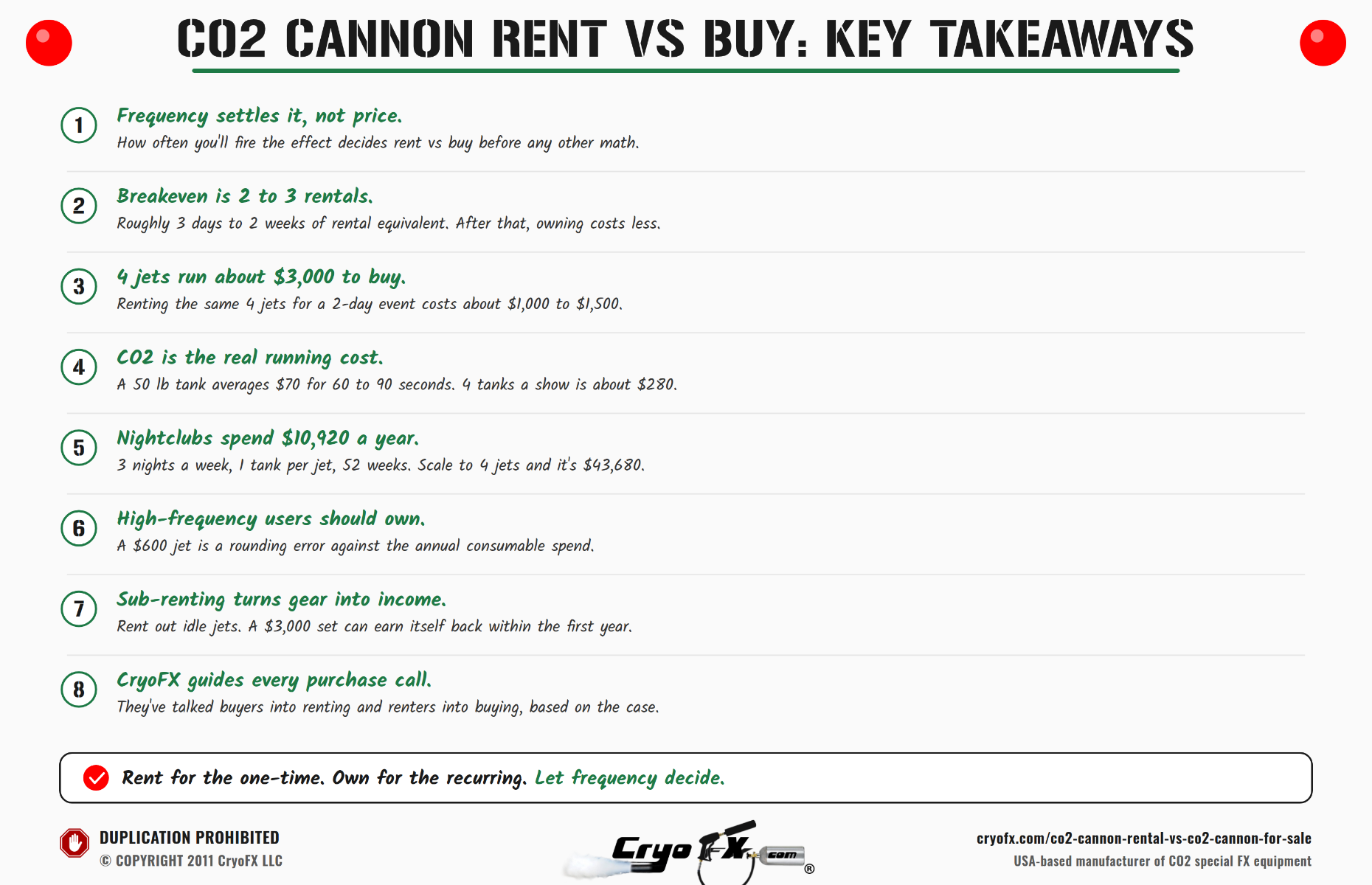
The breakeven point is roughly 2 to 3 rentals. In terms of calendar time, that's somewhere between 3 days and 2 weeks of rental equivalent. Once you cross that line, the economics shift in favor of ownership.
This isn't a hard rule. The type of equipment matters, what you're paying per rental, whether you have storage space, and what happens when something breaks all factor in. But for most buyers, the frequency question gives you a direction, and then the math confirms it.
CryoFX guides customers through this conversation on every purchase call. There have been times they've talked a customer out of buying and into renting, and times they've done the opposite. The goal is to match the customer to the right decision for their situation, not to move product.
What renting costs vs what buying costs
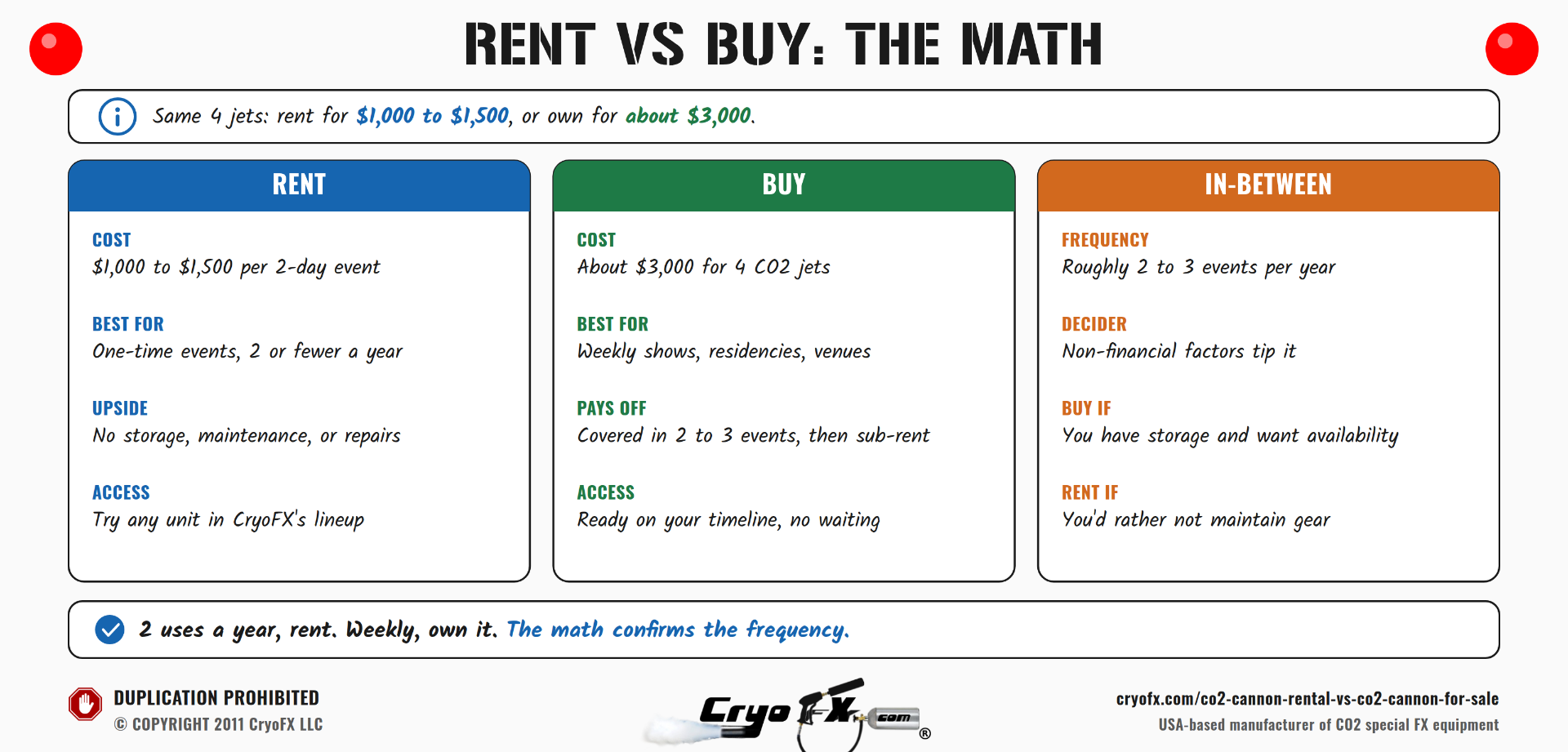
Take a concrete example. Four CO2 jets, a common configuration for DJ setups and club installs, purchased from CryoFX with standard hose lengths and fittings runs approximately $2,800 to $3,200. Call it $3,000.
Renting the same four jets for a 2-day event costs approximately $1,000 to $1,500, depending on hose length, equipment model, time of year, and whether CO2 tanks are included.
The gap looks obvious in isolation: why buy for $3,000 when you can rent for $1,000? The answer is that you're not making this decision once. You're making it every time you need the effect.
Two rentals at $1,250 average puts you at $2,500. Three rentals, and you've spent what you would have spent to own it outright, except you still don't own it.
Now add the CO2 cost. A fifty-pound CO2 tank averages around $70 and gives 60 to 90 seconds of runtime. One tank per jet means 4 tanks per show, at roughly $280 in consumables per event. That number compounds fast in high-frequency use cases.
A nightclub running CO2 effects 3 nights per week, using 1 tank per night per jet, across 52 weeks: 3 nights × $70 average × 52 weeks = $10,920 per year in CO2 alone. That's before equipment cost. At that rate, owning the equipment is clearly the right call. Renting would cost far more than $10,920 on top of the consumables.
The hidden costs on the rental side include: transit times cutting into your event window, potential for equipment to be unavailable when you need it, and the soft cost of coordinating a rental every time. The hidden costs on the buy side include: storage, periodic maintenance, the possibility of equipment failure at an inopportune time, and capital tied up in assets.
What renting gives you
Renting eliminates ownership friction. You don't need storage space. You don't need to manage equipment maintenance. If something breaks, it's the rental company's problem, not yours.
For a one-time event, this is obvious value. You get the effect, return the equipment, and never think about it again. No CO2 hoses sitting in a closet between your occasional gig.
Renting also gives you access to different equipment without the commitment of buying it. If you want to try LED CO2 jets before purchasing, renting first lets you see whether the upgrade is worth it for your specific use case. If you need a specialty piece, an XY-axis moving head jet, for instance, that you'd only use occasionally, renting makes more sense than buying a premium unit that sits idle.
Access to CryoFX's full equipment lineup is another rental advantage. You're not limited to what you own.
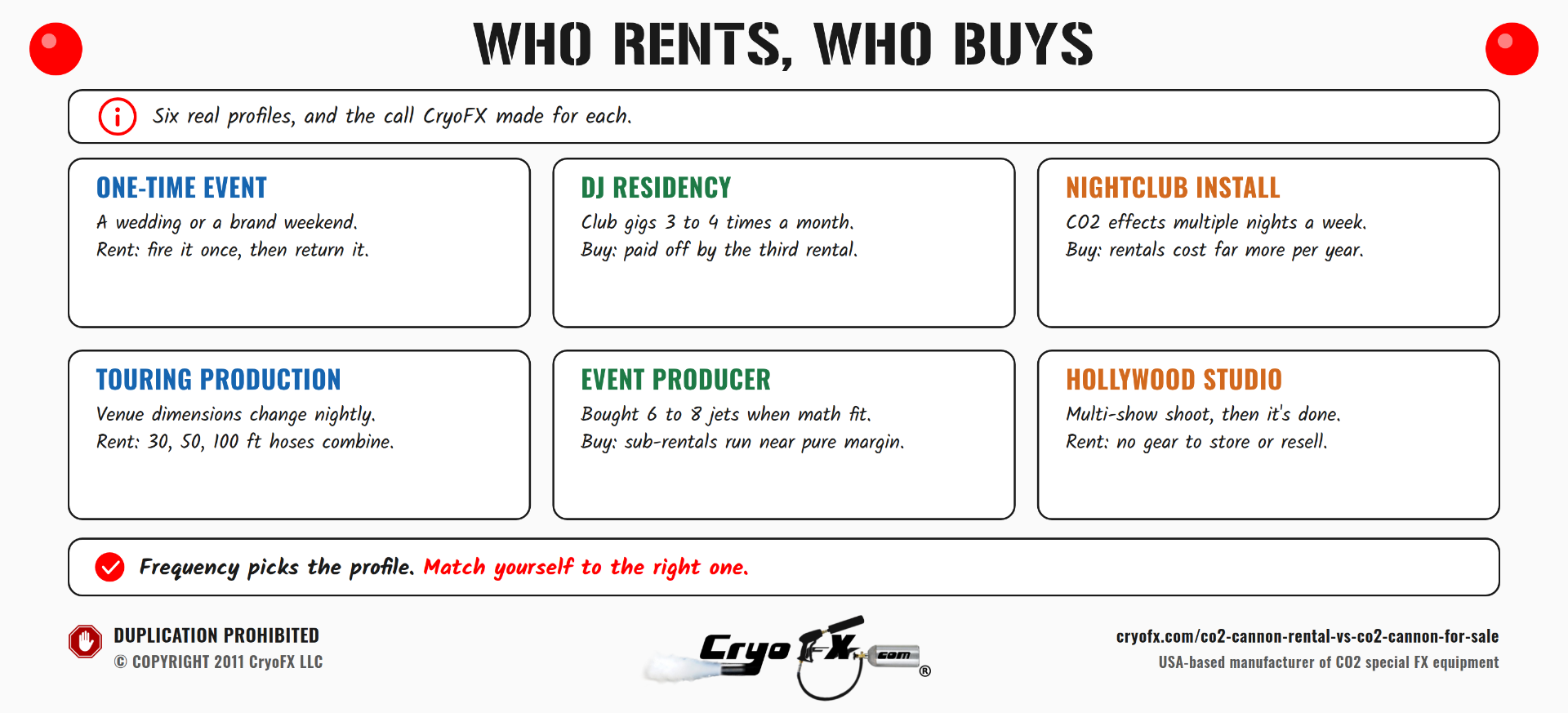
One practical note on production companies and touring operations: they often configure rental hoses in different lengths, 30-foot, 50-foot, 100-foot, that can be connected together in combinations to match whatever stage and tank location the venue requires. This modularity works well for touring because the venue dimensions change every night.
What buying gives you
Ownership pays off in frequency, familiarity, and flexibility.
At the financial level, after 2 to 3 events the equipment has effectively paid for itself in avoided rental fees. Every event after that runs at consumables cost only. For anyone doing weekly or near-weekly shows, DJs with residencies, nightclub owners, touring DJs, the math is decisive.
Familiarity is real value too. When you own the equipment and have run it dozens of times, you know exactly how it behaves. You know the warm-up time, the feel of the trigger, how the effect looks from 20 feet versus 50 feet. That knowledge makes your shows better and reduces the chance of something going wrong at a critical moment. There's no learning curve at every event.
Availability on your timeline matters. When you own the equipment, it's ready when you need it. You're not checking a rental company's inventory for your date, waiting on shipping confirmation, or paying expedited fees because you booked late.
The sub-rental advantage is one CryoFX customers frequently overlook. If you own 4 CO2 jets, you can rent them out to other operators when you're not using them. The equipment pays for itself in your own use, and then generates revenue on top of that when it's working for someone else. Sub-rental turns a one-time capital expense into an income-producing asset. DJs who own CO2 equipment frequently package it as part of their DJ service offering, charging for the effect as an add-on, and the equipment pays for itself within the first few bookings.
There's also an emotional dimension to ownership that's easy to dismiss but worth naming. The CO2 effect is a crowd moment. When you fire a CO2 cannon at the right moment, on the drop, at the height of a reception, as the spotlight hits, the reaction is immediate and physical. People feel it. They see it. They photograph it. Those moments end up in event highlight reels, Instagram stories, and client testimonials. When you own the equipment and deliver that moment consistently, it becomes part of your brand as an operator. You become the person who does that thing at events.
That association has real business value. Clients who've seen you use CO2 effectively will request it specifically at their next event. That creates recurring revenue tied to your equipment.
Annual running cost example
This is worth doing the math on explicitly for anyone considering a nightclub install or DJ residency.
Setup: 1 CO2 jet, nightclub environment, 3 nights per week, 1 fifty-pound CO2 tank per night.
- 3 nights per week × 52 weeks = 156 tank fills per year
- 156 × $70 average per fill = $10,920 per year in CO2 cost
That's just the consumable. The jet itself might be $600. At that cost ratio, the equipment pays for itself in the first week of operation relative to CO2 running costs.
Scale that up to 4 jets and 4 tanks per night: $43,680 per year in CO2. At that volume, every efficiency decision, hose routing, DMX timing, tank sourcing, has real dollar consequences.
These numbers are why high-frequency operators should always own their equipment. The equipment cost is a rounding error against the annual consumable spend.
The recommendation matrix
The right answer depends on your profile:
Rent if:
- This is a single event, one time, no plans to repeat
- You're using CO2 effects 2 times or fewer per year
- You're a touring production that doesn't want to manage equipment between venues
- You need a piece of equipment you don't own for a specific engagement (a Hollywood production renting for 3 months, then returning when the shoot ends, exactly the scenario CryoFX has navigated with effects studios)
Buy if:
- You're running weekly shows or residencies (DJ, club, entertainment venue)
- You want to sub-rent the equipment and generate additional revenue
- You're operating a nightclub or permanent venue installation
- You plan to offer CO2 effects as part of your service package going forward
- You're doing 3 or more events per year that would each require a rental
The in-between zone is roughly 2-3 events per year. At that frequency, the economics are close enough that non-financial factors tip the decision. If you have storage space and want the availability of owning the equipment, buy it. If you'd rather not deal with maintaining equipment between events, rent.
The DJ who owns their equipment. A working DJ with a club residency or regular event calendar doesn't need to think about rentals after the first purchase. The equipment becomes part of their standard setup, like their speakers or lighting rig. At some point clients start requesting the CO2 effect specifically, they saw it at another event, they want it for their reception or their corporate party. At that point, the CO2 cannon has moved from a tool the DJ uses into a service the DJ sells. That transition only happens if you own the equipment.
The event producer who sub-rents. Some of the most efficient CO2 cannon setups CryoFX has seen belong to production companies and event producers who bought 6 to 8 jets when the math first made sense, and now rent them out to other operators on their off dates. The jets paid off within the first year of ownership, and every sub-rental after that runs at near-pure margin. The capital expense became an asset class.
The one-time event client. A couple using CO2 for a wedding reception doesn't need to own CO2 jets. They need the effect once, at one event. Renting gives them exactly what they need and nothing more. The same applies to a brand activation that's running for a weekend at a trade show, get in, fire the effect, return the equipment, done.
CryoFX removed CO2 cannons from Amazon FBA after identifying a pattern of customers buying units, using them for an event or weekend, and returning them under false pretenses. The products worked. The return claims didn't hold up. But the pattern confirmed something real: there's a segment of buyers who actually need a rental, not a purchase, and the buy-return approach is both a misuse of the system and a worse financial decision than renting would have been in the first place. CryoFX's rental program exists precisely for that use case.
Real customer examples
A Hollywood effects studio approached CryoFX for CO2 cannon equipment for a multi-show production. After walking through the details, number of shows, venue footprint, post-production storage, resale value, the right answer was renting for the duration of the production and returning when done. Buying would have left them with equipment they'd need to store or liquidate. The rental gave them everything they needed and nothing they didn't.
On the other side: a DJ who was renting CO2 equipment for club gigs 3 to 4 times per month had a simple financial case for ownership. After the third rental, the purchase price had been covered in avoided rental fees. Every gig after that ran at consumables cost, and they added the CO2 effect as a premium line item in their DJ packages. The equipment paid for itself and then became a revenue driver.
Both decisions were correct for the customer in that situation. That's the point of the conversation CryoFX has before recommending anything.
There are also financial considerations specific to business owners that go beyond simple rental vs. purchase math. Equipment ownership creates a depreciable asset on the books. Sub-rental income is revenue. For nightclubs and entertainment venues, CO2 cannons can be factored into your cost of entertainment just like lighting or audio equipment, a capital expenditure that generates ongoing returns rather than a recurring operational cost.
The math looks different depending on whether you're treating this as a personal purchase or a business purchase. Production companies and nightclub operators who've run the numbers consistently land on ownership for high-frequency applications. The only time a production company rents is when the application is unusual enough that they don't want the specialized equipment sitting in a warehouse between uses, which is exactly what happened with the Hollywood effects studio example above.
For the full breakdown of both buying and renting options, the CO2 cannon buying and rental guide covers this in detail. When you're ready to move forward on either path, see CO2 cannons for sale for current equipment and pricing.
Frequently asked questions
How many rentals does it take before buying makes more financial sense? The breakeven is approximately 2 to 3 rentals for most equipment configurations. In time terms, that's roughly 3 days to 2 weeks of rental equivalent. After that point, purchasing typically costs less over the long run.
What does a fifty-pound CO2 tank cost, and how long does it last? A fifty-pound CO2 tank averages around $70 and delivers 60 to 90 seconds of runtime. A twenty-pound CO2 tank averages less but delivers about 40 seconds of runtime. For high-frequency use cases, tank cost compounds significantly, it's often the largest ongoing expense in a CO2 cannon operation.
Do touring productions typically rent or buy their CO2 equipment? Touring productions typically rent. They configure hoses in multiple lengths that can be connected together to adapt to different stage layouts, and they build the rental cost into the production budget. Managing equipment storage, maintenance, and shipping between venues doesn't make sense for most touring operations.
Can I make money sub-renting CO2 equipment I own? Yes. This is one of the most commonly overlooked advantages of ownership. DJs and event production companies frequently rent out their CO2 equipment when they're not using it. A set of jets purchased for $3,000 can earn back that cost in sub-rentals within the first year if demand in your market supports it.
Should a nightclub buy or rent CO2 equipment? Buy. A nightclub running CO2 effects multiple nights per week will spend far more on recurring rentals than the equipment costs. The annual CO2 consumable budget alone often exceeds the purchase price of the jets within the first year of operation. Permanent installs should always own the equipment. Recurring rental costs compound quickly, and the lack of equipment availability for every show date adds operational friction that ownership eliminates entirely.
What factors should I consider when deciding whether to rent or buy a CO2 cannon? The primary factor is frequency of use. One or two events per year typically favors renting. Three or more events per year usually favors buying. Equipment type, storage availability, maintenance responsibility, and whether you plan to sub-rent also affect the decision. The breakeven for most configurations is 2 to 3 rentals, after which ownership costs less over the long run.
How does owning CO2 equipment benefit a working DJ or performer with a residency? Ownership gives a DJ consistent availability, familiarity with the equipment, and the ability to package CO2 effects as a premium service offering. Clients who see the effect at one event request it specifically at future events. After 2 to 3 uses the equipment has effectively paid for itself in avoided rental fees, and every event after that runs at consumables cost only.
What is the annual CO2 tank cost for a setup running three nights per week? For a single CO2 jet using one fifty-pound tank per night at $70 average, the annual consumable cost is approximately $10,920. Scale to four jets and four tanks per night and the annual CO2 cost reaches $43,680. At those volumes, equipment ownership is clearly the right decision. The equipment purchase price is a fraction of the annual consumable spend.
Why did CryoFX remove CO2 cannons from Amazon FBA? CryoFX identified a pattern of customers buying CO2 cannons, using them for a single event, and returning them under false pretenses. The equipment worked correctly. The returns did not hold up. The pattern revealed buyers who actually needed a rental, not a purchase. CryoFX's rental program exists precisely for that use case, providing the effect for one event without requiring ownership.
Updated - 07/24/2026.