
New CO2 Cannon Permit Requirements - Compressed Gases Laws
New CO2 Cannon Permit Requirements - Compressed Gases Laws | CryoFX
CO2 cannon permit requirements: what you actually need before your next event
Most special effects operators assume permits are optional in most markets and only strictly enforced in a handful of cities. That assumption gets people fined, blacklisted, and shut down mid-show.
The reality is more layered. Government permits, venue approvals, and certificates of insurance are three separate requirements. You may need all three. Confusing them with each other is one of the most common mistakes in this industry.
This article breaks down exactly what's required, where, and why, with particular focus on Las Vegas, which runs the strictest CO2 compressed gas permit calculation methodology in the country.
Do CO2 cannons require a permit?
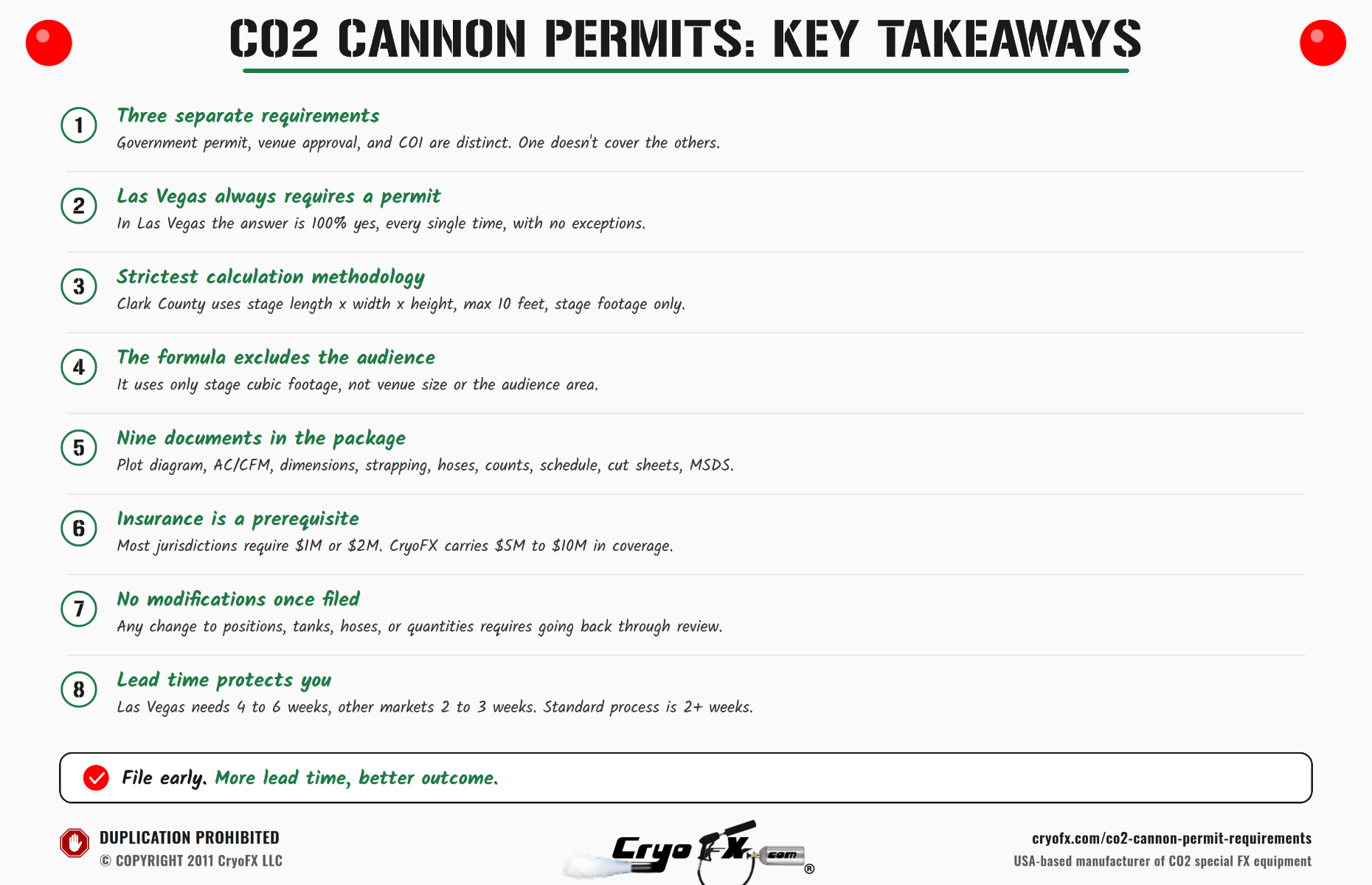
In Las Vegas, Nevada, the answer is 100% yes. Every single time. No exceptions.
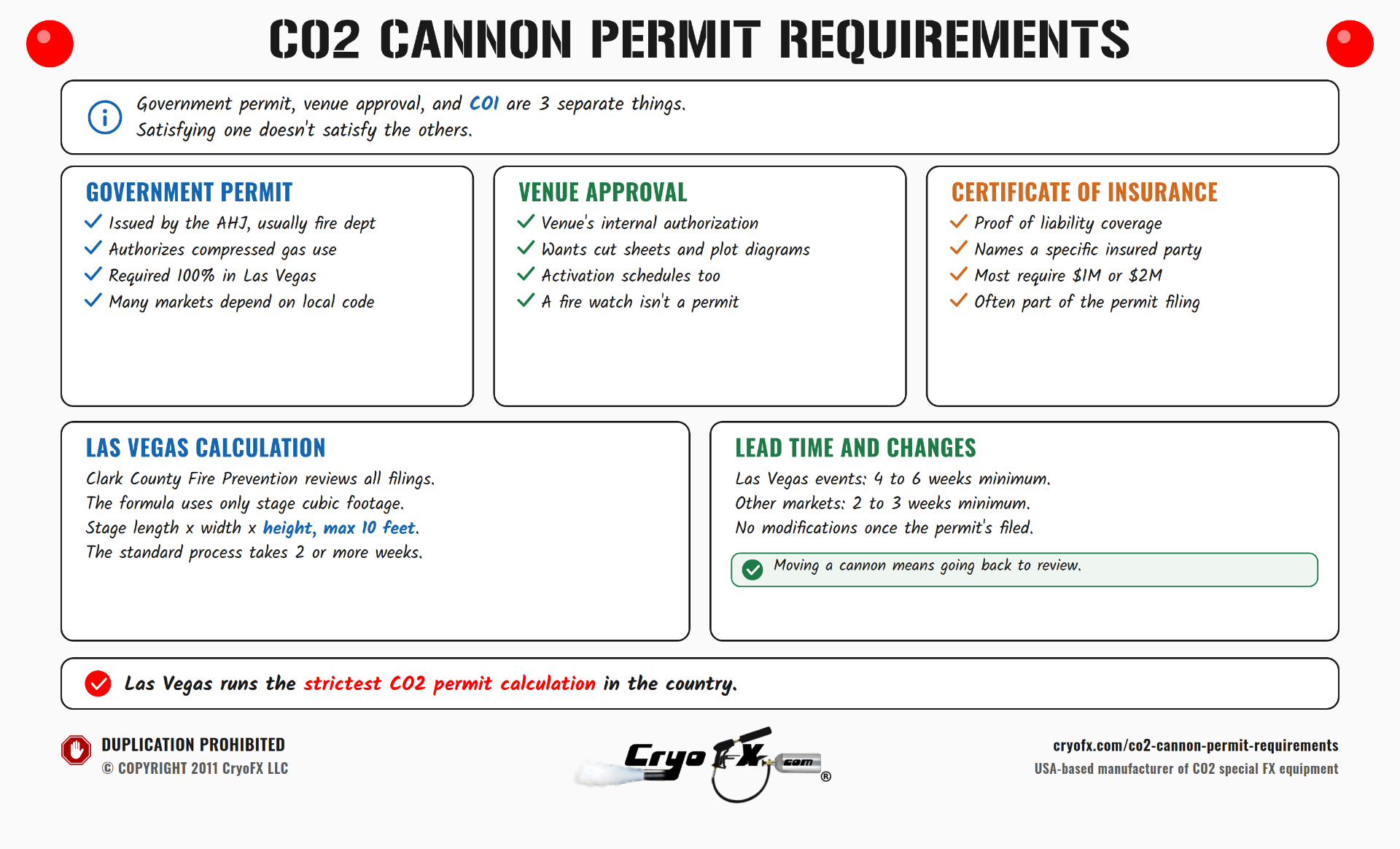
Outside Las Vegas, the answer depends on the authority having jurisdiction (AHJ), which is almost always the local fire department. Some states and cities have no specific mandate requiring a formal CO2 or compressed gas permit application. Others have adopted International Fire Code or NFPA 55 standards that do require one. Some venues in low-regulation markets impose their own internal approval process regardless of what the city requires.
Here's what that means practically: you may be in a market where no government permit is required, but the venue still requires documentation before they'll allow your special effects equipment on-site. That venue requirement is not a permit. It's a separate approval process. Both may need to be satisfied.
The three things you must track independently:
Government permit, issued by the AHJ (typically the fire department or fire prevention bureau) authorizing the use of compressed gas equipment within a defined scope of work. Required 100% of the time in Las Vegas. Required in many other markets depending on local code adoption.
Venue approval, the venue's internal authorization process. Some venues want cut sheets, plot diagrams, and activation schedules even when no government permit is required. A venue having an on-duty fire watch or fire inspector present does not substitute for a government permit in jurisdictions where permits are mandated.
Certificate of insurance (COI), proof of liability coverage naming the specific insured party. Required on nearly every professional special effects job. Also required as part of the permit application in many jurisdictions.
These three things are not interchangeable. Satisfying one does not satisfy the others.
The Las Vegas permit calculation: the strictest in the country
Clark County Fire Prevention reviews all CO2 cannon and compressed gas permit applications in Las Vegas. This is not the Building Department. It is not Planning. It is Fire Prevention, and navigating the wrong department wastes significant time.
What makes Las Vegas unique is the engineering methodology behind the permit calculation. Rather than relying on CO2 monitors to detect unsafe levels during an event, Clark County requires the permit to demonstrate, through engineering, that the CO2 dispersed during the show will remain safe within the stage environment, assuming the worst case.
The calculation uses only the stage cubic footage. It does not include the audience area. It does not factor in the size of the venue. The formula is:
Stage length × stage width × stage height (maximum 10 feet)
That invisible box around the stage is the target environment. The calculation must demonstrate that the total volume of CO2 injected into that space over the duration of the event stays within safe concentration limits. By engineering the safety within that tighter space, the audience section is safe by default.
This is the strictest calculation methodology in the country. It's also why you can't just show up with a loose plan, the calculation must be run correctly and submitted as part of the permit package.
Clark County uses a spreadsheet calculation tool created internally by their engineering staff. CryoFX submits this calculation with every permit filing in Vegas. The calculation takes into account stage dimensions, how much CO2 will be used, how much CFM of air is passing through the facility via HVAC, and the total number of CO2 tanks and duration of the event. If the calculation doesn't show compliance, the permit is rejected automatically.
The standard permit process takes 2 or more weeks. CryoFX can move faster because of direct login access to the Clark County permit system and years of institutional knowledge about exactly what Fire Prevention needs to approve the application on the first submission.
What fire marshals require: the documentation package
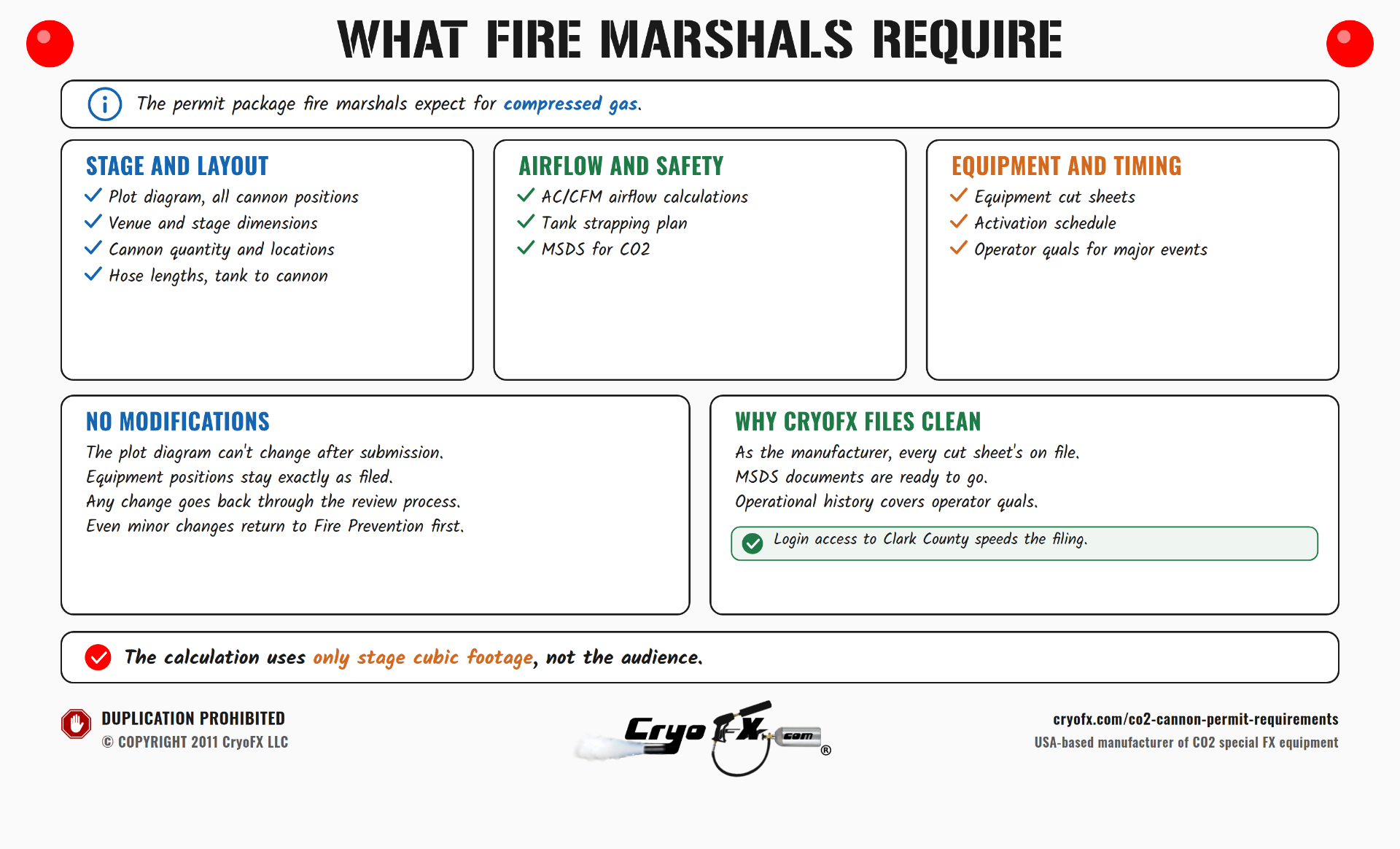
Whether you're filing in Las Vegas or working with a fire department in another market, here is what professional CO2 cannon permit documentation typically includes:
- Plot diagram, exact positions of all CO2 cannons and jets on stage; all CO2 tank locations; all hose routing; this diagram cannot change after submission (more on that below)
- AC/CFM calculations, airflow data for the venue including number of HVAC units and their cubic feet per minute output
- Venue and stage dimensions, length, width, ceiling height; stage length, width, height
- Tank strapping plan, how tanks are secured, what they're strapped to, and the method of securing
- Hose lengths, exact lengths for all CO2 hoses running from tanks to cannons
- Cannon quantity and locations, exact count of CO2 cannons and CO2 jets, and their specific positions on the plot diagram
- Activation schedule, when the CO2 cannons fire, how long each activation runs, and total show duration
- Equipment cut sheets, manufacturer specification sheets for every piece of equipment: CO2 cannons, CO2 hoses, fittings, and any other components
- MSDS, Material Safety Data Sheets for CO2
For major arena and hotel casino events, the documentation package also includes operator qualifications: who is running the system, where they'll be positioned during the show, how the system is being controlled, and what experience the operating company has.
This is one of several reasons CryoFX handles these events smoothly. Being the manufacturer means CryoFX already has every cut sheet and MSDS on file. The company also has the operational history to substantiate operator qualifications without scrambling to document anything.
Insurance and the certificate of insurance
The COI is not an afterthought. It's a core requirement, and the details matter. The COI must name a specific insured party. A generic policy won't satisfy most venue requirements or permit applications. The coverage amount matters too. Most jurisdictions require a $1 million or $2 million policy. Some venues and events require more.
CryoFX carries between $5 million and $10 million in coverage depending on the project type. That includes professional liability, manufacturers' liability, advertising liability, design liability, and vehicle liability. This level of coverage matters on large installs and for major arena and hotel casino events where the venue's own risk management team reviews the COI directly.
The COI should be considered a prerequisite, not a last-minute item. If you don't have appropriate coverage in place, you may not be able to file the permit or get venue approval regardless of how well the rest of your documentation is prepared.
Permanent installation permits: a different process entirely
Permit requirements for a permanent CO2 cannon installation are significantly more involved than event permits. The process is not weeks, it's months. In some cases, it's a year or longer.
Permanent installs require engineered and stamped MEP (mechanical, electrical, plumbing) drawings. These drawings must be submitted to the city for review and are held to the same standard as any permitted electrical or plumbing work on a commercial construction project. The permit process runs through multiple city departments: Fire Prevention, Building, and Planning. Knowing how to navigate all three departments without wasting time requires direct experience with the process.
One complex Las Vegas installation CryoFX completed involved multiple permits for multiple areas within the same venue. Some portions of the permit closed quickly. Others remained open for six to eight months, accumulating more than $250,000 in change orders as the fire department requested modifications throughout the inspection process.
By the time that project was complete, the installed system included an electronic flow monitoring system that tracked CO2 flow rates in real time and could shut the system down automatically if flow exceeded a set threshold for too long. That system was integrated directly into the venue's ADT life safety monitoring network, which notified Fire Prevention electronically any time an alarm triggered.
Fire codes in Nevada were subsequently amended to incorporate elements of how that CryoFX-designed system works. The system is still operating in Las Vegas and is, as of now, the most sophisticated CO2 special effects safety system of its kind in the United States.
Projects like that don't happen without deep institutional knowledge of fire code, engineering documentation, and how to work with fire prevention inspectors across multiple site visits over many months.
Consequences of operating without a permit in Las Vegas
If you show up to a Las Vegas venue with CO2 cannons and no permit, you won't be able to use them. That's the best-case scenario.
The worse case: you attempt to operate anyway. The fire marshal issues a fine. That violation goes on the business record. Future permit applications in Clark County are harder to get approved because of that record. The mark is real and it's difficult to remove.
Code violations in Las Vegas carry hefty financial penalties. Beyond the immediate fine, the relationship with the local AHJ is damaged. Fire Prevention has long institutional memory. Companies that have violated code in the past get more scrutiny on every subsequent application.
There is also a strict no-modification rule once a permit is filed: whatever equipment positions, tank locations, hose routing, and quantities appear on the submitted plot diagram must remain exactly as submitted on the day of the event. If a client asks to move a cannon, reposition a tank, or change the hose routing after the permit has been filed, those changes require the permit to go back through the review process. No modifications during setup, even minor ones, without going back to Fire Prevention first.
CryoFX's role in the permit process
CryoFX assembles the complete documentation package for clients. That means preparing the permit application, running the calculations, compiling cut sheets and MSDS documents, generating the plot diagram, writing the activation schedule, and submitting everything to the relevant authority.
In Las Vegas, CryoFX's login access to the Clark County system speeds up the filing process meaningfully. The company's experience with what Fire Prevention expects in each section of the application significantly reduces the likelihood of rejection or a request for additional information.
For clients who try to navigate the Las Vegas permit process on their own, the experience is typically frustrating. Fire Prevention will not guide you through it. If something in the application is missing or wrong, the permit is denied and the process starts over. The institutional knowledge required to do this efficiently is not something that's easy to acquire without years of direct engagement with that specific jurisdiction.
Lead time recommendations:
- Las Vegas events: minimum 4 to 6 weeks before the event date
- Other markets: minimum 2 to 3 weeks before the event date
CryoFX has had permits denied. In those cases, additional information was supplied, in-person demonstrations were arranged when requested, and the permits were eventually approved. No application CryoFX has submitted has stayed permanently denied. However, denials do happen, which is exactly why lead time matters. There is no guarantee of approval on any timeline, and the more time there is to respond to Fire Prevention's questions, the better the outcome.
Other jurisdictions: what applies nationwide
Outside Las Vegas, CO2 cannon events fall under the authority of the local fire department as the AHJ. The primary standards that apply in most US jurisdictions are:
NFPA 55, Compressed Gases and Cryogenic Fluids Code. This covers the storage, handling, and use of compressed gas including CO2 tanks. It sets standards for tank securing, ventilation, and safe use of compressed gases in occupied spaces.
International Fire Code (IFC), adopted in whole or in modified form by most US states and municipalities. The IFC includes provisions for compressed gas use at temporary events and permanent installations. Local jurisdictions can adopt IFC as written or amend it with stricter local requirements (as Clark County has done in Las Vegas).
Many markets have no specific event-level CO2 cannon permit requirement. The fire department in those areas may still ask for documentation or a COI before allowing compressed gas equipment in a venue, particularly for large events at arenas, stadiums, or casinos.
The safest approach in any market is to contact the local fire department's permit office early and ask what they require for compressed gas use at a temporary event. CryoFX can assist with that inquiry and prepare the documentation package for any jurisdiction.
FAQs
Does every CO2 cannon event in the US require a government permit?
No. In Las Vegas, yes, 100% of the time. In other US markets, it depends on the AHJ. Some cities have no government permit requirement for CO2 cannon events. Others have adopted IFC or NFPA 55 provisions that do require one. Always confirm with the local fire department before assuming no permit is needed.
How much does a CO2 cannon permit cost in Las Vegas?
Permit fees in Clark County are set by the fire prevention bureau and vary based on the scope of the event. CryoFX covers the permit fee as part of the documentation package service. Contact CryoFX directly for current fee information.
Can the venue's fire marshal substitute for a government permit in Las Vegas?
No. A venue having an on-duty fire marshal or fire watch during an event does not satisfy the government permit requirement. These are separate things. The Clark County Fire Prevention Bureau is the AHJ in Las Vegas, and the permit must be filed with them regardless of what approval the venue provides internally.
What happens if equipment positions change after the permit is filed?
Any change to equipment positions, tank locations, hose routing, or quantities after the permit is filed requires the application to go back through the review process. Operating with equipment in positions that differ from the approved plot diagram is a permit violation.
How far in advance should CO2 cannon permits be filed in Las Vegas?
CryoFX recommends a minimum of 4 to 6 weeks for Las Vegas events. More lead time is always better. Permit approvals are not guaranteed on any specific timeline, and denials requiring additional information can push the timeline out significantly.
How does Las Vegas calculate the CO2 volume permitted for an event?
Clark County Fire Prevention uses a formula based on stage dimensions: stage length multiplied by stage width multiplied by stage height, capped at a maximum of 10 feet in the calculation regardless of actual ceiling height. Audience areas are excluded from the calculation entirely. The result determines the maximum CO2 volume permitted for that specific event configuration.
What documentation is required to file a CO2 cannon permit in Las Vegas?
The permit package includes an event plot diagram showing all equipment positions and dimensions, a complete equipment list with model numbers and specifications, a risk assessment identifying hazards and control measures, a certificate of insurance naming the appropriate insured parties, and operator credentials. CryoFX prepares all of this documentation as part of their permit service.
What are the consequences of operating a CO2 cannon event without a permit in Las Vegas?
The show stops immediately when fire prevention arrives and no permit is on file. Code violations are recorded and affect future permit applications in Clark County. Fines apply. There is no workaround once the show has been shut down. No payment made at the event will reverse a shutdown order. The permit process must be completed before the show starts.
What national codes govern CO2 cannon use outside of Las Vegas?
NFPA 55 (Compressed Gases and Cryogenic Fluids Code) covers storage, handling, and use of CO2 tanks and sets standards for securing, ventilation, and safe use in occupied spaces. The International Fire Code (IFC), adopted in whole or in amended form by most US states, includes provisions for compressed gas use at temporary events and permanent installations. Local jurisdictions can adopt IFC as written or amend it with stricter local requirements, as Clark County has done.
For a full overview of CO2 cannon operation, safety, and technical specifications, see the CO2 cannon permit and safety guide on CryoFX.com.
Ready to run CO2 special effects at your next event? Browse CO2 cannons for sale and reach out to CryoFX about permit services.
___
CryoFX® is the leading manufacturer, designer, and global supplier of CO2 special effects equipment and custom special effects systems
for Theme Parks, Sporting Arenas, Mega Nightclubs & Day Clubs , TV/FILM & large scale events & installs in any industry requiring Co2 Systems.
CryoFX LLC Global Headquarters • 3859 S Valley View Blvd, Suite 2, Las Vegas, NV 89103 • 1.855.527.9639
Updated - 07/26/2026.