CO2 Cannon Installation: How to Install A Gun, Jet, Cylinder
CO2 Cannon Installation: How to Install A Gun, Jet, Cylinder | CryoFX
CO2 cannon installation: how to install a gun, jet, cylinder
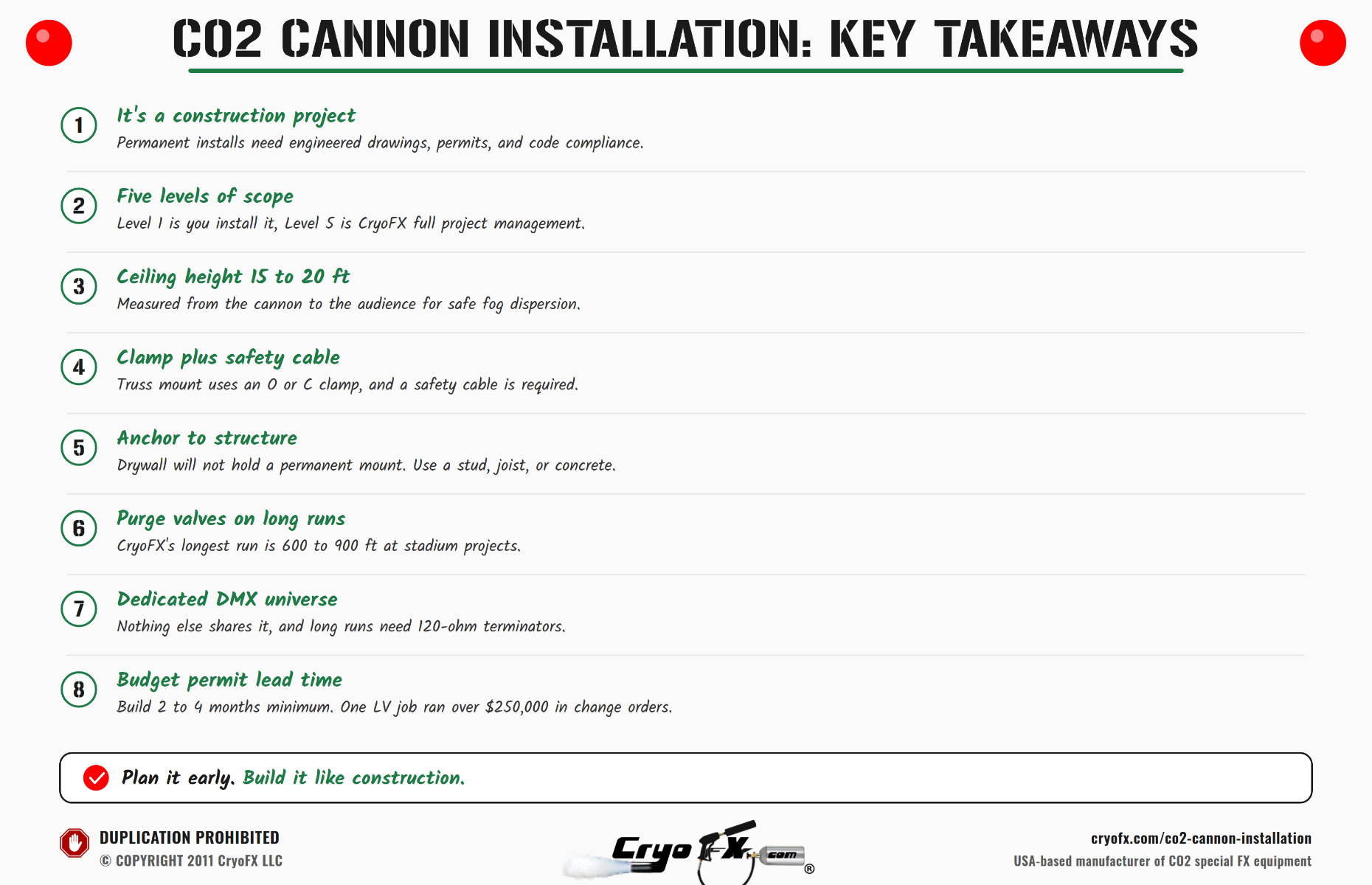
A permanent CO2 cannon installation is not a mounting project. It's a construction project in the same category as electrical or plumbing work: it requires engineered drawings, permit filings, code compliance, and sometimes months of back-and-forth with fire prevention before a single cannon fires live.
That's not said to discourage the work. CryoFX has done permanent installations in some of the most sophisticated entertainment venues in the world. But the operators who treat it like a mount-and-connect job consistently spend more money, wait longer, and still end up working through the same code and permitting requirements. The planning stage is where the project either goes smoothly or doesn't.
Planning a CO2 cannon installation: the 5 levels of involvement
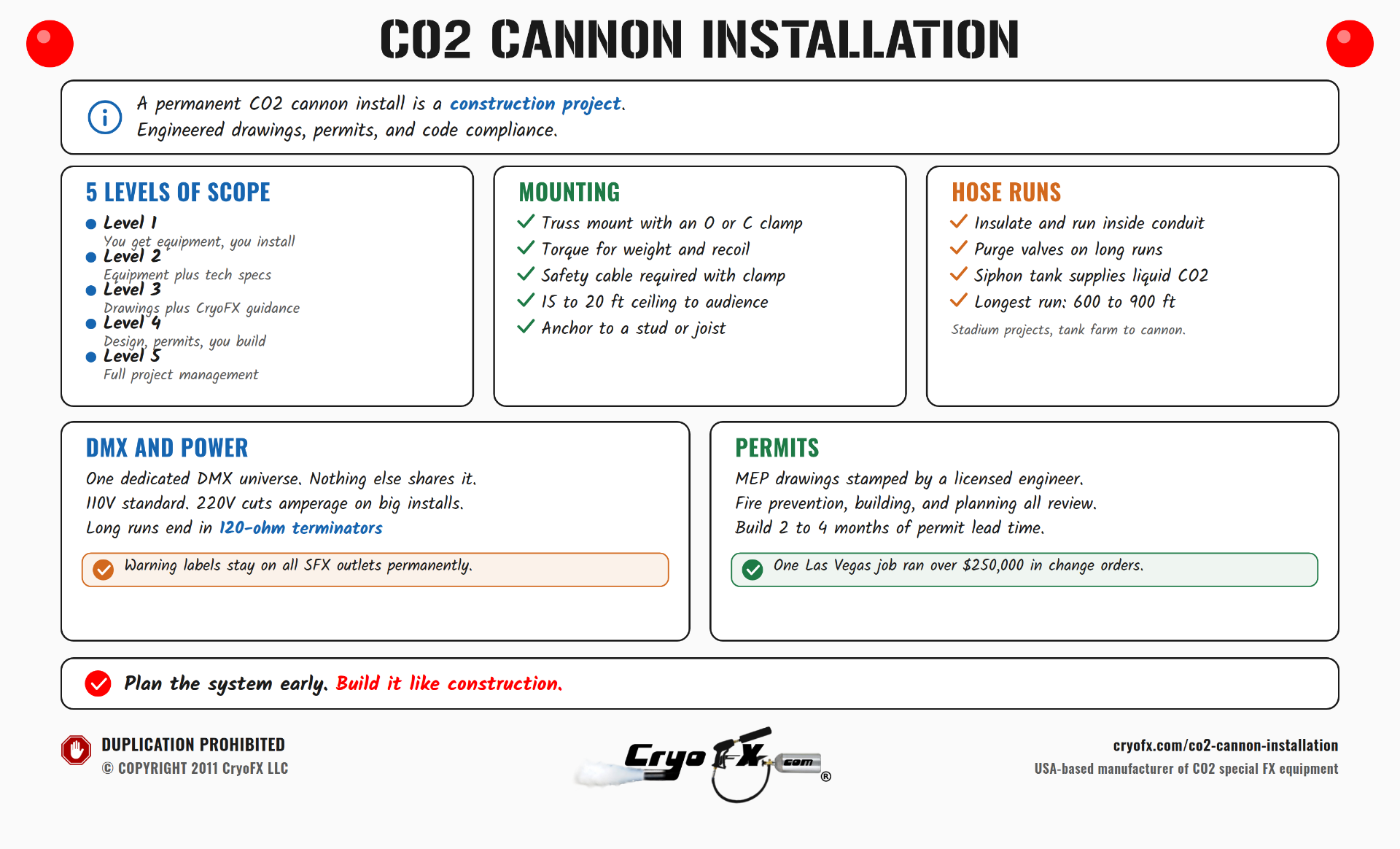
CryoFX uses a defined framework when scoping any installation project. Five levels of involvement, each representing a different scope of what CryoFX provides versus what the client or their contractors handle:
Level 1. CryoFX sells the product. Client receives equipment and handles their own installation. No design consultation, no permit support, no on-site involvement.
Level 2. CryoFX provides equipment with technical specifications and documentation to support the client's own installation team.
Level 3. CryoFX provides design drawings and equipment. Client installs with CryoFX guidance. CryoFX may provide oversight remotely or with periodic on-site visits.
Level 4. CryoFX manages design, engineering drawings, permit filing, and equipment. Client handles construction coordination.
Level 5. CryoFX manages the entire project: design, engineering, permitting, equipment, on-site installation, staffing, and operational training. Full project management from initial scope to show-ready system.
The level appropriate for any given project depends on budget, client capability, venue complexity, and the permit requirements of the jurisdiction. Las Vegas nightclub installations almost always require Level 4 or 5 because of the permit process involved.
The single most common planning mistake event planners and venue operators make: special effects get brought in at the end of the design-build process, after positioning, power routing, and ceiling infrastructure are already finalized. CO2 cannon installation requires the same planning considerations as lighting, audio, and HVAC. It needs to be part of the initial design, not an afterthought that has to work around everything else.
Mounting and structural requirements
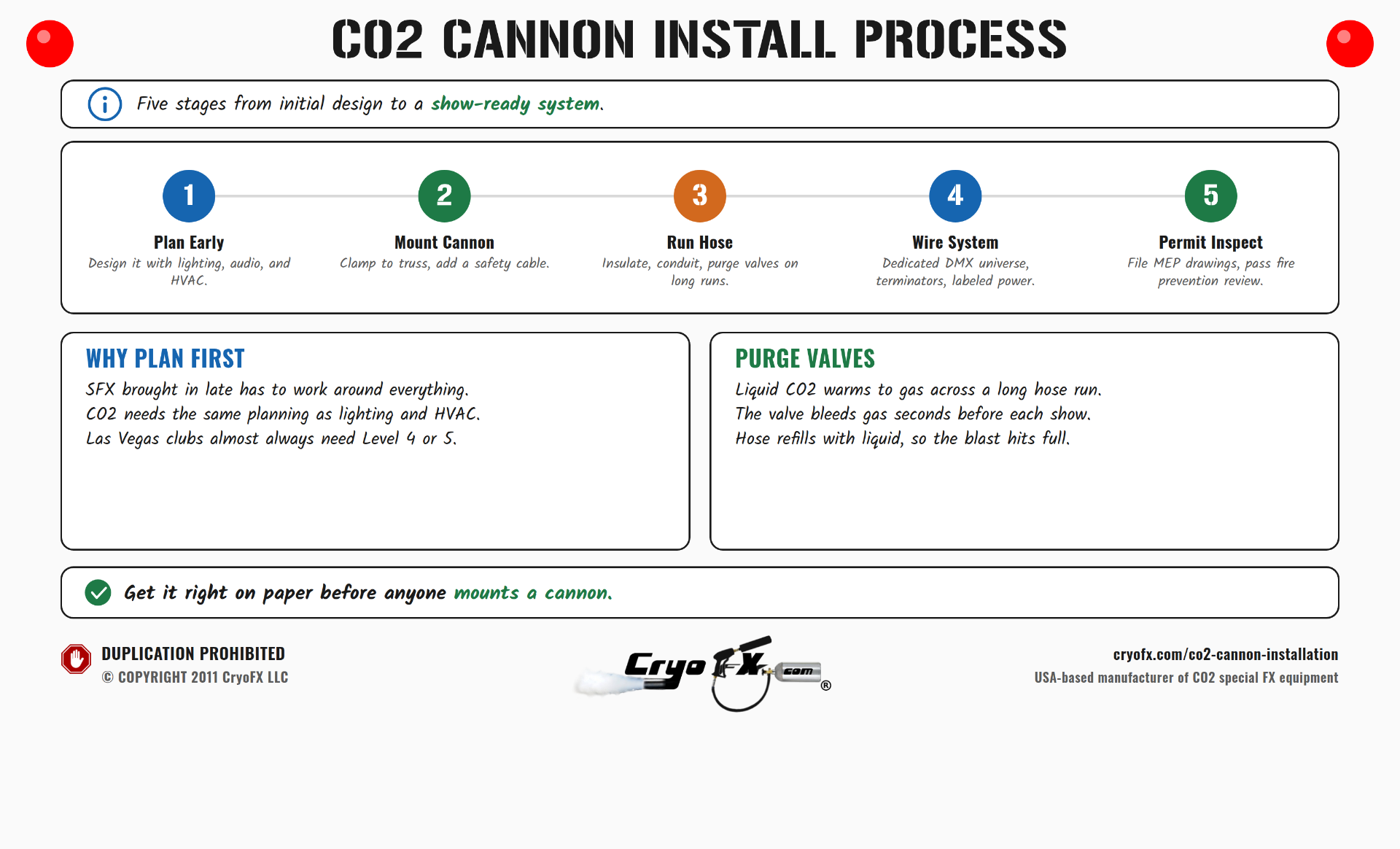
Ceiling height minimum for any CO2 cannon aimed at an audience is 15-20 feet from the cannon to the audience level below. This provides adequate dispersion distance for the cold fog output and keeps the discharge and any equipment failure scenarios away from the crowd.
Truss mounting is the standard approach for overhead CO2 cannons. The correct hardware is an O-clamp, C-clamp, or cheeseborough clamp, torqued to the truss with appropriate force for the cannon weight and the recoil from discharge. A safety cable is required in addition to the clamp. The safety cable passes through a fixed point on the cannon and attaches to the truss independently of the clamp. If the clamp fails for any reason, the safety cable keeps the cannon from dropping onto the audience.
CO2 cannons can be mounted upside down or sideways. CryoFX cannons support non-standard mounting orientations. The one requirement: the LCD control board on the cannon must face away from the direction where condensation accumulates. Condensation forms on the housing during operation. If the LCD board is positioned where condensation runs toward it rather than away from it, electrical issues will develop over time.
Ceiling direct-mount is possible but requires a structural attachment point. Drywall alone is insufficient for a permanent CO2 cannon mount. The cannon needs to be anchored to a structural element: a stud, a concrete ceiling, a joist, or an engineered bracket attached to structure. The recoil force from CO2 discharge cycles repeatedly and will work a drywall anchor loose over time.
Hose runs for permanent installations
CO2 hose runs in permanent installations have to solve a different problem than event-based setups. The hose may need to route through walls, ceilings, conduit, or across long distances from the tank farm to the cannon positions.
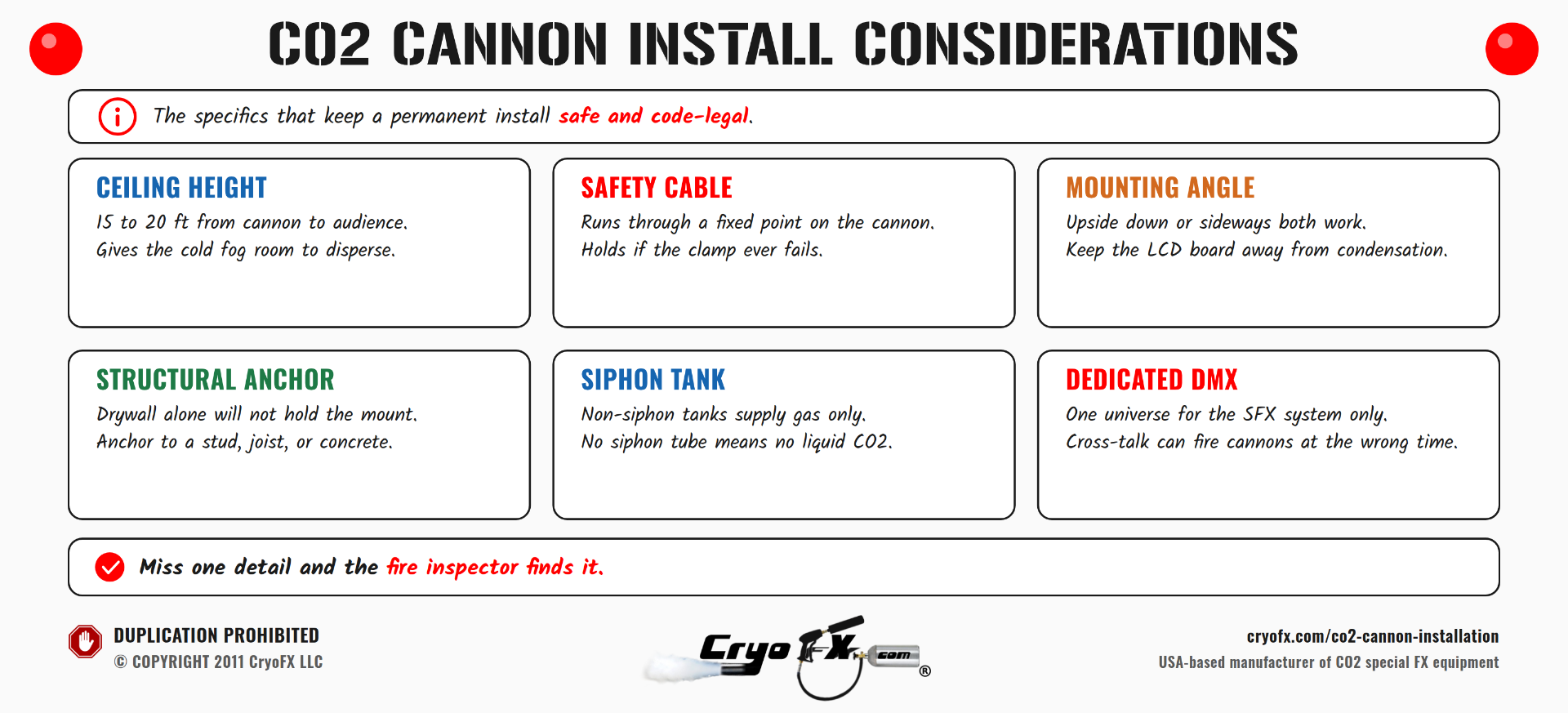
The longest run CryoFX has done in a permanent installation is 600-900 feet at stadium projects. Hose runs of that length introduce a specific technical issue: liquid CO2 starts converting to gas as it warms inside the hose, progressively farther from the tank as distance increases. The CO2 that started as liquid at the tank is partially gaseous by the time it reaches the cannon at the far end of a very long run.
This gas accumulation in long hose runs is why purge valves are required on extended runs. A purge valve is an electronically controlled valve installed at the end of the hose run, before the show valve (the CO2 cannon valve). Seconds before each activation, the purge valve opens and bleeds the gaseous CO2 from the end of the hose silently and out of sight. The hose refills with liquid from the tank. When the purge valve closes and the show valve opens, the output is liquid CO2, producing the correct fog effect rather than a weak gaseous blast.
Hose routed through walls must be insulated and run inside conduit. Plastic conduit (PVC or equivalent) protects the hose and contains any condensation that forms on the cold hose exterior. Without conduit, condensation can saturate drywall and cause moisture damage.
CryoFX has run CO2 hose through electrical conduit on residential and commercial installations where the system was designed to be visually invisible. From the outside, no indication of a CO2 system exists. The conduit matches existing infrastructure, junction boxes are integrated into the wall, and only the nozzle at the output point is visible.
The siphon CO2 tank must always remain the supply source for a CO2 special effects system. Standard non-siphon CO2 tanks supply gaseous CO2 only. No siphon tube equals no liquid CO2 and no desired effect, regardless of hose length, system design, or venue complexity.
DMX and power wiring
CO2 cannon installations require a dedicated DMX universe for the entire special effects system. No lighting equipment, no other devices share this DMX universe. This is non-negotiable for a permanent installation. DMX cross-talk from other devices on a shared universe can trigger CO2 cannons at unintended moments. A dedicated universe ensures the only devices receiving control signals are the ones intended to receive them.
CryoFX places warning labels on all power outlets and DMX outlets designated for the CO2 system. Any operator, technician, or contractor working in the venue after the installation needs to know these outlets are not general-purpose power. The labels stay on permanently.
Voltage. Standard installations run on 110V. For larger installations with multiple CO2 cannons drawing power simultaneously, 220V is sometimes used to reduce the total amperage draw across the circuit. This is a coordination item with the venue's electrician and needs to be specified in the MEP drawings.
DMX termination. Long DMX runs in permanent installations require 120-ohm terminators at the end of the DMX chain. Without terminators, signal reflections cause erratic behavior. This detail is often missed in installations done by crews without specific CO2 cannon experience.
The DMX wiring runs jet to jet, cannon to cannon, through the entire special effects system. Any other special effects on the same system, including spark machines, fog machines, or confetti cannons, can be on the same dedicated universe as long as nothing else is.
Permit requirements for permanent installations
Permanent CO2 cannon installations require the same category of documentation as electrical or plumbing construction in the same space. This means:
MEP drawings. Mechanical, electrical, and plumbing engineering drawings, stamped by a licensed engineer. CryoFX has an in-house design division (CryoFX Designs) that produces these drawings. They document the system layout, hose routing, power circuits, valve positions, tank locations, strapping methods, CO2 monitor placement, and life safety integrations. These drawings go to the city for review and must be on file before the installation is permitted.
The permit process involves multiple departments: fire prevention, building, and planning. Navigating these three departments simultaneously, with the right documentation for each, is a major source of delay and cost overrun for clients who try to manage it without CO2 installation experience. Construction firms or general contractors who work on the broader venue project are not equipped for this specific process. They don't know what fire prevention wants, what the calculations need to show, or how to respond to correction requests from the fire inspector.
The Las Vegas example. A major Las Vegas nightclub installation conducted by CryoFX demonstrates the scope of what permanent CO2 cannon permitting can involve. The initial filing received a conditional approval. Fire inspectors requested additional monitoring equipment beyond code minimums. CryoFX manufactured new electronic flow monitoring hardware that tracked the CO2 flow rate in real time, with automatic shut-off triggers if flow duration exceeded set thresholds. All monitoring data was tied into the venue's ADT life safety system, reporting electronically to fire prevention when any alarm threshold was hit.
The change orders generated by the fire prevention process for that installation exceeded $250,000. Multiple site inspections, multiple revision cycles, and six to eight months of ongoing compliance work. The final system is the most sophisticated of its kind in the United States, as far as CryoFX's knowledge of the industry extends. Fire codes in Clark County were subsequently amended to incorporate elements of what CryoFX designed for that project.
This is not the typical Las Vegas nightclub installation. It is the most complex one CryoFX has completed. But it illustrates what fire prevention has the authority to require, and why building in adequate time, budget contingency, and a permit lead time of multiple months is not overcaution but practical reality for permanent installations.
For complete technical guidance on CO2 cannon systems from event-use to permanent installation, the CO2 cannon installation and systems guide covers specifications, product options, and operational requirements in detail.
For sourcing equipment for a permanent installation, CO2 cannons for sale from CryoFX include manufacturer documentation, cut sheets, and hose specifications required for permit filings.
FAQs
How long does the permit process take for a permanent CO2 cannon installation? It varies significantly by jurisdiction and project complexity. In Las Vegas, a straightforward installation with a clean filing can move through Clark County Fire Prevention in about two weeks once the complete permit package is submitted.
Complex installations with multiple areas, large CO2 volumes, or fire inspector requests for additional information can take months to over a year. CryoFX recommends building a minimum of two to four months of permit lead time into any permanent installation project, with additional buffer for projects in Las Vegas or other jurisdictions with strict CO2 permitting requirements.
Can CO2 hose be run through a wall without conduit? Technically possible but not recommended for permanent installations. CO2 hose at operating temperature produces condensation on the exterior. Without conduit, that moisture saturates drywall over time. CryoFX routes CO2 hose through PVC or plastic conduit in all wall penetrations and insulates the hose to control condensation. This is also typically required by permit drawings, which document exactly how hose penetrates walls and what protective measures are in place.
Does a CO2 cannon mounted upside down work correctly? Yes. CryoFX cannons support upside-down and sideways mounting orientations. The only positioning requirement is that the LCD control board faces away from the direction where condensation accumulates during operation. Beyond that, the cannon functions correctly in any mounting position.
What is a purge valve and do I need one? A purge valve is an electronically controlled valve installed at the far end of a long CO2 hose run. As CO2 sits in a long hose run, the portion farthest from the tank warms slightly and begins converting from liquid to gas. A purge valve opens seconds before each show activation to bleed that gaseous CO2 from the line, allowing liquid CO2 to reach the cannon for the correct effect.
Purge valves are needed on any hose run long enough that gas conversion becomes noticeable in the output. For stadium-scale hose runs of 600+ feet, they're required. For shorter runs in smaller venues, they may not be needed, but the symptom of needing one is a weak or gaseous first blast followed by improving output on subsequent activations.
What voltage does a CO2 cannon installation typically use, and does the electrician need to know anything specific? Most CO2 cannon installations run on 110V AC. Large-scale installations with many cannons drawing power simultaneously sometimes use 220V to reduce amperage. The electrician working on the venue needs to see the MEP drawings, which specify the circuits, voltage, amperage draw, and outlet requirements for the system. Warning labels on all designated special effects outlets are required by CryoFX's installation standard and should be in place before handover to venue operations staff.
What is the most common planning mistake venues make when adding CO2 cannons to a permanent installation? Special effects get brought in at the end of the design-build process, after ceiling infrastructure, power routing, and positioning are already finalized. CO2 cannon installation has the same early-phase planning requirements as lighting, audio, and HVAC. Positions, power circuits, hose routing paths, and tank storage locations all need to be resolved before construction begins. Retrofitting CO2 into a finished venue is more expensive and produces worse results than planning for it from the start.
What hardware is required to mount a CO2 cannon on truss? An O-clamp, C-clamp, or cheeseborough clamp torqued to the truss with appropriate force for the cannon weight and discharge recoil. A safety cable is also required, passing through a fixed point on the cannon and attaching to the truss independently of the clamp. If the clamp fails for any reason, the safety cable prevents the cannon from dropping onto the audience. Truss mounting without a safety cable is not an acceptable configuration.
What engineering drawings are required for a permitted permanent CO2 cannon installation? MEP (Mechanical, Electrical, and Plumbing) drawings stamped by a licensed engineer. CryoFX's design division (CryoFX Designs) produces these. They document the system layout, hose routing, power circuits, valve positions, tank locations, strapping methods, CO2 monitor placement, and life safety integrations. These drawings are submitted to the city for review and must be on file before the installation is permitted.
What are the 5 levels of CryoFX involvement in a CO2 cannon installation project? Level 1: CryoFX sells equipment only; client handles installation. Level 2: equipment plus technical specifications and documentation for the client's own installation team. Level 3: design drawings and equipment with CryoFX guidance; client installs. Level 4: design, engineering drawings, permit filing, and equipment; client handles construction coordination. Level 5: full project management from initial scope through on-site installation, staffing, and operational training.
___
CryoFX® is the leading manufacturer, designer, and global supplier of CO2 special effects equipment and custom special effects systems
for Theme Parks, Sporting Arenas, Mega Nightclubs & Day Clubs , TV/FILM & large scale events & installs in any industry requiring Co2 Systems.
CryoFX LLC Global Headquarters • 3859 S Valley View Blvd, Suite 2, Las Vegas, NV 89103 • 1.855.527.9639
Updated - 07/25/2026.