
Co2 Blasters vs Co2 Blasting AKA Dry Ice Cleaning
Co2 Blasters vs Co2 Blasting AKA Dry Ice Cleaning | CryoFX®
Co2 Blaster available from CryoFX. Co2 Blasters for sale by CryoFX. In Stock - Order Today
A Co2 Blaster can be either a Handheld Blaster or a Stage Mounted Blaster.
Not sure which one is best for your needs? Call 1.855.527.9639
CryoFX Co2 Blasters have appeared in numerous productions, events, and nightclubs. Whether you need one or more, picking the right Co2 Blaster for your event is key.
----------------------------------
CO2 blasters vs CO2 blasting AKA dry ice cleaning
The phrase "CO2 blasting" means two completely different things depending on who's using it. One refers to a special effects device used in entertainment. The other refers to an industrial cleaning process used in manufacturing, aerospace, food processing, and mold remediation. They share some terminology, both involve carbon dioxide in some form, and that's where the similarity ends.
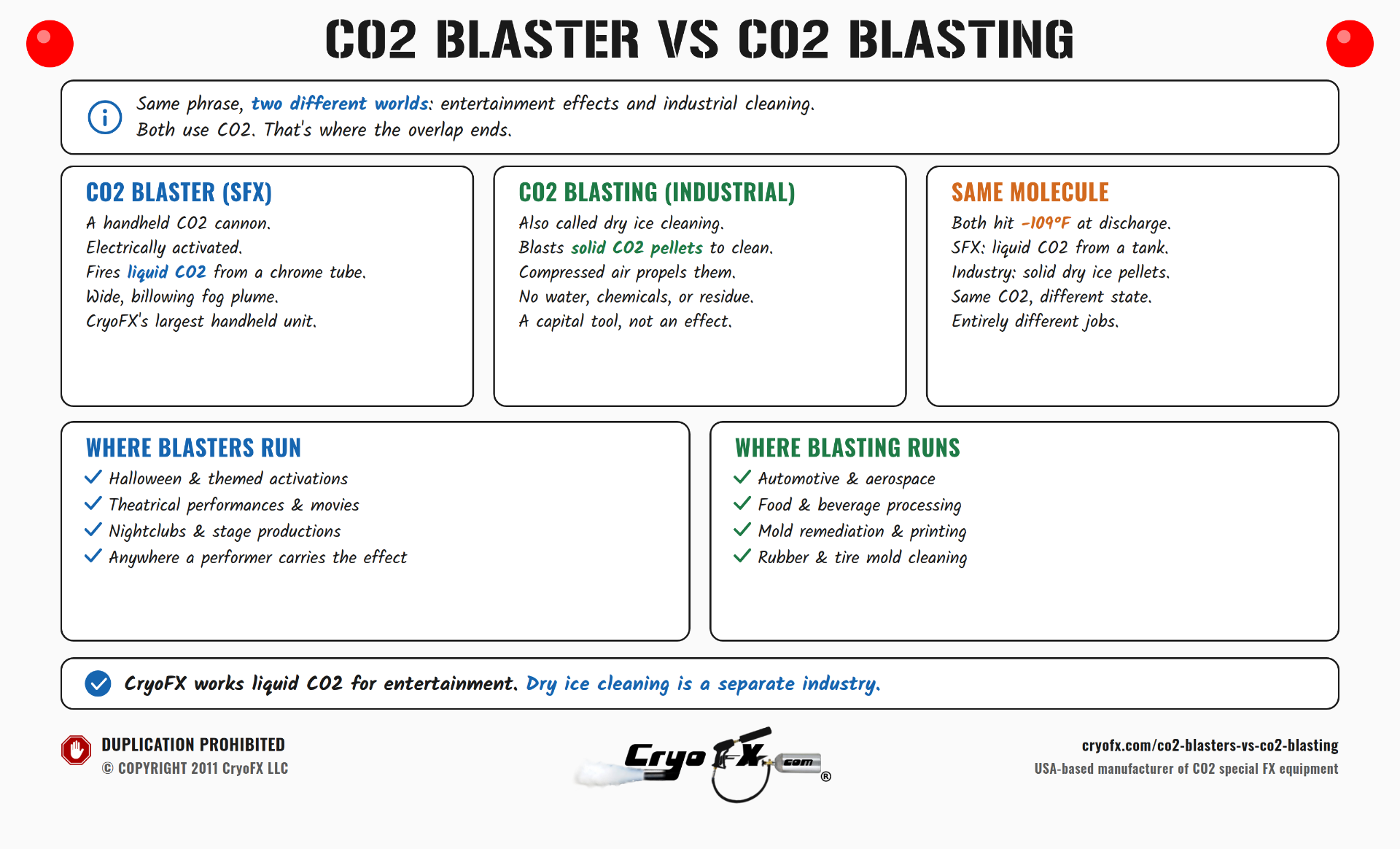
If you found this page looking for a CO2 blaster for a live performance, a stage production, or a DJ setup, you're in the right place, and the entertainment section below covers exactly what you need. If you're looking for industrial CO2 dry ice blasting equipment for cleaning or surface prep, that's also explained here, and CryoFX can point you to the right companies in that space.
What a CO2 blaster is in entertainment
In the entertainment industry, a CO2 blaster is a handheld CO2 cannon. CryoFX uses "CO2 blaster" as a product name for a specific type of large, handheld CO2 cannon that's electrically activated and fires liquid CO2 from a substantial chrome-finished metal tube.
The CO2 blaster sits at the top of the handheld CO2 cannon category in terms of size and visual impact. It's operated manually by a person who holds it, aims it, and activates it with a button trigger. The design is intentionally striking, a large, polished chrome tube that reads as dramatic prop-scale hardware from a distance.
The output is different from a standard handheld CO2 cannon. The blaster produces a wider, billowing plume rather than a long-distance jet. It fills the immediate atmosphere with CO2 fog rather than shooting a narrow blast across the room.
The liquid CO2 source is the same as any other CO2 cannon system: a siphon CO2 tank (also called a dip tube tank) that draws liquid carbon dioxide from the bottom of the tank. At the nozzle, the liquid CO2 discharges at -78.5°C (-109°F) and vaporizes on contact with the air, creating the visible white plume associated with CO2 special effects. It does not trigger smoke detectors because it's not smoke, it's carbon dioxide vapor.
CO2 blasters are used in Halloween activations, theatrical performances, movies, themed experiences, nightclubs, and stage productions where a performer needs to carry the effect rather than firing it from a fixed position.
Industrial CO2 blasting: an entirely different category
Industrial CO2 blasting, also called dry ice blasting or dry ice cleaning, uses solid carbon dioxide, not liquid. This is a cleaning and surface preparation method, not a special effects tool. The two applications use the same molecule (CO2) in different physical states for completely different purposes.
Dry ice is solid CO2. At atmospheric pressure, it exists at -78.5°C (-109°F), the same temperature as the discharge from a CO2 special effects cannon, but in solid form rather than liquid. Dry ice doesn't melt into liquid at normal atmospheric pressure. It sublimates: it goes directly from solid to gas, skipping the liquid phase entirely.
In industrial dry ice blasting, a machine (the blaster) converts liquid CO2 into dry ice pellets or particles and then propels them at high velocity using compressed air. The pellets are blasted at the target surface, where three mechanisms act simultaneously to clean it:
Kinetic energy: the dry ice pellets impact the surface at high speed, physically dislodging dirt, paint, grease, and contaminants much like abrasive blasting.
Thermal shock: when the extremely cold pellets contact the substrate, they cause rapid localized thermal contraction. This fractures the bond between the contaminant and the surface, lifting it away.
Sublimation: on impact, the dry ice immediately converts to CO2 gas and expands in volume rapidly. This expansion happens at the interface between the contaminant and the substrate, which further lifts and removes the contamination.
The result is a cleaning process that removes surface contaminants without leaving secondary waste. The CO2 sublimates to gas and disperses. What's left behind is only what was removed from the surface, no blast media to clean up, no water, no chemicals.
Industrial dry ice blasting is used in automotive manufacturing (removing paint overspray, adhesives, and mold release agents), aerospace and aviation (cleaning engine components and composite tooling), food and beverage processing (cleaning equipment without chemicals or water), mold remediation (removing mold from structural surfaces), rubber and tire manufacturing (mold cleaning), and printing operations.
Dry ice blasting equipment costs between $15,000 and $50,000 for commercial-grade units. It's a capital investment for industrial operations, not a special effects purchase.
The key distinction: special effects CO2 cannons and blasters use liquid CO2 from a siphon tank. Industrial dry ice blasters use solid CO2 (dry ice) made from liquid CO2 that's been converted to pellet form by the blasting machine itself. Liquid CO2, solid CO2, same molecule, entirely different applications.
CryoFX receives calls from industrial operators looking for dry ice blasting equipment from time to time. They're not in that space. CryoFX is a special effects manufacturer working with liquid CO2 for entertainment applications.
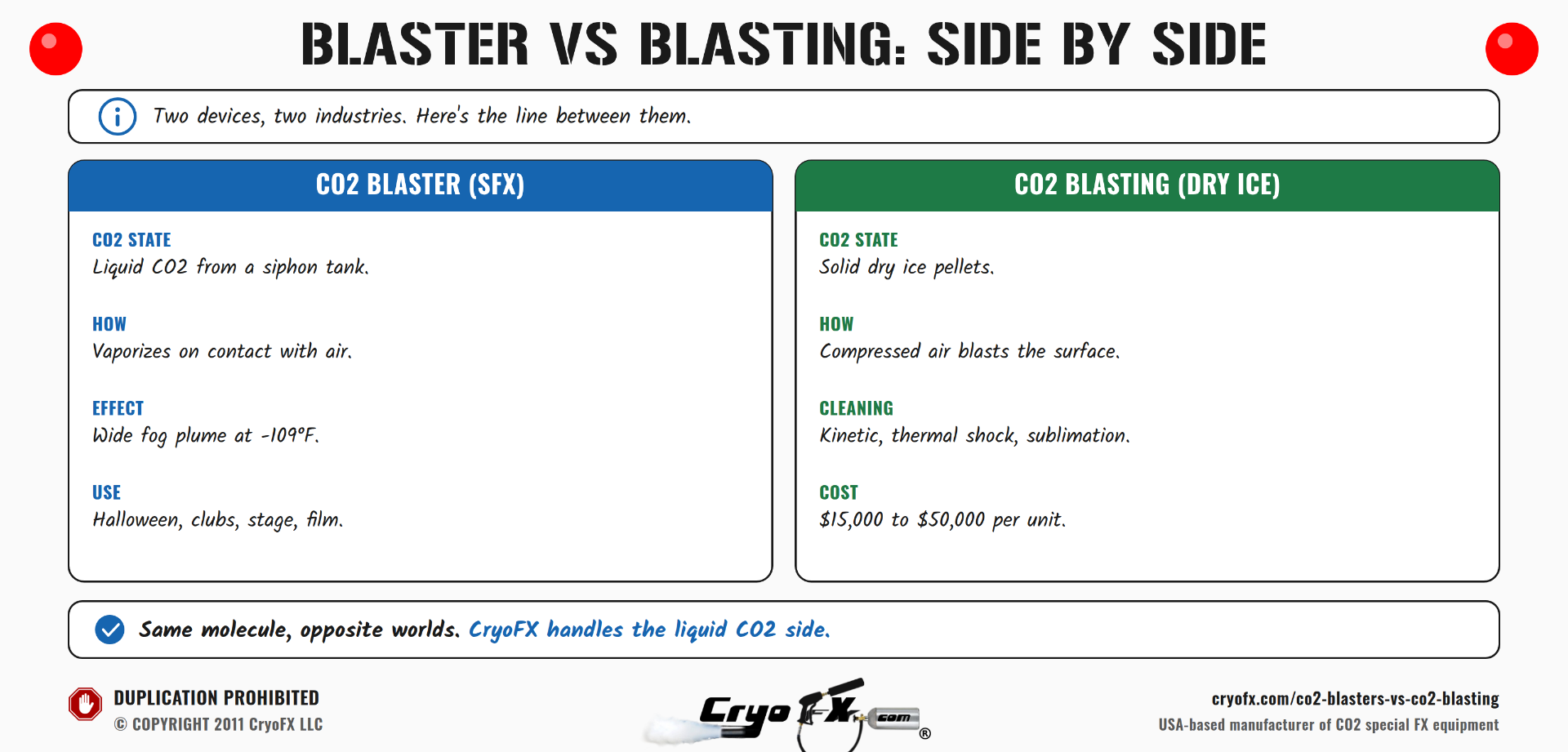
CO2 blaster types in entertainment
Within the entertainment and special effects category, there are two primary CO2 blaster formats:
Handheld CO2 blasters are the larger of the two handheld CO2 cannon formats. They're electrically activated, chrome-finished, and designed to be carried and operated by a performer or technician. The output is a wide, dramatic fog plume. CryoFX's CO2 blaster is the largest off-the-shelf handheld CO2 cannon in their lineup.
Fixed CO2 cannons (cryo jets) are stage-mounted units that fire in one direction from a fixed position. They're DMX-controlled rather than hand-triggered. Output can reach 20 to 30-foot plumes of high-pressure CO2. They're used for recurring, timed activations on stage rather than performer-operated mobile effects.
The output comparison: fixed cryo jets typically achieve greater distance and height because they're positioned optimally and can draw from larger siphon CO2 tanks without the size constraints of a handheld setup. A handheld CO2 blaster trades distance for mobility and the visual impact of a human-operated device.
Both use siphon CO2 tanks and liquid CO2 at high pressure (850-900 psi). Both discharge at -78.5°C (-109°F). The difference is in positioning, activation method, and visual effect profile.
CO2 blaster vs CO2 cannon: the honest answer on terminology
The terms are mostly interchangeable in common usage, and there's no industry-wide standard that enforces a hard line between them.
In CryoFX's product architecture: CO2 cannon is the category. Handheld CO2 cannon and fixed CO2 cannon are subcategories. CO2 blaster is a specific product that falls within the handheld CO2 cannon subcategory.
In general industry usage: "blaster" often implies a handheld or mobile device, while "cannon" more often implies a fixed or larger unit. But event planners, DJs, production companies, and venue operators use both terms interchangeably and mean whatever they're picturing at the time.
When CryoFX receives a call where someone asks for a CO2 blaster or CO2 cannon, the first question is always about intent and use case, not about which word they used. Handheld or fixed? Indoor or outdoor event? What's the activation scenario? Those answers determine what equipment makes sense.
For the full comparison of CO2 cannon and CO2 blaster options across the entertainment spectrum, the CO2 cannon and blaster complete guide covers every format in the lineup. When you're ready to buy, see CO2 cannon blaster for sale for current product options.
Frequently asked questions
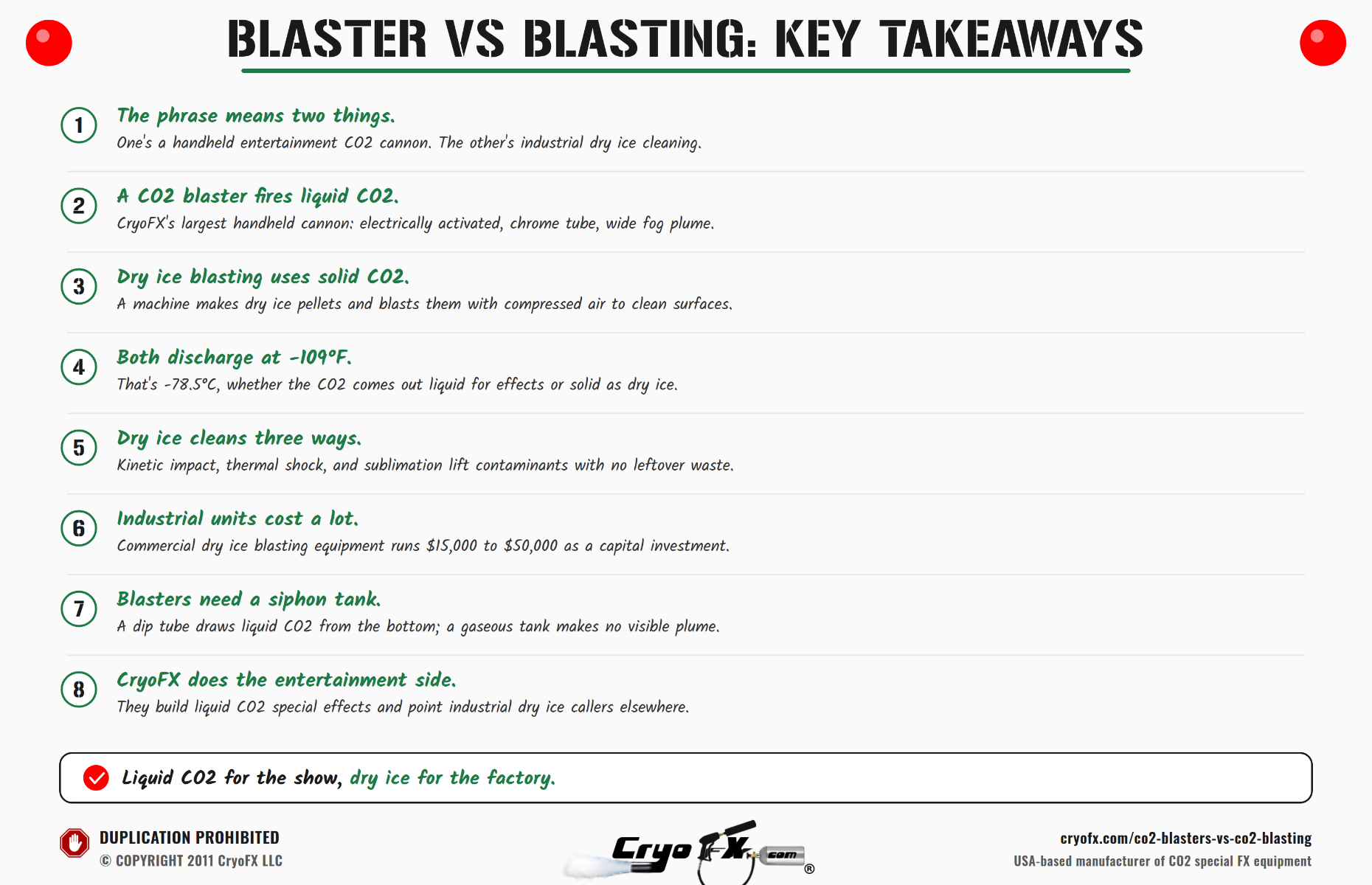
What's the difference between a CO2 blaster and industrial dry ice blasting? A CO2 blaster in entertainment uses liquid CO2 from a siphon tank to produce fog and visual effects. Industrial dry ice blasting uses solid CO2 (dry ice pellets) propelled by compressed air to clean surfaces through kinetic impact, thermal shock, and sublimation. They share CO2 as the source material but use it in different physical states for completely unrelated purposes.
Does CO2 from a special effects blaster set off fire alarms? No. Standard fire alarms, photoelectric, ionization, and laser-based, detect smoke particles or combustion. CO2 is neither. A CO2 blaster or any CO2 special effects device will not trigger standard fire alarms. Some venues have dedicated CO2 safety monitors that detect CO2 concentration levels, those are separate from fire alarm systems.
What CO2 tank does a CO2 blaster require? A siphon CO2 tank (also called a dip tube or liquid CO2 tank) is required. The siphon tube draws liquid from the bottom of the tank, and liquid CO2 is what creates the visible plume effect on discharge. A standard upright gaseous CO2 tank will not produce a visible effect.
Is a CO2 blaster the same as a cryo gun? In most practical contexts, yes. "Cryo gun" and "CO2 blaster" both refer to handheld CO2 special effects devices. The exact terminology varies by company and context. CryoFX uses "CO2 blaster" as a product name for their largest handheld CO2 cannon variant, which is electrically activated and chrome-finished, making it distinct from a standard handheld cryo gun in size and output profile.
How is dry ice made for industrial blasting? Dry ice for industrial use is made by taking liquid CO2 and releasing it rapidly into a chamber where the pressure drop causes it to solidify. The solid CO2 is then extruded into pellets or blocks. Industrial dry ice blasting machines often make dry ice on-site from a liquid CO2 supply. The dry ice pellets are produced right before they're blasted, so they don't need to be stored. This is a completely different process from CO2 special effects, which use liquid CO2 directly from a siphon tank without any conversion to solid form.
What are the three mechanisms that make industrial dry ice blasting effective for surface cleaning? Industrial dry ice blasting works through three simultaneous mechanisms. Kinetic energy: dry ice pellets impact the surface at high speed, physically dislodging dirt, paint, and contaminants. Thermal shock: the cold pellets cause rapid localized thermal contraction, fracturing the bond between the contaminant and the substrate. Sublimation: on impact, the dry ice converts instantly to CO2 gas and expands rapidly, further lifting contamination from the surface.
What type of CO2 cannon qualifies as a handheld CO2 blaster? A handheld CO2 blaster is an electrically activated, chrome-finished device designed for a performer or technician to carry and operate while moving. CryoFX's CO2 blaster is the largest off-the-shelf handheld CO2 cannon in their lineup. It outputs a wide, dramatic fog plume and operates from a siphon CO2 tank connected via high-pressure liquid CO2 hose.
Do special effects CO2 devices use dry ice pellets? No. Special effects CO2 cannons and blasters use liquid CO2 directly from a siphon tank. The liquid CO2 vaporizes as it exits the nozzle, creating the white plume. Industrial dry ice blasting uses solid CO2 pellets typically made on-site from liquid CO2 by the blasting machine. The physical state of the CO2 is completely different in each application.
Where is industrial dry ice blasting used? Dry ice blasting is used for cleaning mold tooling, printing equipment, electrical components, food processing equipment, and automotive parts where chemical residues from conventional cleaning agents are a problem. The process leaves no secondary waste: the dry ice converts to gas on impact and vents away, so there's no blasting media to clean up after the job.
CryoFX LLC • 3859 S Valley View Blvd, Suite 2, Las Vegas, NV 89103 • 1.855.527.9639
Updated - 07/25/2026.